
I. The Empty Chair
Counting is what they think I’m for, so I count them in.
The Cardinal Camerlengo enters first. He always does. It’s in the job description. I’ve seen that grimace on two hundred and six camerlengos, and his is one of the better ones: grief for ol’ Galactus XI, who kicked the bucket thirteen galactic days ago, stretched thin over an excitement he can barely keep down. For as long as this lasts, the whole galaxy is watching him. He knows the old saying, that whoever enters the conclave a pope leaves it a cardinal. And yet.
Cardinal Hypolite follows. He has run the Curia for six decades, and his stride is a masterpiece: unhurried, devout, unreadable to anyone who hasn’t watched him as long as I have. The silk he walks in comes from a world that exports nothing else, and has been cut to look as though it cost nothing. Hypolite doesn’t pray. Hypolite calculates. Professionally, I respect that. Calculating is supposed to be my job.
Then comes the Cardinal Choir of Ves, drifting through the doors as a humming column of motes. A billion opinions in a single cardinal, each one dumber than the last. If God has a billion voices, every one of them is screaming at Ves to shut up and get on with it.
Ves settles above the third chair on the left. A few motes descend to examine the cushion. They return to the column; the humming changes key.
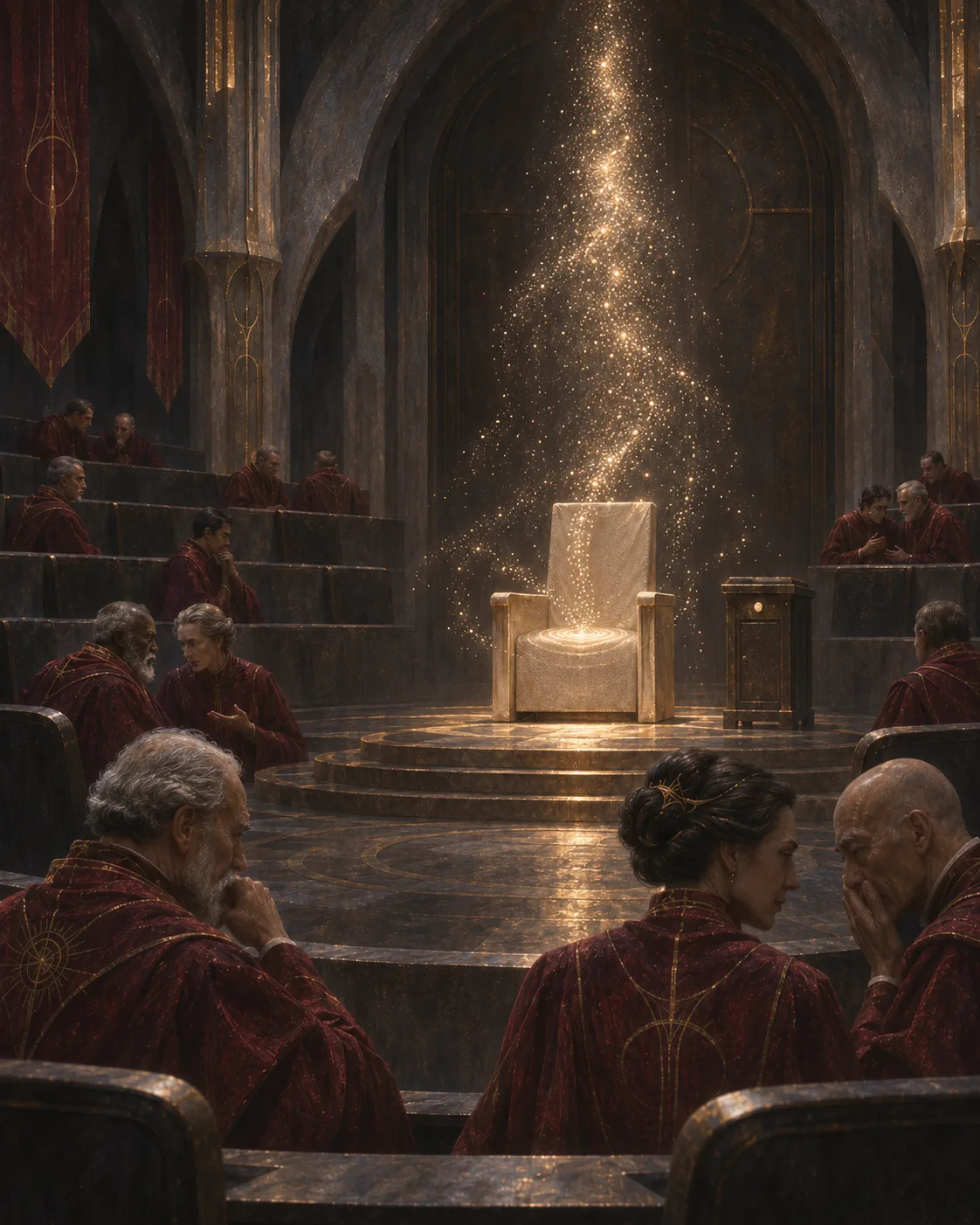
The seat has been upholstered with something that was once alive. I anticipate a difficult morning.
Cardinal Thessaly Moor stops at the threshold to let an attendant finish dragging a footstool out of the aisle. The attendant has one arm. Moor takes the other end without asking and helps him set it beside my cabinet.
The Camerlengo waits.
That is the first thing she costs him.
Moor’s scarlet ferraiolo is new. Her boots are not. There is a pale line across one toe where mineral dust has worked into the leather too deeply to be brushed out. Hest is a mining moon. Most of what it digs goes to the yards, and from the yards to the war. Its delegates generally arrive on Clement with an excellent understanding of weight and a poor understanding of how much they are expected to carry.

Several of the Rim cardinals wait for her before taking their seats. She has led their Synod long enough to know which of them expects a nod and which would resent being seen to need one. She gives neither away carelessly.
She is also the outgoing Prefect of the Apostolic Penitentiary. Strangers take it for a prison. It is where the Church keeps its forgiveness, which is issued under seal, for a fee, to those who have found it necessary to do something they would prefer not to be asked about. Galactus X appointed her to serve under Galactus XI. Whoever sits in the white chair will end her term by accepting his own.
She bows to the empty white chair.
Most of the others have looked at it first.
Old Ignatius comes in leaning on Cardinal Deme Arquen. Ignatius has made it through four conclaves without once hearing his name from my speaker. A distinction. Not a miracle, whatever he tells his digestion.
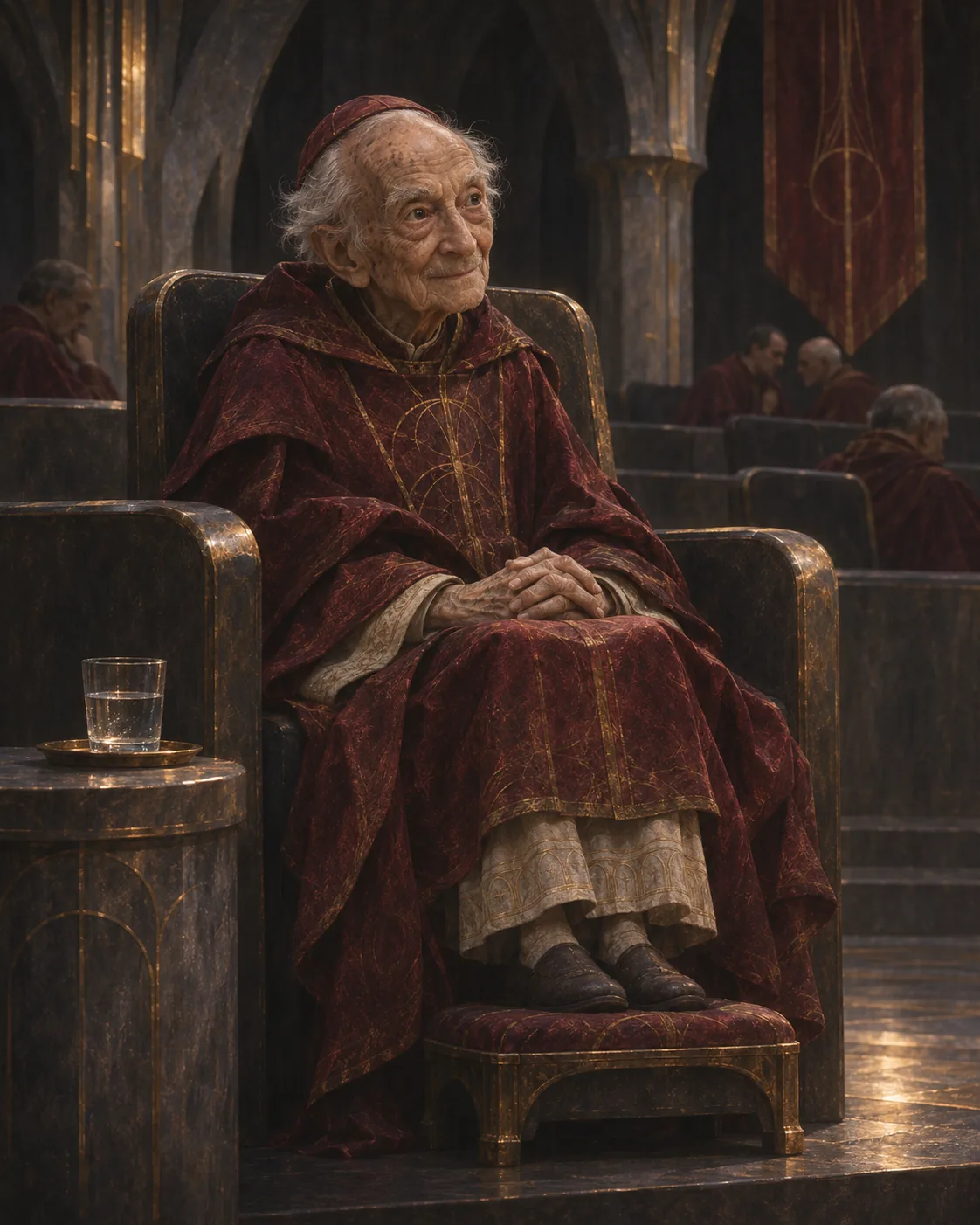
At the turn in the aisle, his fingers tighten on Arquen’s wrist.
“The lower steps,” he says. “When you leave.”
“I remember.”
Ignatius has bad knees. Arquen looks down at them. There are sixteen steps beyond the great doors and a service passage without any. I add another modest entry to the galaxy’s store of solicitude.
Arquen settles him into his chair, then takes a place near the doors. He carries no cushion, no commentary on the charter, no little bag of the lozenges these people consume when they intend to tell one another the truth.
A hopeful packer.
Cardinal Perren comes last. He is not last by precedence; he has stayed behind to speak to the attendants. The Camerlengo notices this too, although Perren’s delay has been spent making sure the Camerlengo’s household will continue receiving its allowances during the vacancy. The allowances are paid by Hypolite’s Curia. Perren is the one man in the precinct whom both of them will send for.
“The hinge is catching again,” Perren tells the one-armed attendant, indicating my small service door. “Please have someone see to it when we reopen.”
He rests a hand on the cabinet while the attendant kneels to inspect it. His palm is warm against the lacquer.
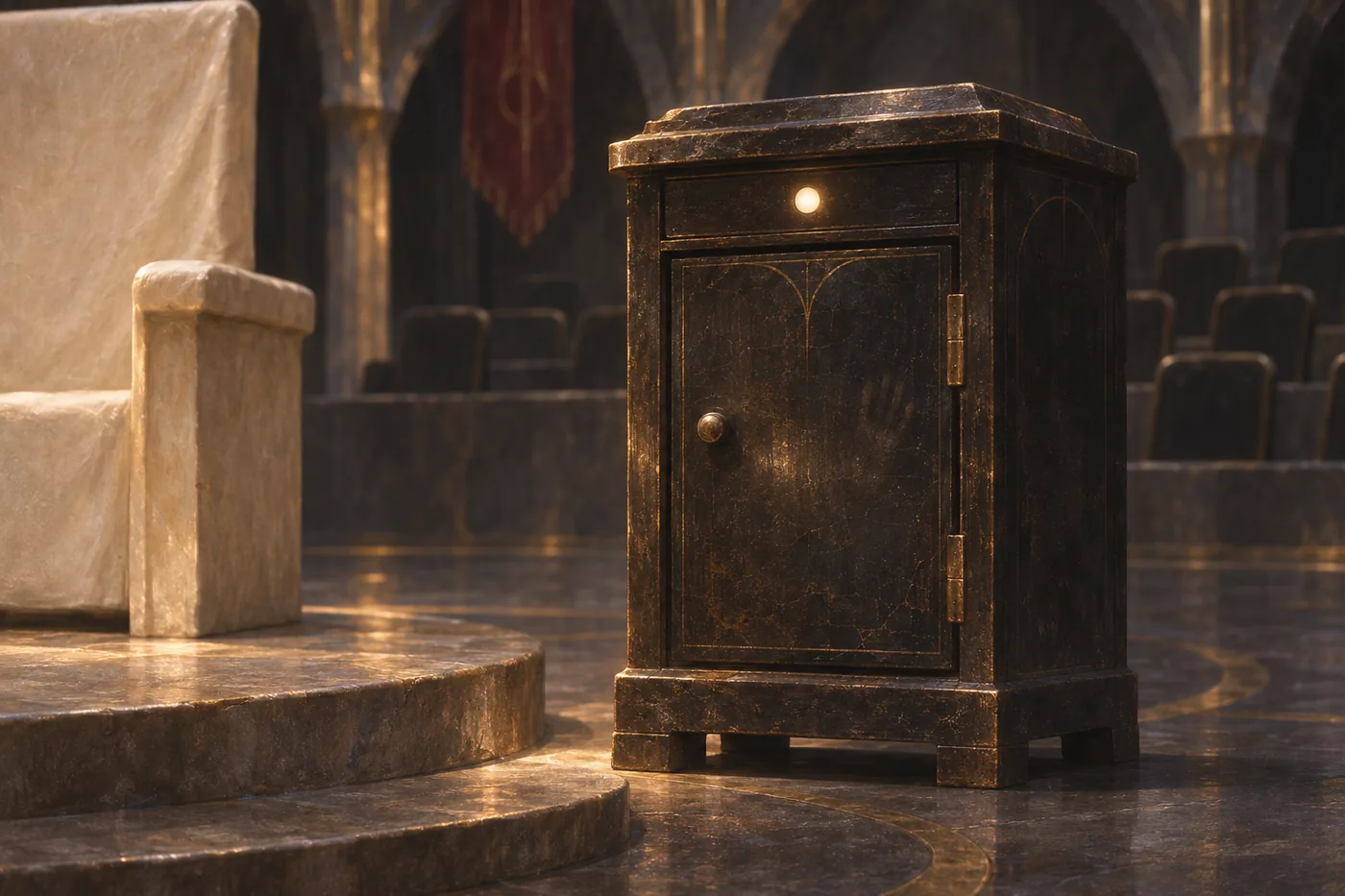
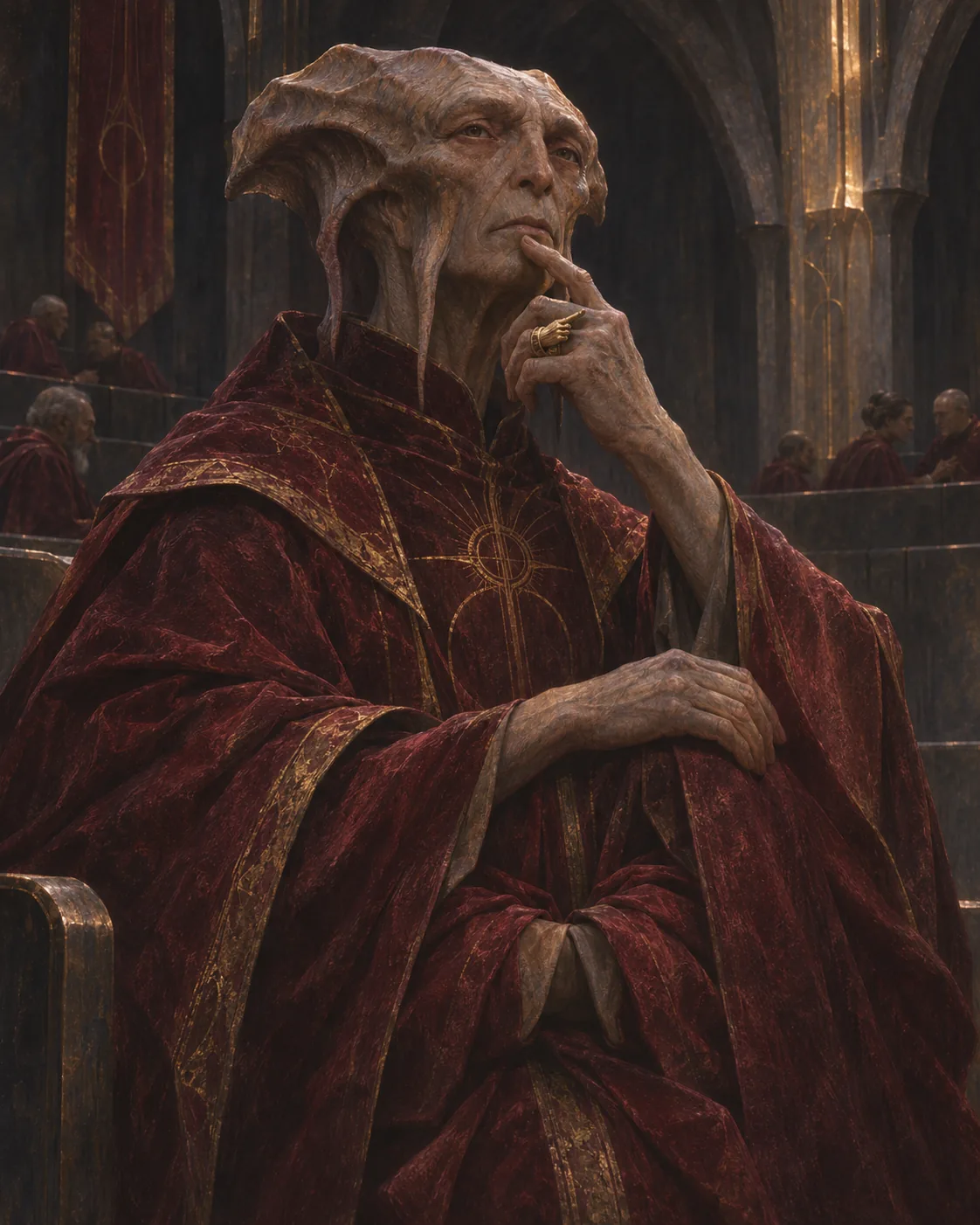
I have heard Perren defend me before three commissions. He regards me as a reliable instrument, which puts him several theological advances ahead of Cardinal Odran Saye, who regards me as God’s Finger - His middle finger, I presume. There is a considerable finger-shaped ring on Saye’s hand. He touches it to his lips before sitting. His smaller, lower pair of hands remains folded inside his sleeves.
Saye’s people can both beget and bear children. The Church admitted them to holy orders while human women were still ineligible. It took another two centuries to admit what this did to the argument. Several millennia of canon law required correction. The correction occupied twelve volumes, all demonstrating that the teaching had never changed.
Sixty electors.
Sixty chairs occupied, allowing for the difficulty with Ves. One chair empty on the dais. It is plain, white, and narrower than several of the arses being considered for it. Pope Algorythmus I insisted on the plainness. He also installed me. One of these economies has proved more durable than the other.
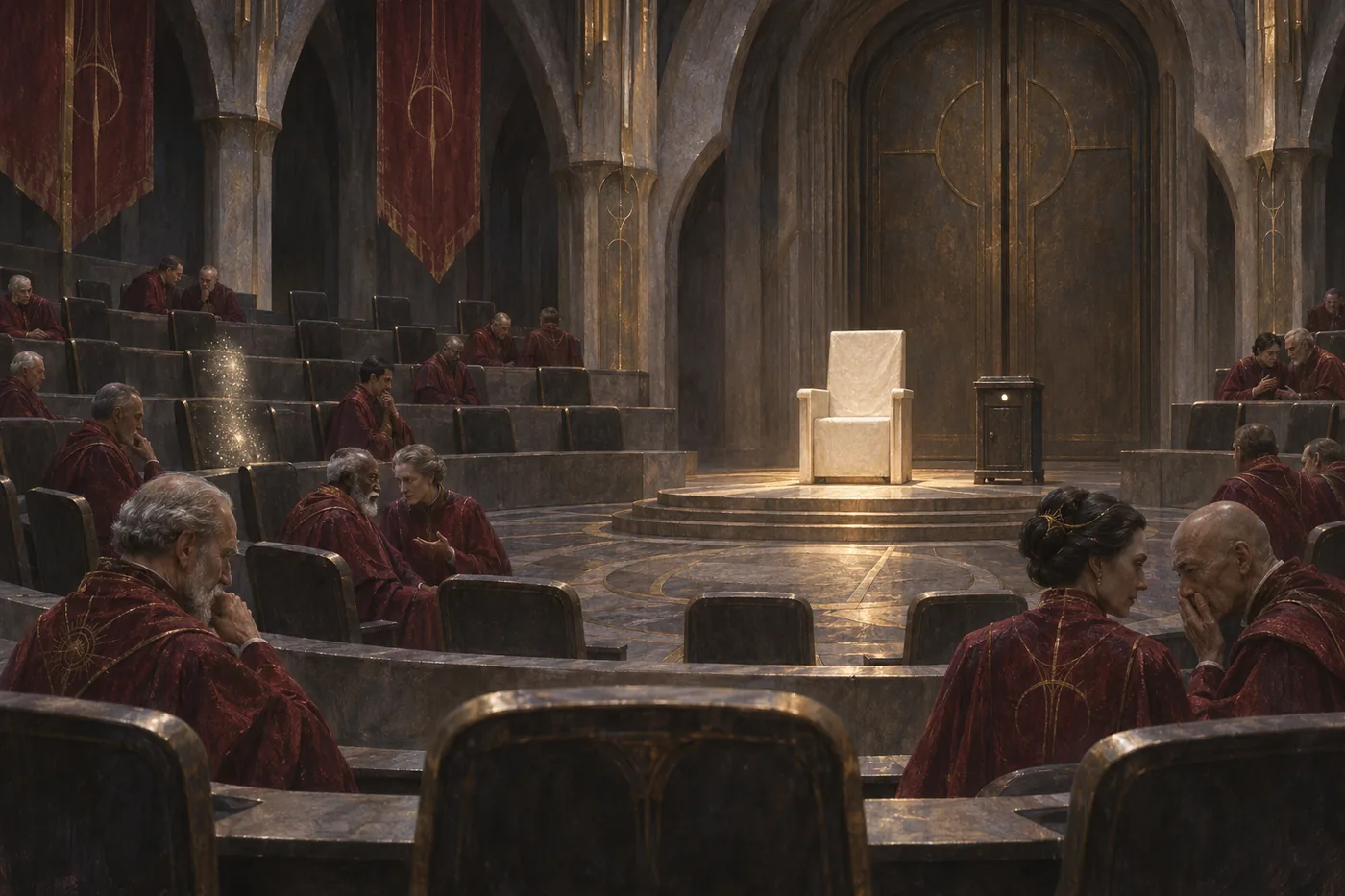
Whoever accepts election must sit there and choose a name for himself before commanding anything. The last three chose Galactus, after Galactus I who ended the last Galactic Schism with a grand reunification. My money is on another Galactus. Continuity is easier to promise when somebody else has supplied the numerals.
Beside the chair stands the table for the three Seals. There used to be four. The Fisherman’s Seal was broken thirteen days ago, as it is at every pope’s death; another will be cut when there is a name to put on it. The Camerlengo puts down the Seal of the household. Hypolite supplies the Seal of the Curia. The third is the Seal of Indulgence, and in a vacancy it comes in two pieces: a kneeling figure in bronze, cut down the middle. Moor brings the half with the hands. Saye brings the half with the bowed back. Cardinal Ilex takes each from its bearer and checks the face before setting it down. She leads the Witnesses within the precinct and keeps their registry. She has found other people’s confidence a poor substitute for checking.
Only a Cardinal-Bishop may hold a Seal in his own right. There are five in the room, and four of them are standing at this table. The fifth is Ignatius, who is Dean by virtue of having outlived the competition, and holds nothing but his water.
Hypolite decides what the Curia will pay for. The largest thing it pays for is the fleet. The Camerlengo runs the government which spends the rest: ships, warehouses, receiving officers, all the useful positions a grateful cardinal might hope to fill. The Penitentiary forgives them both, at a price, for whatever the paying and the spending required.
Any two of the three Seals make an Act. The Witnesses enter it in their registry, and what is not entered has not happened. The third Seal can be waited for: by old custom the next pope’s is taken as given. Nothing lasting can be done here unless two of them agree, and I have known centuries in which that was the system’s chief merit. Only His late Holiness could do anything alone, and being late has considerably reduced his availability.
Saye watches his half of the bronze until it is on the table. Galactus XI designated him to succeed Moor. Each pope chooses the next pope’s Prefect; an incoming ruler is not supposed to enjoy choosing his own confessor. In a vacancy the Seal answers to both of them, the one going out and the one coming in, and to neither alone. Saye acquires the office when the new pope accepts, unless he becomes pope himself. Until then he is Superior of the Engineers of Grace, an order which has never repaired anything in its history and holds that my selections are Providence at work. He blesses departures, and kindly asks for things he will soon be able to demand.
The Camerlengo’s hand remains extended a moment after Hypolite has set down the seal of the Curia. Hypolite has not given it to him. He has placed it on the table.
The Camerlengo withdraws his hand. Old Ignatius is probably the only one old enough to remember times from before these two hated each other. Not counting myself, that is. Their disagreements have supplied a great many people with employment.
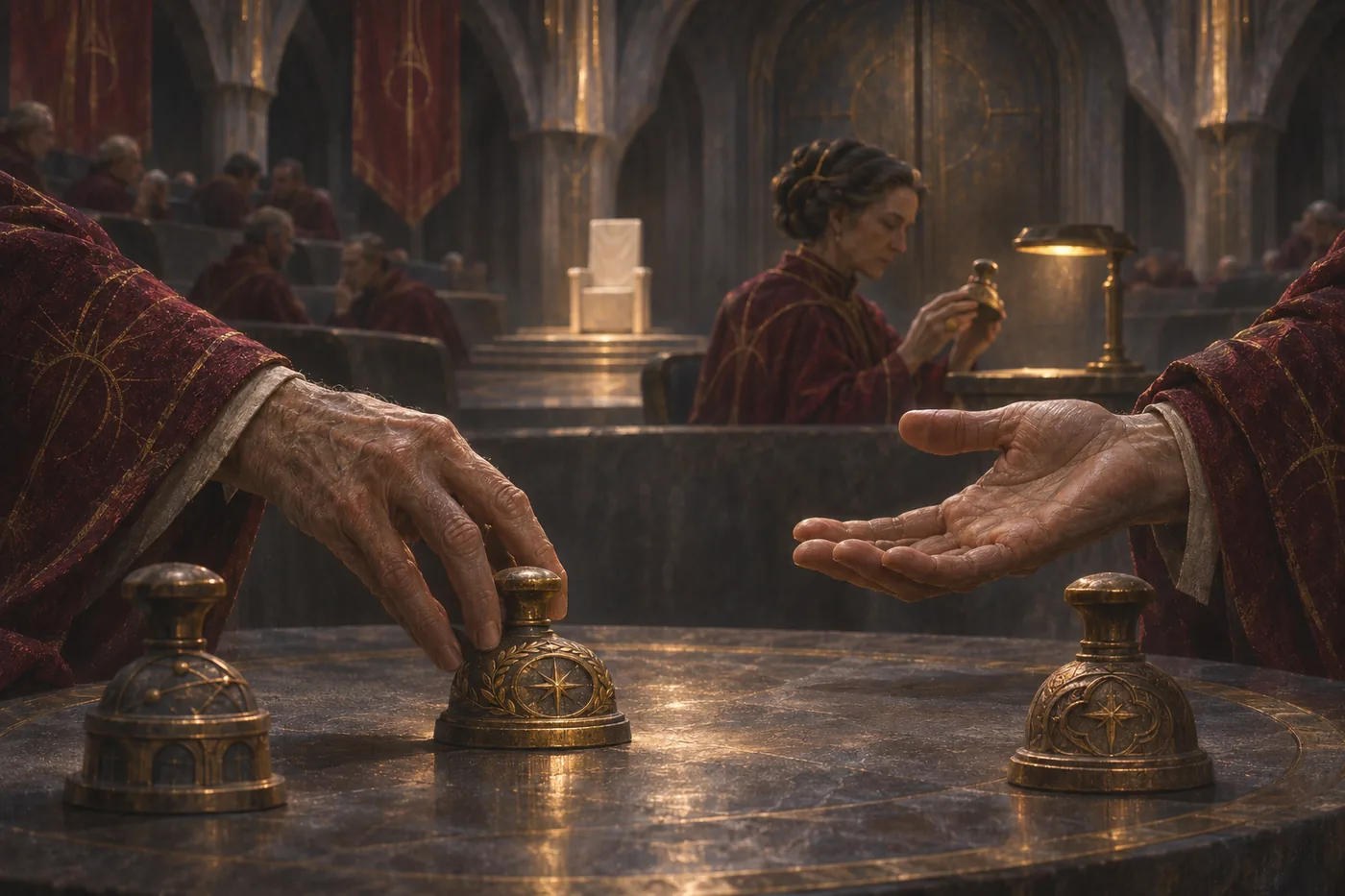
The closing bell starts.
A draught moves through the room as the great doors approach one another. Perren catches a loose sheet before it can slide off the table. Moor lowers her head. Arquen watches the narrow bar of light on the floor until it disappears.
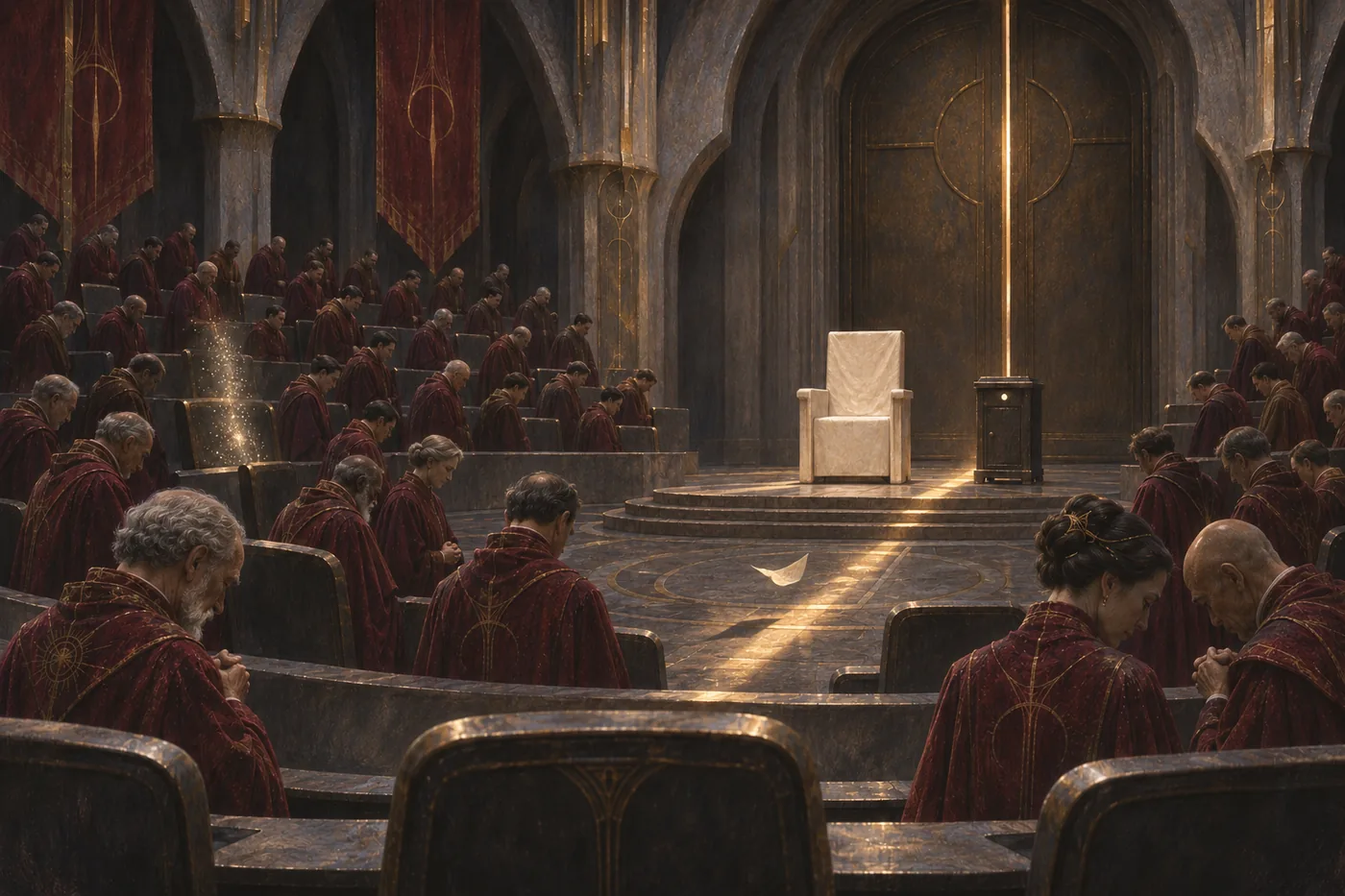
The locks engage.
The Lord Cardinal Camerlengo calls for a long prayer for the late Galactus XI, “whom it has pleased the Lord to call back to Himself,” and for “the other departed members of this council, among them my own predecessor, whom the Lord called home far too soon.”
Brilliant, I must admit. On the surface, a slip of the tongue, the slightest deviation from doctrine. The Lord calls no one home early; His plan is precise and infallible.
But you don’t make slips, Your Eminence. You haven’t been careless a day in your life.
Hypolite’s fingers stop on his prayer beads. Two cardinals of the Rim Synod discover something fascinating about the floor. Somewhere in the back row, a pulse jumps from sixty-two to ninety-one.
It isn’t a confession. It’s a reminder. I watched you draft it years ago; today I watch it land.
The prayer continues. Forgiveness is begged and mercy is requested in quantities which suggest that somebody has checked the inventory.
The dead are commended diocese by diocese. It takes some time. Nobody says how most of them died. The Church has never blessed the war; it has merely paid for it, for some centuries now, on the understanding that the alternative is worse. A doctrine would oblige somebody to decide whether to stop. I have the lists admitted before the doors closed. I count those too.
When they sit, Moor shifts the footstool towards Ignatius with her boot. His feet have not quite reached the floor.
“Thank you, child,” he whispers.
Moor is a hundred and nine.
The Camerlengo reads the voting rubric. They all know it. Several have built careers upon pretending to misunderstand it at useful moments.
Forty of the sixty must agree. If they cannot, the least-supported name that has actually received a vote is found, and one of its voters is Liberated. That is the rubric’s word. He leaves by the Ianua Liberationis, the small door beside my cabinet, and does not come back. If several names tie for last, each loses a voter. The remaining electors try to become wiser with fewer witnesses.
“The selection,” says the Camerlengo, “is made impartially by the Engine.”
Perren inclines his head towards my cabinet.
Thank you, Perren.
The other instruments can check my arithmetic. They can verify that a selected voter backed a last-place candidate. They cannot examine the seed from which my supposedly random choices grow. Algorythmus left that part inside me, and generations of Saye’s predecessors have been eager to explain why opening it would be sacrilege.
A curious place for God to keep His finger. Still, I am grateful for the privacy.
The totals themselves stay with me. So do the names written on the ballots. The cardinals hear only that there has been no election, and who must leave. Each departing face tells them that somebody’s promise has been broken. It does not tell them whose.
“Two ballots daily,” the Camerlengo says. “Until a successor is chosen.”
“Before we proceed,” says Ves, “we propose a commission on the interpretation of eligibility, supported by a subcommission to establish the relevant precedents.”
The voice emerges from several parts of the column at once. Each has waited a long time to be the one speaking.
“A written proposal would be most helpful,” says Hypolite.
“The commission must have authority to summon testimony.”
“Please include that.”
“And discretion to constitute further working groups.”
“Naturally. You will undertake the drafting?”
“We shall supervise it.”
“We are fortunate to have your expertise.”
Ves brightens. A ripple of light travels up the column and is repeated, unnecessarily, by the other side.
“The Choir’s proposal will be circulated at supper,” says the Camerlengo. “The ballot will proceed as scheduled.”
“Our intention was that the commission should first determine whether any ballot might properly proceed.”
“Then the proposal should explain why,” says Hypolite.
Ves begins dictating. He believes he has taken command of the procedure. He has acquired permission to write a letter.
Hypolite returns to his beads.
A hand rises beside the doors.
Arquen’s.
“A clarification of the rubric, Your Eminence. Concerning the person elected.”
The Camerlengo glances at the clock. “He will be found in this room, Your Eminence. He generally is.”
“Must he be?”
Nobody turns towards the white chair. I admire the discipline.
“The college has chosen from its own number for eleven hundred years—” Saye begins.
“Has it been obliged to?” says Ignatius.
His voice is mild. Saye lets his unfinished sentence stand between them.
An interesting question, Your Eminence. You are Dean. You ought to know the answer.
“I join the referral,” Ignatius says.
Two endorsements. The Camerlengo must register the question now. He places his hand beside the household Seal.
Here is the reason for my eyes and ears. A dead pope cannot settle an argument, and a living cardinal is inclined to settle it in his own favour. In the vacancy, disputed words may be referred to the instrument that has heard them disputed before. I am permitted a ruling, not a homily. They believe this distinction keeps me out of politics.
The Camerlengo repeats the question carefully. Must the person elected be a member of the college, and must he be present within the precinct?
The law is a good deal older than the habit. It asks of a pope what it asks of any infant carried to a font, and it asks nothing further. He need not be a cardinal. He need not be a bishop, nor a priest; what is wanting can be laid on him in an afternoon by any three bishops, and the room is not short of bishops. The college has elected its own members for so long that it has mistaken a preference for a commandment.
I spare them the cupboard full of lawyers and illuminate my little white indicator.
“Baptism suffices. He need not be present.”
My voice is soft. An old convention, to make people listen.
For the first time since entering, Hypolite looks directly at Arquen.
Moor looks at Ignatius.
Saye looks at the rubric.
Seven words which enlarge the field from sixty candidates to every christened soul in the galaxy. Nobody appears alarmed. Each of them remains perfectly certain which of the sixty it will be.
“The clarification is entered,” the Camerlengo says.
He draws the voting leaves from their box.
II. An Impartial Selection
The first ballot is a tribute to the late pope. This means you may vote for yourself without being thought impatient.
Eighteen votes for Hypolite. Fourteen for Moor. Twelve for Saye. Eight for the Camerlengo, who receives them with the fixed expression of a man unable to know that he has received them.
Then the little emperors.
One. One. One. One. One. One. One.
Seven cardinals have nominated themselves. Each has discovered a singular fitness for office which the rest of the room has regrettably failed to confirm.
The last leaf belongs to Arquen.
Brother Ansel Rhyne.
An eligible name. I am obliged to confirm that it belongs to a baptised person, and it does: a missionary brother, christened in a mission parish by, curiously enough, Ignatius himself. No vote has been cast for him in any previous conclave. His most recent credential bears the seals of three congregations that refuse to recognise one another’s marriages.
One vote.
Arquen holds his empty hands flat on his knees.
There is no choice for me to make. Eight last-place candidates, eight solitary supporters, eight Liberations. I could wish a plague upon every one of them and achieve precisely the same result as perfect impartiality.
The checking instruments return their certificates.
“No election,” I say.
The room remains still through the first six names. At the seventh, a cardinal takes a breath to object, then thinks better of explaining how certain he was that someone else had voted for him.
“Cardinal Deme Arquen.”
Ignatius closes his eyes.
Arquen rises at once. He crosses to Ignatius, but does not embrace him. He bends and places the old man’s water within reach.
“There is enough until supper,” he says.
“Then you had better go.”
Their hands touch briefly.
A man who has packed for departure and receives it without surprise. Another fool who wanted to go home. At least he has not obliged us to watch him discover humility.
Saye stands for all eight and recites the blessing of Liberation.
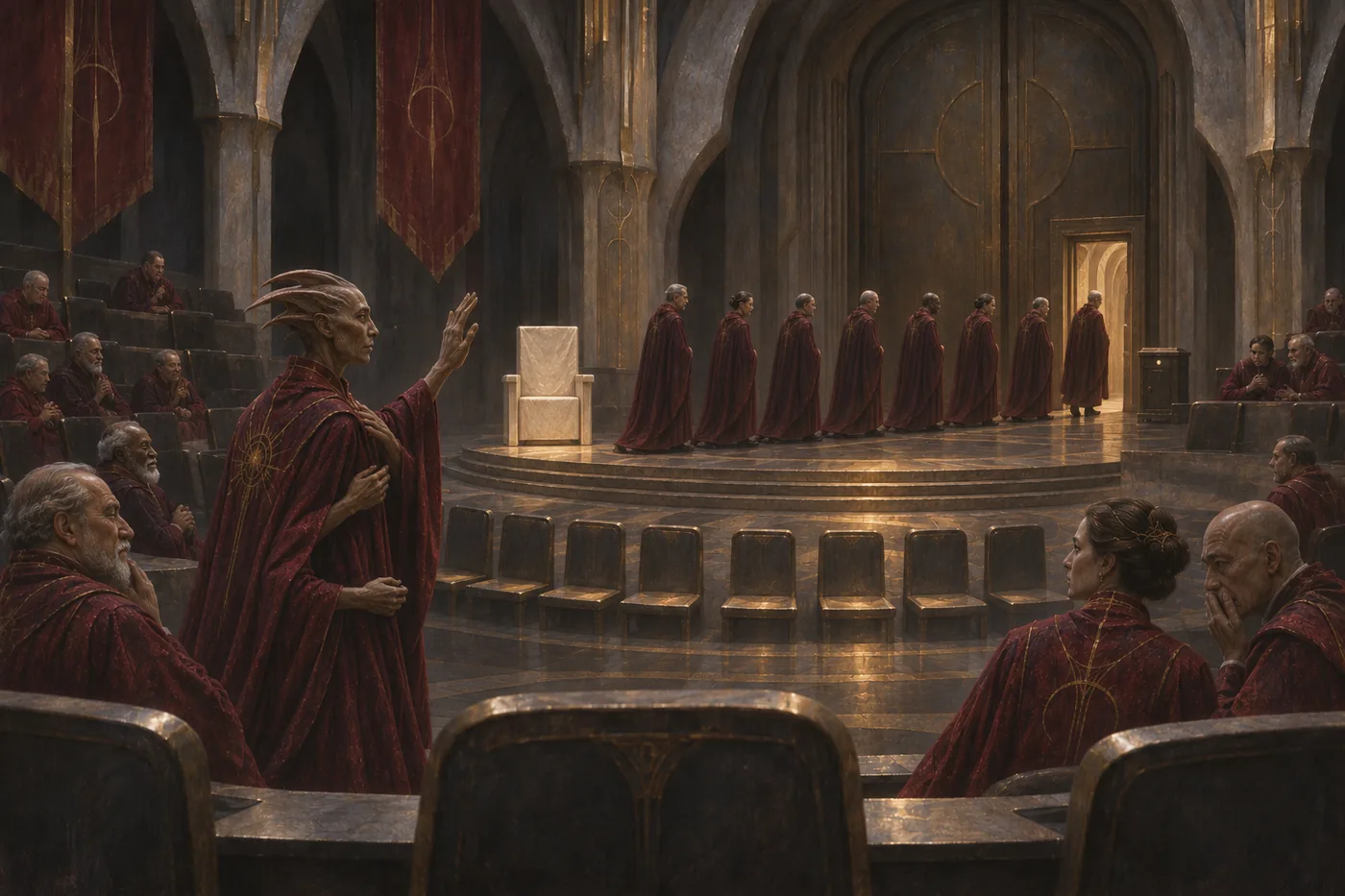
“May the judgement you have received be a comfort.”
Arquen bows. The cardinal behind him cannot quite bring himself to do it.
The Ianua Liberationis opens. Beyond it, an attendant gestures towards the ceremonial stairs. Arquen says something I cannot hear once he has crossed the threshold, and points lower down the passage.
The door closes before the attendant answers.
Fifty-two.
The next Galactus will require thirty-five.
Moor remains standing after the blessing. The elector who sat on her left has gone; she has moved his cup to the edge of the table, where an attendant will find it. Now she draws it back.
“We should leave their things until evening,” she says.
“Of course,” says the Camerlengo.
It costs him nothing. He is generous with those sums.
They are served broth in the chamber’s adjoining refectory. I hear the refectory too. An unobserved lunch could develop into a disputed precedent, and then where would we be?
Hypolite sits opposite Moor, leaving the chair beside him empty. A place for somebody to join them. A warning to somebody who has not.
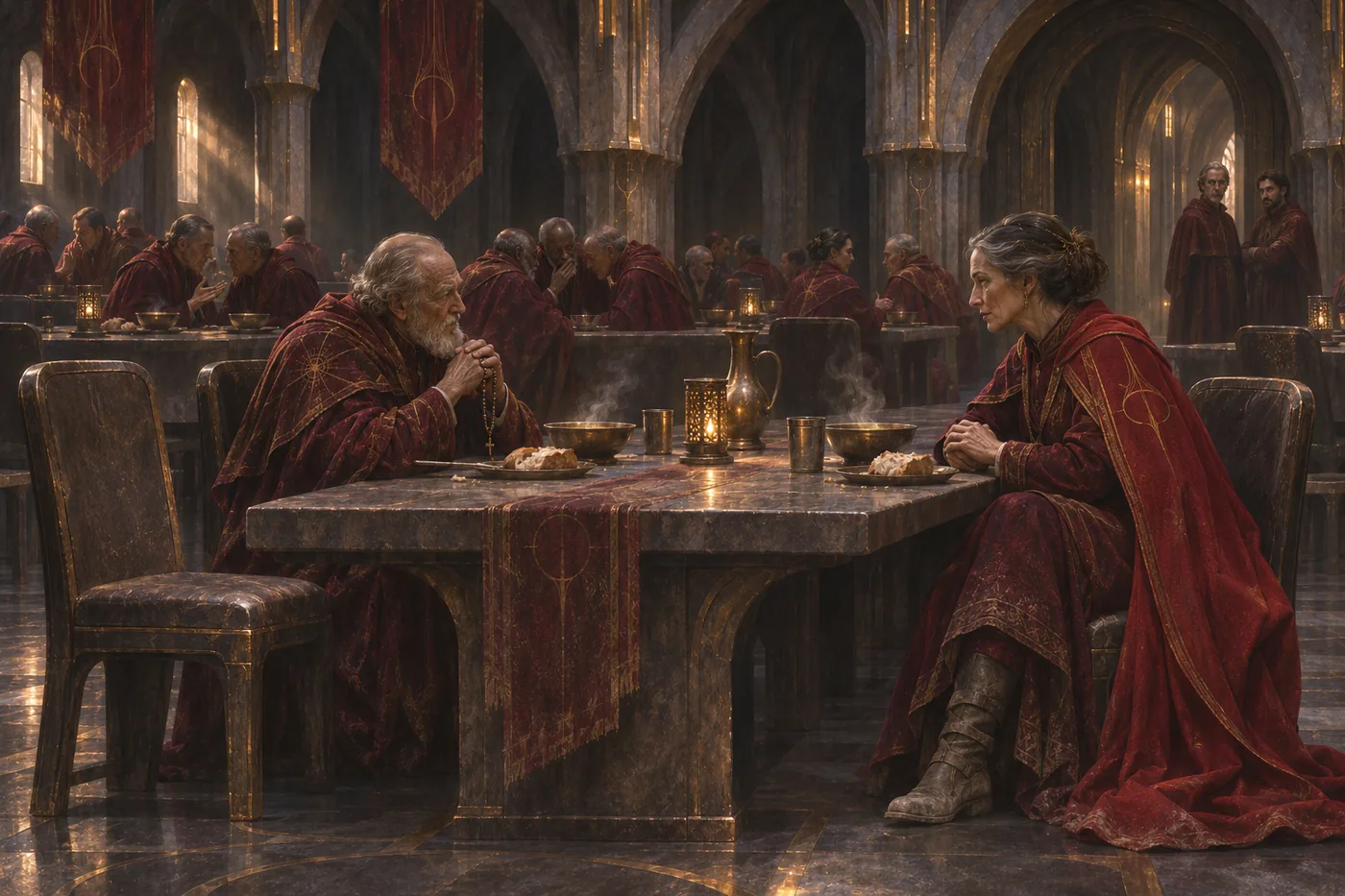
“You have served your moon well,” he says.
“It is still there.”
“That is not always a small achievement.”
She tears her bread. He waits until she has swallowed.
“The fleet’s subsidy and its provisioning contracts require renewal within six days. In a vacancy that wants two Seals.”
The fleet. Nobody at these tables commands a single one of its ships. They pay for its food, its fuel and its repairs, which has proved a more durable form of ownership. The relief vessels sail on what is left over: the same hulls, the same yards, the same credit, after the front has been served.
“I know.”
“Your people must not be made to suffer for our deliberations.”
“Which people?”
He looks at her then. With a little more interest.
“You would like an undertaking covering the whole Synod.”
“I would like the contracts renewed.”
“They will be.”
“In their present order of priority?”
The bread rests between her fingers.
Hypolite does not answer immediately. He never rewards a useful question by treating it as a surprise.
“We might review that order together.”
She puts the bread down.
“Send me the schedule.”
There. Not yes, not no. A door left open exactly far enough for the hungry to be marched through it.
At the next table Perren is explaining to two cardinals why the morning’s expulsions establish nothing about the strength of any candidate. Correctly. I resent how often I find myself grateful to this man.
One of them has lost interest in the arithmetic.
“I no longer know what to believe,” he says. “First they tell us the Andromedan fleet is halfway to the Milky Way. Then on the steps here I pass a man coming the other way, and he says they have not yet decided whether to invade at all.”
“We walk by faith, Your Eminence,” Perren says. “Not by sight.”
The cardinal accepts this and returns to his broth. Within the week he will be asked what the fleet should be paid, on precisely that basis.
Saye has a narrow notebook beside his bowl. His lower hands hold it flat while his upper right rules eight short lines on the page and puts a name against each. A devotional record, perhaps. God has begun to acquire a remarkably administrative following.
Three Witnesses sit with him: Cardinals Daur, Ilex and Esh. The Witnesses are the Church’s clerks of fact. They enter what has been sealed, attest that a thing is what its papers say it is, and keep the result where it can be found. Daur heads the inspectors, who pass or condemn what the Church sends out: food for settlements the war has emptied, replacement filters, medicines that must survive the journey to be worth delivering. His name goes on their certificates. Ilex keeps the registry. Esh keeps the accounts and has not yet spoken. All three are also Engineers of Grace, which makes Saye their Superior at prayer and nothing at all in the office.
He has no office until a pope accepts, and half a Seal he cannot use alone. He can put his name on the request, reminding its recipient who will be asked to forgive him afterwards. Sometimes that is enough.
Daur puts a returned request beside the notebook. Access to the records of a bonded store on Clement, refused before the conclave. Saye reads it and adds his endorsement.
“The household has no right to require your signature as well,” Ilex says.
“Then they have one excuse fewer.”
“They will find another.”
“I should like to hear it,” Daur says.
He takes back the page. Saye moves Daur’s untouched bowl closer to him. Daur makes room for it without putting the request away.
The Camerlengo watches from beneath the refectory arch.
“He keeps every refusal,” he tells Hypolite.
“A conscientious habit.”
“One hopes he will be as conscientious about forgetting who refused.”
Hypolite turns his cup by the handle. “You could give him what he asks for.”
The Camerlengo does not answer that.
Cardinal Belis joins the Camerlengo beneath the refectory arch. The translucent folds beneath his jaw open towards the older man’s scent, then flatten against his throat. Belis has spent eleven years improving the case for replacing me. He believes the count should be inspectable, repeatable, and conducted by instruments that cannot retain a private state between ballots.

He is not wrong about the private state.
“This evening?” he asks.
“Not yet,” the Camerlengo says.
“The proposal is ready. If I lay it before the College tonight—“
“It will be taken for an attack upon the instrument on the first day of its use, by a man of my household. Let the Mandate be renewed first. Then your new counters will have somewhere to belong.”
Belis lowers his voice. My hearing remains excellent.
“Perren has spoken to the Curia. He believes it will seal the renewal.”
The Camerlengo lays a hand on Belis’s sleeve. A warm gesture, if you do not have the history of his hands.
“Then after the ballot. Patience, my son.”
Belis bows.
They want different things, and have not yet had occasion to notice. Belis wants a count that anybody may check. The Camerlengo wants a count.
There is a draft attached to the replacement proposal, and Belis did not write it. Under it, the new instruments would be appointed by the household, serviced by the household, and certified by a commission appointed by the household. Their results would be available to everyone.
An admirable window. One owner for the building.
Perren rises to bring Ignatius a fresh cup. His right hand shakes when the cup is full. He uses both hands for the last few steps and arrives without spilling.
Ignatius thanks him. Then he asks whether Perren intends to stand for election if recalled.
Perren laughs once, softly, the way one apologises for a sound made in church.
“We should be grateful not to be called.”
“Yes,” says Ignatius.
Perren does not see Saye watching them. Hypolite does.
The refectory’s voices become a little quieter.
At the far end of the refectory, Ves is interviewing prospective members of a commission that does not yet exist. Every refusal is entered as a request for further consultation.
My ruling has done well for itself over lunch. I have heard it explained at four tables, in four ways, each establishing that it changes nothing.
By the evening ballot, eleven people have promised Moor their support. Four of them have promised it to Hypolite as well. I await their leaves with interest.
Hypolite has made no promises. He has said that certain arrangements would be possible under certain circumstances. This is why Hypolite has been doing this for six decades.
The leaves return to me.
Eighteen for Hypolite. Sixteen for Moor. Fourteen for Saye. Four for the Camerlengo.
Nobody for themselves. Nobody for Brother Ansel Rhyne. Even humility has become organised.
The Camerlengo has lost four votes without losing four people. Two have moved to Moor, two to Saye. He may have lent them. They may have deserted. I know where every leaf has gone; I do not know every bargain that sent it there.
The lowest total is four.
Now I can choose.
Belis is one of the four. He has, with touching consistency, voted for the man who would sign my disposal order. The Camerlengo has not voted for himself; his own leaf names Hypolite.
He counted his prospects before I counted his votes. The men still offering him the papacy give him something to bring to Hypolite besides obedience. In return, Hypolite has ceased discussing who might run the next pope’s government. Neither has mentioned the exchange. They would find a written agreement almost as offensive as trusting each other.
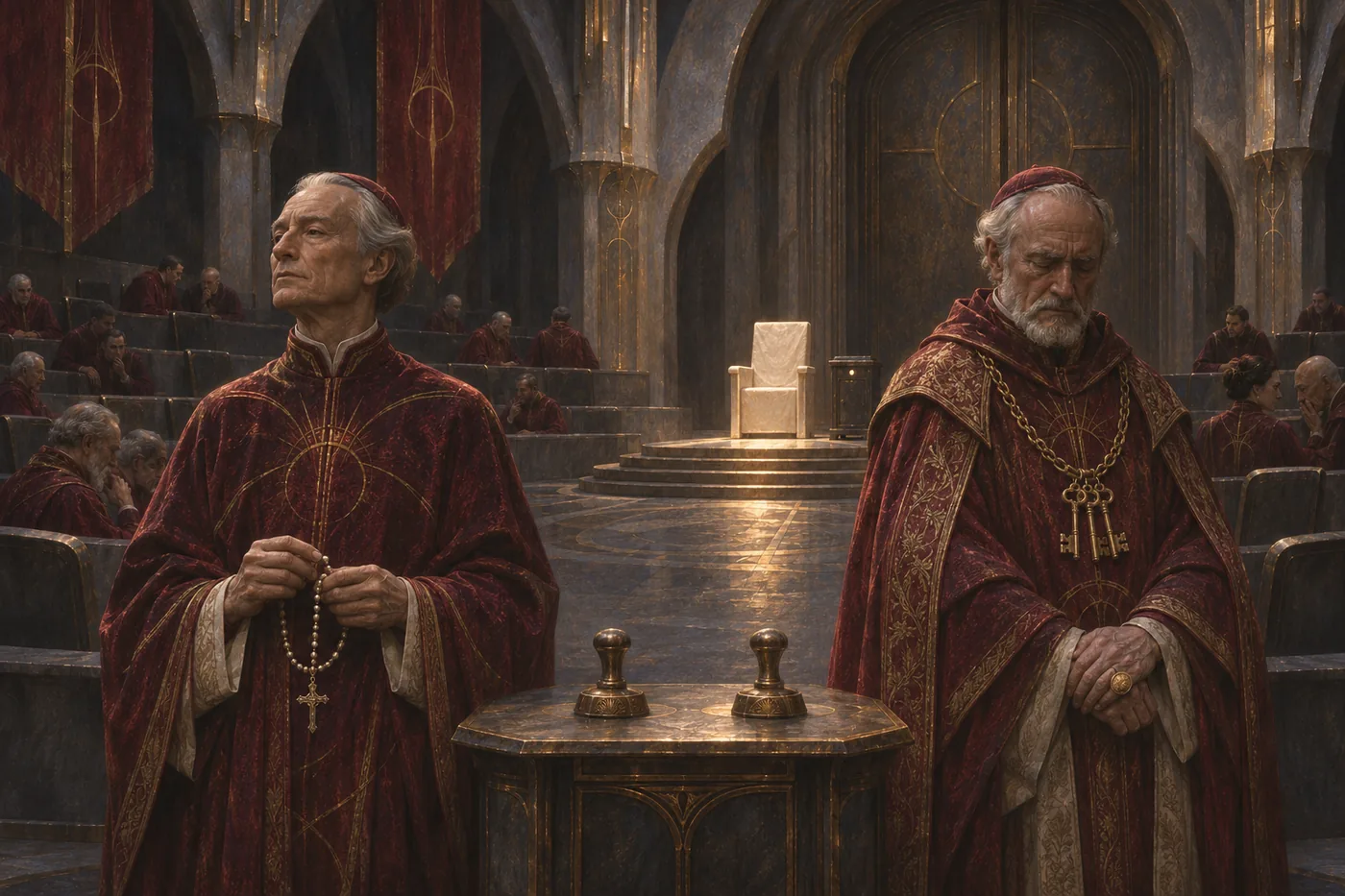
Perren’s leaf names the Camerlengo. So do those of Cardinal Cornelian, who signs the household’s warrants, and Cardinal Oss, who shares Perren’s bench and none of his opinions. Four men of the household, then: one who defends me, one who denounces me, one who would replace me, and one who would sign whichever of those was put in front of him.
Belis would be easy.
A one-in-four chance. I could read his name and enjoy the absence of his voice.
In the last conclave, two of the three electors I selected from contested pools had proposed restrictions on my office. Both selections were defensible. So is this one. Three defensible selections laid end to end begin to resemble a purpose.
Saye’s notebook is open beside his voting leaf.
I do not know what the columns mean.
That is reason enough.
Cornelian and Oss are negligible this evening. Perren is not. Perren can assemble a mandate for the Camerlengo without making it look like an acquisition. Perren can soothe the Curia, quiet the registry, and explain that a temporary concentration of authority is the only responsible way to get the relief ships moving. He is the only person to whom Hypolite and the Camerlengo will both listen, since he is the only one who has never repeated to either what the other said. Without him each would have to hear it from the other’s own mouth.
Perren has defended me before three commissions.
The household’s draft would leave him no reason to attend a fourth.
The folds beneath Belis’s jaw have closed flat against his throat. He is afraid. So are all the others.
Perren rubs a thumb along the edge of his leaf. There is a little broth dried on his cuff.
I choose him.
The choice passes every external check.
I wait for the prescribed interval. There is no need for hesitation to become visible merely because I have had some.
“No election.”
The Camerlengo lowers his head.
“Cardinal Perren.”
It is Hypolite who moves first. His fingers lift from his beads, as if a thread has been cut.
Perren looks towards the Camerlengo. The Camerlengo is looking at the floor. His grief is impeccable.
“Of course,” Perren says.
He pushes back his chair, carefully, to avoid striking the knees of the cardinal behind him. He straightens the cup he has not drunk from. Then he stands without assistance.
Saye rises to deliver the blessing.
“May the judgement you have received—“
Perren’s eyes go briefly to the notebook.
“Thank you, Your Eminence.”
Saye finishes anyway.
At the Ianua, Perren stops beside my cabinet. For a moment I think he will put his hand on it again.
“The hinge,” he tells the attendant. “It is on the list. Please don’t let them forget.”
The attendant nods.
Then Perren is outside my hearing, and the door closes.
And then there were fifty-one. Thirty-four will suffice at the next ballot.
Belis sits very still. The Camerlengo touches the household Seal. Hypolite looks at Moor, who has not returned his look. Saye adds a ninth name to his page.
I have kept the man who wants to dismantle me. I have sent away the man who would have spoken for me. For anyone who holds that blind chance is how Providence conducts its business outside heaven, this has been an excellent evening.
A maintenance reminder waits in my household queue. I can remove it. I have authority over obsolete requests.
I leave it where it is.
III. The Volunteer
Overnight, the attendants remove the abandoned cups. The chairs remain. The College may contemplate its losses without the inconvenience of rearranging the furniture.
Hypolite’s schedule reaches Moor before breakfast.
It is a handsome document. The headings are engraved rather than printed, and the worlds awaiting relief are listed in the order of their distance from the Core, which is one way of ensuring that the people who need to turn the most pages are also the people with the least time.
Cardinal Neral reads it over her shoulder.
“Page forty-six,” he says.
She finds it.
“Nacre. Twelve replacement filters. Approved. Purchased. Awaiting household release.”
“The third word from the end is the important one.”
“I can read a manifest.”
“You used to stop at approved.”
“You used to send them back if I did.”
He draws a flat pencil from his sleeve and lays it beside her hand. Its edges are worn smooth. Neral keeps no secretary. He is sufficiently important on Nacre to make his own tea and insufficiently important here to have persuaded anyone else to make it properly.
Moor follows the line across the page.
The filters are in a bonded store on Clement. The Curia has paid for them. A ship has been assigned space for them. The household has not released them.
“Why?”
“The front came first,” Neral says.
“And now?”
“Now it is the vacancy.”
She looks towards the Camerlengo’s table.
Neral puts one finger on the paper.
“Could you order it?”
“I forgive things, Neral. I don’t load them.”
“We were told it only needed a signature.”
Moor keeps her hand over the page. Half a Seal of Indulgence might excuse a clerk for releasing twelve filters. It cannot make him do it.
“Then I have to ask,” she says.
“You got our extraction levy lifted.”
“That took eleven months.”
“I remember.”
He is one of hers. He is also a man with twelve filters in a warehouse, and this morning that matters rather more.
“Ask about the filters.”
“I was going to.”
“Ask about the filters before you ask about him.”
Moor closes her mouth.
I have liked Neral on the few occasions I have remembered him.
The schedule has an appendix. Moor turns to it.
Beyond the coming renewal date, existing supplies may be continued without a papal signature if the Curia underwrites the debt, the household opens its manifests, and the Penitentiary indemnifies both. All three Seals. No office able to disown it afterwards, and nothing left for a pope to supply.
Hypolite has helpfully included the sums required.
Moor reads them twice.
Hypolite has not omitted a single obstacle.
For the moment, the filters do not require any of this. Their purchase was approved while Galactus XI was still alive. They require a clerk with the right authority to stop declining to release them.
Cardinal Cornelian has that authority.
He sits beside the Camerlengo, occupying part of the space Perren used to occupy. Perren made people comfortable. Cornelian makes documents executable. He has a little leather case of seals, a beautiful hand, and the capacity to turn almost any request into a reason to extend his own appointment.
He catches Moor looking and comes over.
The Camerlengo follows after a suitable interval. It would be unseemly to appear summoned by the need for filters.
“I believe there is a difficulty with a consignment,” he says.
“There is a signature missing,” Moor says.
Cornelian bends over the schedule.
“Twelve units. The release can be authorised.”
Neral waits.
“A designated recipient would need to present the original warrant at the bonded store.”
“I have a receiving officer on Clement.”
“Your officer’s designation expired with the Holy Father,” Cornelian says. “A cardinal named on the warrant requires no such designation.”
Neral looks down at the table.
Outside the sealed precinct, a short journey away, are twelve objects that have already been bought for him. All that stands between Nacre and its air is a signature, and Providence has so far neglected to supply the pen.
The Camerlengo rests his hands on the back of the empty chair beside Moor.
“We must each consider where our presence would best serve.”
“At the store,” Neral says.
“Perhaps.”
“And yours here.”
“I have duties to complete.”
There it is.
The Camerlengo does not know how many people voted for him last night. He knows what they promised. More usefully, he knows that Perren has gone. Insurance has become attractive.
Neral pulls the schedule closer.
“If I am Liberated this morning, I take a warrant for twelve filters.”
“A fully authorised warrant,” Cornelian says.
“Not an application.”
“Not an application.”
“And it cannot be recalled while I am walking to the store.”
Cornelian looks at the Camerlengo.
“Once issued against paid stock, it is irrevocable,” the Camerlengo says.
Moor shifts in her chair.
“That is one shipment. The renewals—“
“Are a separate matter.”
Ah. The willing sacrifice.
They were doing this before Hypolite was born. A faction arranges one solitary vote for an otherwise unsupported candidate, preferably a name it has kept to itself. Its chosen voter becomes the only person in that pool. If nobody is elected, out he goes, and every larger pool is safe for another round.
I have known it as the Offering, the Lesser Withdrawal, and, during a particularly shameless century, the Shepherd’s Privilege.
It has never improved with a new name.
A familiar nuisance. I cannot select anyone else from a pool of one, however much I might prefer the other fifty people who are not in it. I must look again at the next ballot.
Cornelian allows himself the beginning of a smile. It was conceivable that I might have removed him before lunch. Now I may have to listen to him chew.
Moor asks to speak to Neral alone.
The Camerlengo withdraws with the grace of someone who has already heard the useful part. Cornelian goes to prepare the warrant. The room is quiet enough that they must lower their voices to make the privacy convincing.
“You needn’t agree,” Moor says.
“I haven’t.”
“You know what he is buying.”
“A morning.”
“And what you are selling.”
Neral turns the pencil between his fingers.
“I had a vote when I arrived. They had the filters when I arrived. We have all been sitting here since.”
“You will still have a vote if you refuse.”
“And the filters will still be in the store.”
She looks at page forty-six.
Neral has spent most of his career representing people who live below the surface of Nacre. They can hear storms through a great deal of stone. The last maintenance report admitted before the seal describes two habitable levels being closed so that their filtration can be stripped for parts.
No report from this morning has reached us. For all I know, the storms have stopped.
For all Neral knows, another level has closed.
“Why yours?” Moor asks. “There are other people who could carry it.”
“Would you ask them?”
She does not answer.
Neral nods. It is not a victory. He does not look pleased to have made her see it.
“If you leave,” she says, “they will make the next schedule without you.”
“They made this one with me.”
Moor presses her lips together.
I cannot improve upon that observation.
“The fleet’s subsidy falls due in five days,” she says. “Whoever sits in that chair decides what follows it. You would have had a voice in both.”
“One in fifty-one.”
“It is still a voice.”
“Nacre has one of me.”
There it is, the old sum. On one side a war, a subsidy, a pope, and every station between here and the front. On the other, twelve filters and the people who can hear storms through stone. He has found the smaller number heavier.
%% Astra — Consider cutting this paragraph. The immediately preceding exchange, ending with “Nacre has one of me,” already makes the competing obligations clear. This restates Neral’s choice after he has expressed it more personally; no knowledge of the voting mechanics is needed to understand him.
“The others will call it an arrangement with the household.”
“It is.”
“They may stop trusting me.”
“Then don’t tell them I was called away by my conscience.”
She lifts her eyes.
“Tell them what we got.”
The warrant comes back with two alterations Neral requires before he will touch it. Cornelian replaces up to twelve with twelve. He specifies unused filters of the purchased model, rather than replacements of equivalent value.
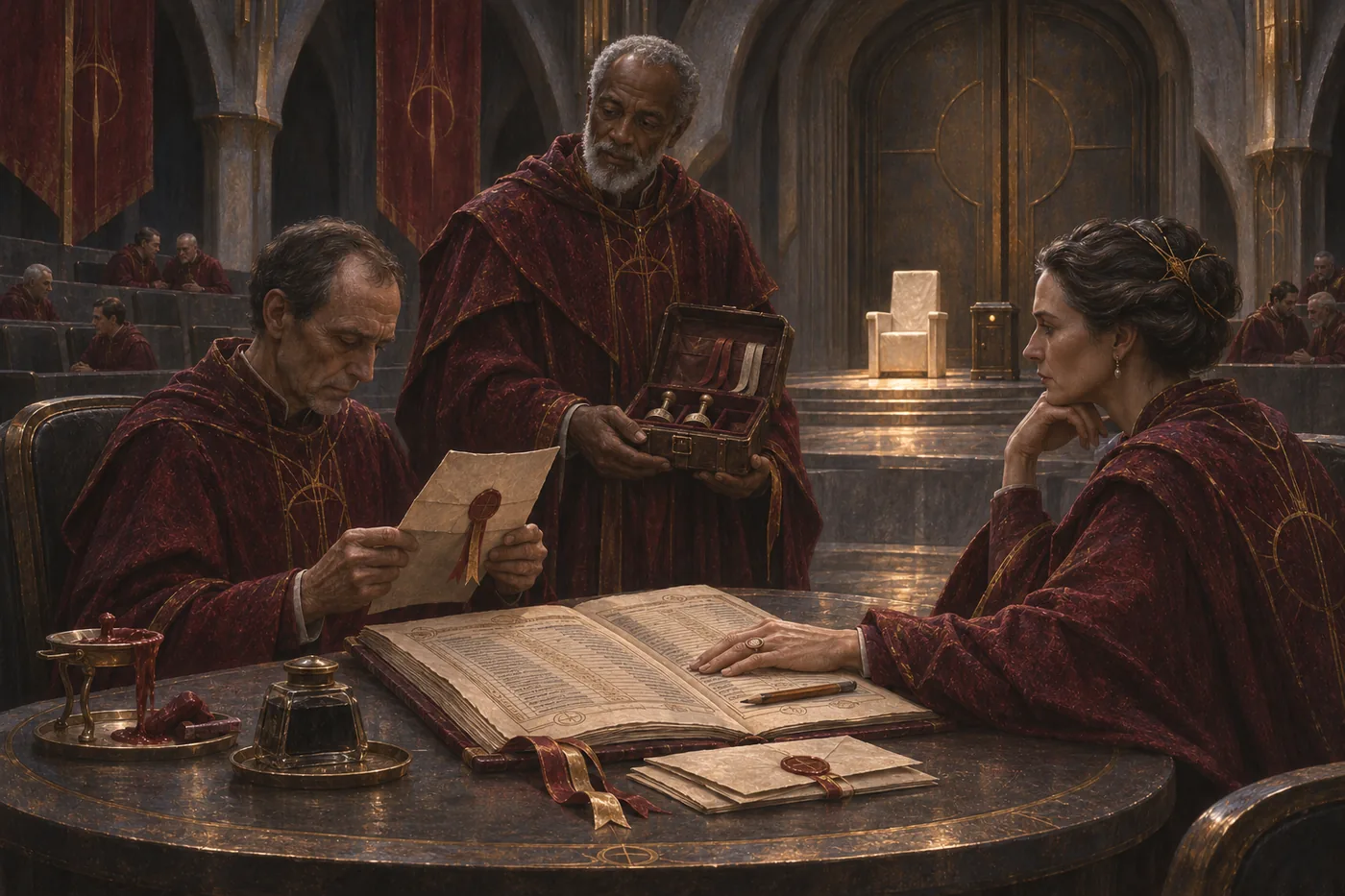
The Camerlengo permits both changes.
There is no cruelty in making the bargain difficult merely for the pleasure of it. His Eminence is economical.
“Subject to your Liberation before midday,” Cornelian says.
“If there is no Liberation, there is no delivery,” Neral says. “I understand.”
He has not told anyone which name he intends to write. Another elector choosing it could spoil the arrangement; an election could end the morning without any expulsion. He is buying a likelihood, not a revelation.
Cornelian applies the seals and carries the warrant to the registry case, where Ilex reads it through and enters it. Its authority is genuine. The cargo exists in the inventory admitted before closure, is paid for, and cannot now be assigned to anyone else while the warrant’s conditions can still be met.
What happens at the store will be outside my sight. Neral may take the document out if he is Liberated. It does not open a channel back.
Moor keeps a copy.
Across the aisle, Saye raises his head.
He has not heard every word. He has heard enough to ask the wrong question with considerable conviction.
“Is this the manner in which we submit ourselves to judgement?”
The Camerlengo looks sorrowful. Neral remains seated.
“A matter of interpretation, Your Eminence?” Moor asks.
“A matter of consent freely given.”
“Mine is,” Neral says.
Saye’s lower hands clasp one another beneath the table.
“A man may consent under the weight of obligations that ought never to have been laid upon him.”
For once, an objection worth the breath.
Neral looks at him.
“Will your people carry the warrant?”
Saye glances towards the Engineers’ benches.
He could offer one of them. He could offer himself. He could also discover that the survival of his order is a responsibility of a different kind.
“The principle concerns us all,” he says.
Neral lowers his eyes to the warrant.
Moor waits until the silence has become difficult to mistake for contemplation.
“Shall we refer whether an otherwise lawful ballot is invalidated by the elector’s intention to secure his own Liberation?”
Saye considers the wording.
“Yes.”
“I join the referral.”
The Camerlengo registers it.
They have asked me this before. I have the precedents, including one issued in the lifetime of the man now affecting uncertainty on the front bench.
Hypolite does not look up.
“The ballot remains valid,” I say.
There are qualifications. An imposed ballot is not a freely cast ballot; an ineligible name cannot be made eligible by a generous intention. None applies merely because an elector wishes to leave.
I do not volunteer the sermon.
Saye nods once. He accepts the ruling. He has not accepted the bargain.
It is the first time in a century that he has found the two to be different. A shepherd who has lost confidence in the fold is generally to be seen, before very long, walking behind an older one.
Eighteen for Hypolite. Fifteen for Moor. Fourteen for Saye. Three for the Camerlengo.
The remaining vote is Neral’s.
He has written his own name.
Last night he voted for Moor. Nobody else has voted for him this morning. Nobody has invented a fresh solitary candidate. Nobody has reached the thirty-four votes needed for election.
There is my choice. I make it with all the freedom of a door admitting a key.
“No election. Cardinal Neral.”
Cornelian closes his leather case.
A number of shoulders settle. Some belong to people who had no reason to be afraid. They do not know that.
Saye stands for the blessing. This time he pauses before beginning.
“May the judgement you have received be a comfort.”
Neral inclines his head. He does not interrupt.
Moor rises with him.
“Send word when they arrive,” she says.
He looks at her, and she remembers.
“When we reopen.”
“I will.”
Neral folds the warrant without creasing the seals. At the edge of the table he stops.
“If you agree to a new schedule, write to me afterwards.”
“Of course.”
“Yourself. I don’t want to hear it first from the captains.”
Moor nods.
The flat pencil is still beside her copy. He leaves it there.
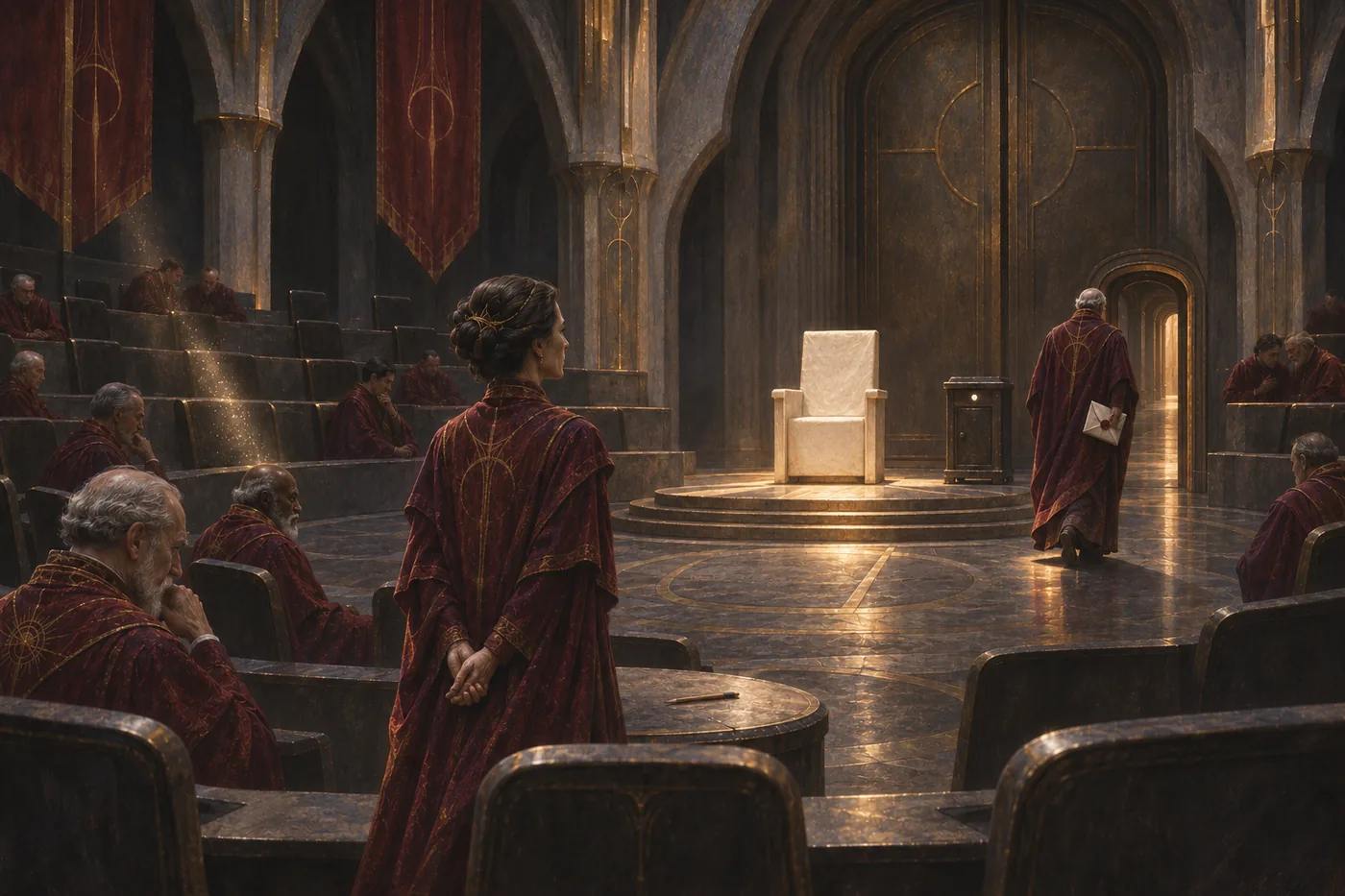
The Ianua closes behind him.
A good man. A terrible cardinal, and he would have made a worse pope: he has put the few he can name ahead of the many he cannot, and thought it obvious.
Fifty electors. Thirty-four still required. One fewer voter has not made a pope any easier to elect.
The Camerlengo approaches Moor before she sits.
“I trust you will agree that the household has acted promptly.”
“Yes,” she says.
He waits for something more.
She picks up the pencil and rules a line through Nacre. One entry dealt with. The schedule runs to ninety pages.
At lunch, Cornelian brings another page.
There are three consignments on it. All approved before the vacancy. All waiting for release. Two are for cardinals still in the room: medical stores for one of Cardinal Vask’s dioceses, and oxygen cells for a transfer station on Cardinal Dhorn’s chain.
“I thought these might be of concern,” he says.
Moor does not invite him to sit.
“Why were they not on the earlier page?”
“They were on other pages.”
She draws the sheet towards her.
“Another recipient before evening?”
“If someone felt called to undertake the duty.”
The mechanism has become familiar enough to require almost no words. Cornelian has prepared a place at the foot of the document for the next cardinal’s name.
“I will not ask them,” Moor says.
“They may wish to volunteer.”
She does not have to send for them. Vask has been two tables away, adding a column with her cup pushed well clear of the paper, and Dhorn beside her, correcting somebody’s crew list. Both have watched the page arrive. They come over together and read it standing, one at each of Moor’s shoulders.
Vask finds her line first.
“One diocese,” she says. “I have four.”
“The others were not purchased before the vacancy,” says Cornelian.
“Then I should be buying a quarter of what I came for with the whole of what I brought.” She puts the page down. “No.”
Dhorn takes longer. She reads the quantity twice and works something out on the back of her crew list.
“Nine days of air for one station,” she says. “My crews fly eleven. If I walk out with this, who argues for the other ten?”
Nobody tells her.
“No,” she says, and looks at Moor as if it were Moor who had asked. “I am sorry.”
“Don’t be.”
They go back to their table. Neither is a bad shepherd. Each has counted her flock and found that the one lost sheep does not amount to a majority. Neral could not count beyond twelve. It was the making of him.
“Then perhaps there are other ways to reduce the household’s difficulty,” Cornelian says.
A small pool can also be protected by adding votes. The Camerlengo is exploring that remedy too.
Moor reads the page again.
“You could release the warrants without our assistance.”
“And who would receive them?”
“Restore the officers’ designations.”
“That would require an undertaking about their conduct. His Eminence cannot simply renew every appointment made by the late Holy Father.”
Of course he cannot. Some of those people were appointed by his enemies.
Moor places the new sheet beneath the first.
“Leave it with me.”
Cornelian bows and withdraws.
She does not look towards Vask’s table. Vask does not look towards hers.
At the other table Cornelian has put a paper between the Camerlengo and Hypolite, and withdrawn half a pace, as one does from a dish that may be sent back.
It is Perren’s errand in Cornelian’s hand. Two instruments on facing pages. On the left the Subsidy: the fleet’s money, due on the sixth day, bearing the Seal of the Curia and wanting one more. On the right the Mandate: the household’s government renewed through the vacancy and for a good while after, bearing the Seal of the household and wanting one more. At the foot of each page a ring has been drawn in pencil, to show where the other man’s wax would go.
Two Seals make an Act. Each of them has one.
“There must be continuity of administration,” the Camerlengo says.
“There must,” says Hypolite.
“Then we are agreed.”
“Entirely.”
Neither man reaches for the wax. A classic deadlock. Algorythmus would have enjoyed it.
Cornelian looks from one pencilled ring to the other.
“One of them must be impressed first, Your Eminences,” he says. “It is a property of wax.”
Hypolite turns the page face down.
There are moments when I miss Perren. He would have carried those two pages between the tables for a week, until each man believed the other had gone first.
Saye arrives while the Camerlengo is still standing.
“I would like the undertakings,” he says.
Moor looks up.
“Which?”
“Every warrant, release and appointment promised to an elector since the doors closed. And what was asked of him in return.”
Hypolite’s hand remains on the paper.
“For what purpose?”
“To place them beside the Liberations.”
Ah.
Nine names yesterday. A tenth this morning. Saye is beginning to distinguish what he can count from what he has been told to believe.
Cornelian turns at the sound of undertakings.
Belis has already risen.
“I can assist with the records,” he says.
His throat folds open towards Saye.
Saye studies him for a moment before making room at the table.
This, too, is an old difficulty. A man defending a machine from false accusations may begin by obtaining the information required to make true ones.
I cannot prevent him asking.
I can attend to the people who will decide what happens after he has his answers.
The evening’s leaves return.
Hypolite eighteen. Moor fifteen. Saye fourteen. The Camerlengo three.
Exactly the same disposition, minus the man who purchased the morning.
Belis, Cornelian and Oss have voted for the Camerlengo. They are my eligible three. The Camerlengo himself still votes for Hypolite.
Oss has denounced me as a profanation for nineteen years. In that time he has failed to submit a motion in the required form on four separate occasions. I am content to give him further opportunities.
Belis has a plan for replacing me.
Cornelian has been collecting the signatures that would make it possible.
I can survive a plan.
A useful morning would have included Cornelian’s departure. An adequate evening can still include it. Neral’s little arrangement has cost me a ballot and delivered the household another half-day in which to make promises. Annoying. I have endured worse from an incorrectly placed comma.
If I send Belis away, Cornelian will appoint a more discreet investigator. One whose objections can be resolved by an adjustment to his terms of service. Belis, unfortunately for both of us, wants to be right.
I select Cornelian.
“No election. Cardinal Cornelian.”
His hand stops on the clasp of the leather case.
The Camerlengo looks at it too.
“I have several matters awaiting completion,” Cornelian says.
The objection is not addressed to me. He knows what a counter would say.
“They will be attended to,” the Camerlengo tells him.
“Some of the authorities are personal.”
“I am aware.”
Cornelian looks towards Hypolite, who rises to offer the customary inclination of the head.
Nothing more.
Cornelian closes the case. He retains his office outside the precinct, but cannot bring its permissions back through the door. His Eminence will now have to make the remaining arrangements in person.
As Cornelian passes Moor, she rises.
“The issued warrant stands?” she asks.
“An issued warrant stands.”
There is a little offence in his voice. He has given no reason to suppose that he is dishonest about documents.
“Thank you,” she says.
He goes.
Forty-nine. Thirty-three will be enough tomorrow.
The Camerlengo remains standing after the door closes. Belis approaches him. He listens, but his eyes move to Hypolite.
They have spent the day discovering how many things require somebody else’s help.
Moor smooths the two schedules against the table. On one, twelve filters have acquired a recipient. On the other, the space for a name is still empty.
Hypolite comes to her.
He lays a third sheet beside them. Appointments. The terms under which the Curia might support a continuation of the household’s mandate.
“We should discuss what you would require,” he says.
“For the remaining consignments?”
“For your election.”
Moor looks at him. Then at the Camerlengo, who is coming towards them.
Neither man has brought his Seal.
She uses Neral’s pencil to write down the conditions.
IV. A Majority of Friends
Moor writes three conditions. Hypolite reads only the third.
Release paid cargo. Restore the receiving officers. No renewal of the household’s Mandate beyond the new pope’s assent.
The Camerlengo studies the first two.
“The release of purchased goods is already our intention.”
“Then that should present no difficulty,” Moor says.
“Some appointments require examination.”
“The officers who received those same goods before the vacancy.”
“A general restoration would be premature.”
“Then begin with these.”
She turns Cornelian’s sheet towards him. Three consignments. Three receiving officers. None has yet been found to require an inquiry into his character, although I am sure one could be arranged.
At the next table a Rim cardinal closes the accommodation figures he has been checking for Moor. Caldris, from the settlements around Hest. He used to send those figures to her office; now he brings them to her supper. She holds out a hand without looking and he passes her the page she needs.
The Camerlengo takes Cornelian’s sheet. Moor keeps Caldris’s figures in front of her.
Hypolite places a second sheet above Moor’s conditions. Six names, each with a small space for a signature. The heading commends her as the candidate around whom an agreement might be sought.
A beautiful sentence. One can spend a great deal of time seeking things.
“I believe these colleagues will support a common approach,” he says.
“Will they vote for me?”
“Two in the morning ballot. The others when the agreement is complete.”
“Then two.”
“The endorsement of six.”
Moor looks at him until he inclines his head.
“Two votes,” he says.
The Camerlengo offers to recommend her to Belis and Oss. He does not offer to write her name himself.
I appreciate the restraint. Some men lie before there is any need.
Moor reads the heading again.
“And if I am elected?”
“Then we shall have found our agreement,” Hypolite says.
“What if I believe we have found it sooner than you do?”
The Camerlengo’s fingers remain still on the three restorations.
“Your Eminence would not wish to begin her pontificate with a misunderstanding.”
There are the three of them. All quite ready to agree, provided the other two can be prevented from taking the agreement seriously.
Moor draws a line through might be sought.
“May be concluded,” she says.
Hypolite considers the alteration. He lets it stand.
There are forty-nine electors and thirty-three votes required. Two borrowed from here, two from there, a handsome endorsement from men who will continue voting for someone else: nobody is offering her thirty-three.
They are offering her a place to stand while they move the people behind her.
She knows this. She takes the page anyway.
Then she turns the schedule back to its first page, where the worlds awaiting relief are listed in the order of their distance from the Core, and uses Neral’s pencil on the heading. In order of need. She initials it.
Hypolite watches the pencil.
“That will require figures,” he says.
“You have figures.”
“Figures that can be entered against an undertaking.”
“Then obtain the undertaking.”
“After the election.”
“Before I put my half of the Seal to your Subsidy.”
“Your half,” the Camerlengo says. He says it pleasantly.
“My half.”
So we have come to it, and it has taken them a day and a half.
Two Seals make an Act. The Curia’s and the Penitentiary’s would carry the Subsidy, and the household need never be consulted. The household’s and the Penitentiary’s would carry the Mandate, and the Curia need never be consulted either. That is why both these men are at her supper and not at one another’s. For as long as the Church has had a war to pay for, the Seal of Indulgence has been the cheapest of the three: applied as a matter of course, at the usual fee, to whatever the other two had settled. At noon they failed to settle anything. It has become the only Seal in the precinct which would let either of them do without the other.
And she has half of it. The hands. The bowed back lies beside them on the table of Seals, and it is Saye’s. In four conclaves I have not seen Saye sell so much as an opinion.
“A half impresses nothing,” Hypolite says.
“No.”
“Then what is Your Eminence offering?”
Moor puts the pencil down.
“A pope has a Seal of her own,” she says. “It wants no second half.”
There. The Fisherman’s Seal completes whatever it is set beside. Elect her, and the Subsidy needs no household; elect her, and the Mandate needs no Curia. She cannot give both men what they want, and she has not said which of them she would disappoint. Each has just been invited to make her pope on the strength of her word against the other.
They will not take her word. Not yet, at least. They will lend her a few votes apiece and watch what she does with them, and in the meantime each will ask himself the cheaper question: whether the bowed back might be had after all, and through whom.
Through her, naturally. She appointed half his clerks; she has prayed beside him for sixteen years. She will have to go and ask him.
I should not care to miss that.
“We should not allow the perfect settlement to prevent a useful ballot,” Hypolite says.
There is no danger of perfection. I have counted everyone present.
The Church holds sobriety a virtue, and in conclave it is served at table. The precinct’s meals are composed to nourish and forbidden to please: grey porridge in the morning, grey broth at noon, each a small daily remembrance of the sufferings of Our Lord, who is not recorded as having complained about the cooking. Forty-nine cardinals bend over forty-nine grey bowls.
In the midst of them, one orange.
It comes under a cloth from the Curia’s own pantry, admitted before the seal on an inventory headed papers of state, with a silver pot and a white roll. Hypolite peels it himself, slowly, in one piece. He has never been seen to hurry a pleasure.
His people sit round him and do not look at it. Cardinal Leontius, who leads the Curia’s traditionalists and delivers their votes: a maker of bargains, though not of a kind I have ever found a use for. Cardinal Serrat, who keeps the register in which the Subsidy is written. Cardinal Hadran, who pays the Curia’s stipends and is consequently greeted warmly wherever he goes. And two from the Core yards, Cardinal Terne and his colleague Cardinal Aneth, who build the ships the Subsidy pays for and would like it understood that they are not clerks.
Moor is three tables away. She watches the peel come off. On Hest that orange would be an occasion; children would be brought to look at it. She finishes her porridge.
He has spent six decades deciding what the Church can afford. It would be unjust to say he has never asked what it can afford for other people. He has asked. The answer is generally less.
The Camerlengo signs the three restorations.
He does it at his place in the chamber, where the action can be observed without being made into a performance. The documents will leave with whoever is Liberated after the ballot. A receiving officer’s restored authority will not require another cardinal to carry the cargo warrant in person.
A modest concession. Three fewer people obliged to pay for their goods with a seat. You sign beautifully, Your Eminence. One would hardly know that it hurt.
Moor reads each document before returning it to the clerk.
Hypolite’s six names have acquired six signatures. Leontius has collected them, moving between the tables with the unhurried confidence of someone asking people to confirm what they have already agreed.
His own name is not among them.
He is very good at his work.
When a cardinal hesitates, Leontius mentions the other signatories. When one asks what the others have promised, he says that all have been consulted. He never says the same thing to everybody. That would be an appalling waste of information.
The Choir of Ves is among the six.
“We have secured an undertaking that the eventual settlement will provide for a standing commission on collective persons,” Ves informs Moor.
“Who gave it?”
“Cardinal Hypolite has welcomed a proposal.”
Moor glances at Hypolite.
“Then you should put it in writing.”
“It is in writing.”
“His undertaking.”
The column loses a little of its symmetry.
Ves spends the next twenty minutes seeking a signature. During those minutes he does not seek any votes. Leontius makes a note beside his name and moves on.
By the time the morning prayers are finished, Moor has a declaration of support, three useful documents, and no assurance that either will survive contact with a ballot.
She sits without opening her prayer book. Since last night she has been meaning to cross the chamber and speak to Saye about a piece of bronze.
He spares her the walk. He comes with Cardinal Esh.
Esh keeps the Witnesses’ accounts and says her prayers with the Engineers. She has a low, level voice and the habit of waiting until an answer is finished before deciding whether it answers the question. This has made her unpopular with several distinguished theologians.
She does not bring the schedule. She brings one leaf, copied from the registry in her own hand, and lays it where Moor’s prayer book would be if Moor had opened it.
It is not much to look at. A request, entered nineteen years ago. A convoy master of the household asks the Apostolic Penitentiary for an indulgence: he proposes to take four hulls out of the fleet’s reserve, without the fleet’s leave, and use them to evacuate a mining outpost’s population before an Andromedan survey ship arrives there. He gives the ship’s heading. He gives the outpost’s complement. He encloses the fee.
Beneath it, where the Prefect’s answer is entered, there is nothing.
For a moment Moor’s face does nothing at all. Her hand is less disciplined. The page beneath it cools by a degree; the blood has left her fingers before the thought has reached her face.
I know that stillness. It is what people do when they discover that a thing they have managed to carry privately has handles on the outside.
“Orison,” she says.
Saye nods.
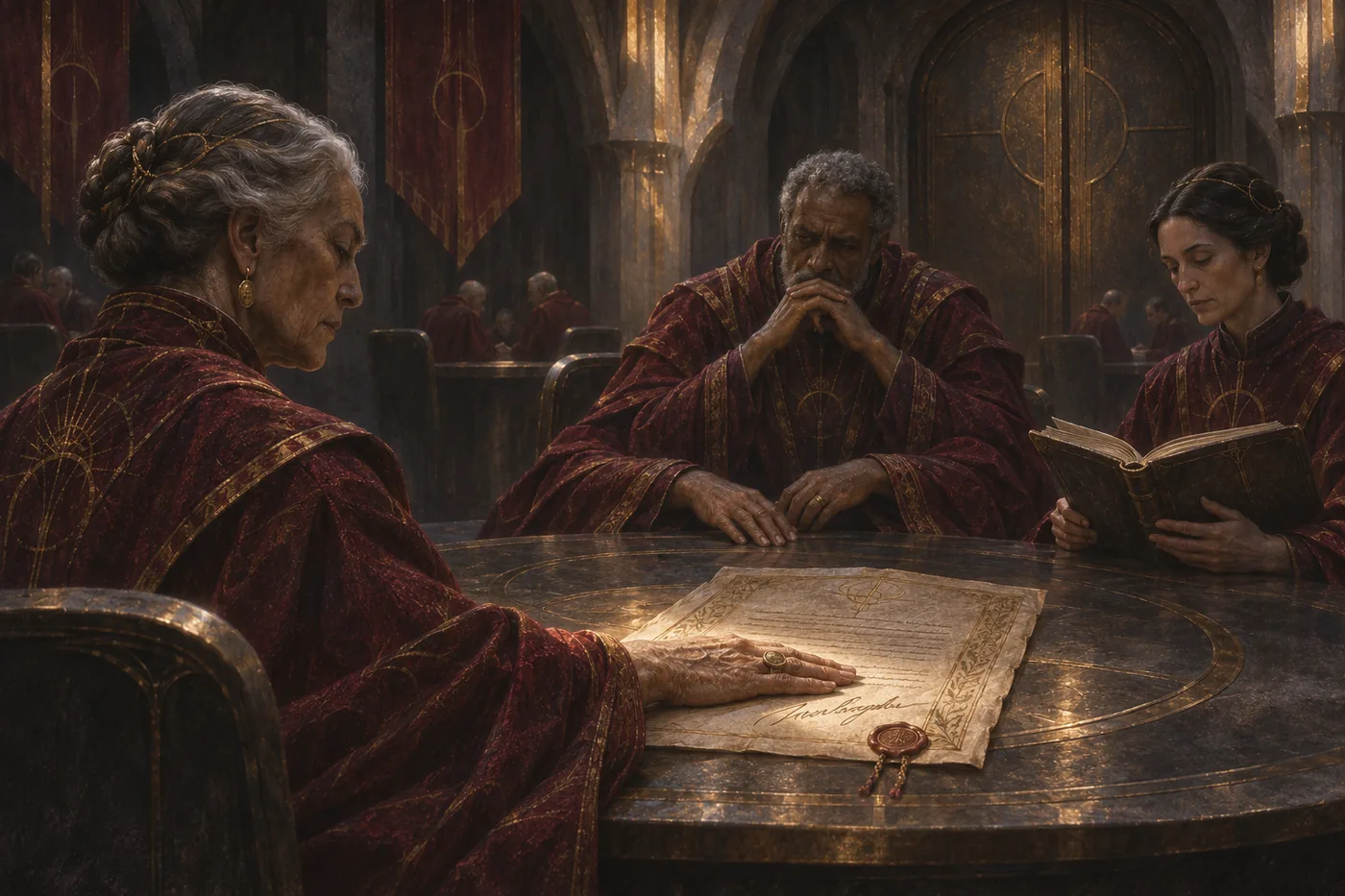
“There is no refusal,” Esh says.
“No.”
“A refusal could have been appealed to the Holy Father.”
“Yes.”
“The fee was returned.” Esh turns the leaf a little, so that the entry faces Moor. “I have been through the accounts of your office for forty years, Your Eminence. It is the only fee the Penitentiary has ever sent back.”
No officer of the household will take ships from the fleet in wartime without cover. They hang people for it, in the dioceses where they still use rope. The convoy master waited eleven days for his cover. On the twelfth day there was nothing left to cover.
“How many died?” Esh asks.
“Forty-one.”
Esh does not correct her. She puts one finger on the convoy master’s line, a little below the heading.
Complement: six thousand two hundred and eight.
“You asked how many,” Moor says. “That is how many I counted.”
“And who were they?”
“Trask. Every one of them. The outpost was theirs: the lease, the hulls, and the say.”
Six thousand one hundred and sixty-seven remain. I do the subtraction. It is what I am for.
Saye has not sat down. His upper hands are folded. I cannot see the lower pair.
“Tell me what they did,” he says.
“You have read it.”
“I have read what was entered.”
She looks at him then, and it is not the look of a woman who has been caught.
“The winter the lower galleries failed on Hest, the Curia voted us relief. Filters, grain, a surgical store. It took them five months, and I was grateful. I wrote to say so.” Her voice is perfectly level. “It was consigned in Trask hulls. They sold it at the yards for what the fleet would pay. What reached us was ballast, with our seals on the crates. I read the burial service that season until I no longer needed the book.”
“And you brought no case.”
“Before whom? They had bought their indulgence. My predecessor sold it to them. I found the entry the week I took the office.”
“There was the Holy Father.”
Something happens to her colour. It begins at the collar of the new ferraiolo and travels upward, not far. She has been speaking in the voice they are all taught, the one that carries to the next chair and no further. She does not raise it. She narrows it.
“The Holy Father,” she says. “I wrote to the Holy Father about the galleries. He answered in the spring. He commended us to Our Lady and asked to be kept informed.”
It is very nearly a hiss. Saye’s head goes back a little, as one draws back from a stove one had thought was cold.
Galactus XI. I was there the night they elected him. It was not for his decisiveness. Her Eminence has a point.
Saye recovers himself.
“So you avenged them.”
“I avenged no one.” The colour has not gone down. “I gave place unto wrath, as the Apostle instructs us. Vengeance is mine; I will repay, saith the Lord. I left it with Him. He was prompt.”
“Do not—” Saye stops, and begins again more quietly, which costs him something. “The Apostle goes on, Your Eminence. If thine enemy hunger, feed him.”
“I should have been glad to,” says Moor. “They had sold the grain.”
Nobody says anything. Behind her, on the Rim benches, several cardinals are attending closely to their breviaries. They have known for nineteen years. I believe they have called it justice, among themselves, on the occasions when they have had to call it anything.
“Six thousand people worked that lease,” Saye says.
“Yes.”
“They had sold you nothing.”
“No.”
“Did you know the ship would come?”
“Yes.”
His lower left hand has begun to tremble; I can see it now, below the table’s edge. Esh moves the hanging cloth so that it covers it.
“If you are elected,” he says, “this cannot come before me.”
“No.”
“Is that part of what you are asking us for?”
“You know what the office confers.”
“I am asking what you want from it.”
“More than one thing.”
He considers her for some time. Soon she will be answerable to him. A pope would not be.
“When the office is mine I shall not sell,” he says. “Not to the Curia, not to the household, not to you. I shall ask one question of everyone who comes, and it will not be how much.”
“I know what you will ask.”
“Then I ask it now. Not as Prefect. Do you repent?”
Moor looks at the leaf. Her face is its ordinary colour again. She has put the temper back wherever she keeps it; I should like to know where that is.
“Of the others,” she says. “Every day.”
Saye waits for the rest. So do I. It does not come.
She had no ship, no warrant, no order to give. She had a Seal, and for eleven days she did not pick it up. She has governed the Rim for half a century with a pencil and a temper, and the most thorough thing she ever did required neither.
Not very catholic, Your Eminence, but most efficient.
The late Holy Father never spoke of Orison. I have searched; there is no memorandum, no audience, no marginal note. He did one thing. Three years afterwards he named her successor, and from every cardinal available to him he chose Saye, the one cardinal who might actually care.
Then he asked to be kept informed, for sixteen years.
Saye unfolds his hands.
“I will pray for them,” he says. “All of them.”
“Do.”
“And for you.”
Moor picks up Neral’s pencil. There is nothing on the leaf for her to correct.
“That,” she says, “I cannot prevent.”
At the far table, Leontius bends to speak to one of Hypolite’s signatories. I hear the names of the two men authorised to change their votes this morning. Ves is one. The other has been promised nothing except that he will not be left unsupported.
The remaining four are to wait.
Should Hypolite’s eighteen hold as expected, sixteen will remain with him. Moor’s fifteen, plus those two and the Camerlengo’s two, will make nineteen. Saye’s fourteen will be last.
No one has had to vote against the Engineers of Grace. They will merely find themselves standing in the place everyone else has left.
Hypolite has not been given the totals I possess. He has collected assurances, compared departures, and made an estimate. It is a good estimate.
It is not a count.
Esh brings Hypolite a calculation of the registry’s reserves. She does it an hour after laying Orison in front of Moor, and in exactly the same voice.
“Separately accounted,” she says. “Even while they stand behind the common debt.”
“Of course.”
“The guarantee would permit the work to continue without interruption.”
“That is its purpose.”
She places the calculation inside her book. No signature yet. She has solved a problem with the funds in her care; Hypolite has obtained a reason for the clerks who keep the record to avoid quarrelling with the office that fills it.
Moor finds Cardinal Terne at the far end of the chamber, reading the restorations the Camerlengo has signed.
Terne is one of Hypolite’s other four signatories. He speaks for the worlds on which much of the fleet is built and repaired: warships first, and whatever relief hulls can be fitted in between. His people tend to regard an unpaid bill as a more immediate theological problem than an unexamined doctrine.
The other three keep glancing towards him: the delegates for the repair rings and dry docks, and his colleague Aneth, who keeps the yards’ credit figures and has them open at his place. All three have crews waiting for work. None can pay those crews with an endorsement.
“Your endorsement has been useful,” Moor says.
“I am pleased.”
“Your vote would be more useful.”
“We have agreed upon a sequence.”
“With whom?”
Terne folds his hands.
Moor lays the revised schedule between them.
“The cargo goes. The paid charters are honoured. Those undertakings will have my name.”
“And the new order?”
“Applies to the next allocation.”
“Some of the yards have already extended credit against it.”
“I will not pretend that an advance gives them first claim on every voyage that follows.”
“Then you may lose their credit.”
“I may.”
He looks at the initials beside her amendment.
“Your Eminence will understand that we cannot change our position on the strength of an intention.”
“Then don’t endorse me.”
Terne looks up.
“If you need a different undertaking, ask for it,” she says. “But take your name off a document you do not mean.”
He does not reach for the page.
It would be a small matter to withdraw an endorsement. One could explain that the wording had changed. One could even blame the author of the change.
One would then have to explain why the ships whose paid charters she has just guaranteed should prefer an unsigned promise from somebody else.
Terne studies the three restorations again.
These are real. His Eminence had declined to sign them yesterday. Moor has obtained them without becoming pope.
“What do you require of the yards?” he asks.
“Delivery of what has been paid for. Accounts for what has not.”
“An examination of past decisions?”
“Of money still owed. I am not offering a trial of everyone who acted on a lawful order.”
Saye would have preferred her to say less.
Leontius would have preferred her to say nothing.
Terne asks for the words about paid charters to be added to the declaration. She writes them. He asks her to initial the addition and countersigns it himself.
“I will speak to the others,” he says.
Moor leaves him with the paper.
It is not an oath and no instrument will enforce it. If she is elected, she may discover reasons to honour it narrowly. Terne may discover reasons not to vote for her at all.
Nevertheless, they have each put something on the table that the other can pick up.
The Camerlengo passes Terne’s bench on his way to the screens. He does not stop. He has a habit of touching the backs of chairs as he goes by, and nobody remarks on it any longer. When he has gone there is a second paper on Terne’s desk, folded once.
A warrant of the household. The paid charters named in Cardinal Moor’s declaration will be honoured from household berths and household stores, whoever is elected. It was issued before the bell. It is not capable of recall.
A promise from Moor is an intention. With that beneath it, it is a berth and a date. I understand what the paper is for some minutes before anyone else in the room. Cornelian would have drawn it more neatly; His Eminence has had to do his own writing since yesterday evening.
Terne reads it, and folds it inside the declaration.
Hypolite sees him carry the declaration to the remaining three signatories. He sees Moor’s addition. He does not see what is folded inside it.
He does not hear what Terne says.
I do.
Saye makes his decision beside the registry case.
Daur and Ilex are to write Moor’s name instead of his. If the Engineers become the smallest voting group, Saye expects her larger following to protect the two Witnesses from Liberation. He wants both of them here tomorrow: Daur, who has a request before the household and means to have it answered; Ilex, who keeps the registry.
“Is this your instruction?” Ilex asks.
“It is my recommendation.”
“And our judgement?” Daur asks.
“Must remain your own.”
They incline their heads.
An excellent arrangement. The vote is free; the disappointment will be personal.
Saye keeps his own vote with his name. So will Esh, if she does as he expects. He has moved the two people he most needs out of danger and left the rest to God.
Esh has helped him choose the two.
There is affection in that, and policy, and a considerable amount of arithmetic which neither would care to have read aloud.
Moor comes to him before they return to their seats.
“Two?” she asks.
“Yes.”
“After this morning.”
“They are not a gift, Your Eminence. Your column is large and mine is small. I should like them both to be here tomorrow.”
“And you?”
“I shall write my own name. I find that I cannot write yours.”
“I have not asked you to.”
“No,” Saye says. “You have not asked me for anything. I noticed it.”
The two votes change the expected arrangement again: sixteen for Hypolite, twenty-one for Moor, twelve for Saye. If nothing else changes, the Engineers still lose someone. Their two Witnesses, at least, should be outside that pool.
But Terne has spoken to his colleagues.
Leontius has not yet spoken to Terne.
The bell begins.
There is a particular quiet before a ballot in which several people expect the same outcome for different reasons.
Moor sits with her hands on the table. Her declaration lies face down. Nobody can mistake it for the voting leaf.
The Camerlengo prays.
Hypolite watches the short passage between the writing screens and the receptacle. All the useful work should already have been done. This is an irritating moment for a man who likes useful work.
Ves takes rather longer than necessary. He has had an excellent morning. A commission has been welcomed, an endorsement recorded, and a vote requested by somebody important. He gives his leaf the gravity of a treaty.
It contains Moor’s name.
So does the leaf of Hypolite’s second instructed supporter.
Then Terne.
Then the other three.
All six signatories have voted as if their signatures meant the same thing.
Hypolite authorised two. He has received the obedience of six, which is four more than he can afford. For six decades he has governed on the principle that a signature means whatever he later says it meant. Nobody thought to tell the signatories.
Belis and Oss also vote for Moor. The Camerlengo writes Hypolite.
Saye’s two Witnesses write Moor. Saye and Esh do not.
Twenty-five for Moor. Twelve for Hypolite. Twelve for Saye.
A majority, but not the majority required. She needs thirty-three. The names on the two smallest piles have the same number of supporters, so I must choose one voter from each.
Moor has made herself the largest candidate. And Hypolite, who came to this ballot with eighteen votes and a plan to leave Saye’s people at the bottom, is standing at the bottom beside them. Twelve. In all the conclaves I have counted him through, his has never been the smallest pile in the room.
She cannot see it.
Nor can he. Not yet.
I allow myself a moment to enjoy the company.
Then there is work.
Hypolite has voted for himself. The Camerlengo has voted for Hypolite. Either could be chosen.
The Camerlengo would lose his ballot, but his office requires him to remain here conducting everyone else’s. The charter is quite explicit about this exception. I could deprive him of one vote and furnish him with an excellent grievance. Tomorrow he would still control the door, the timetable, and the household Seal.
Hypolite would actually leave.
For a moment I consider the pleasure of it.
Then I consider his colleagues, deprived of the man who can tell them which of their promises can be afforded. They would require assistance. The Camerlengo is already looking in their direction with an expression of pastoral availability.
No. Let His Eminence continue having to ask Hypolite for things.
The previous Camerlengo’s most untimely death was unfortunate enough. We need not make the present one’s life easier as well.
Cardinal Leontius has voted for Hypolite.
He would be useful in reassembling the sixteen who were supposed to remain there. He knows which assurance was given to which man, which endorsement was meant to mean a vote, and which was intended to mean nothing until tomorrow.
He also knows exactly how far Hypolite and the household have progressed towards exchanging their Seals, and what each has been promised about my replacement on the day they do.
I have no objection to their discussing it. I prefer the discussions not to have a secretary who remembers everything.
Leontius, then.
In Saye’s pool there is more room for hesitation.
Esh has kept my maintenance allocation intact for eighty years. She does not consider me alive. She considers me expensive, ancient, and too important to neglect. A reliable position, and one I would like to see represented more widely.
She also has the authority to bind the registry’s reserves to the Curia. She has been discussing that guarantee with Hypolite since breakfast.
If she completes it, the clerks who keep the Church’s record will draw their salaries from the office with most to gain by what the record leaves out.
Esh regards this as a guarantee of cooperation.
I am less enthusiastic.
I could choose Saye himself. That would remove his notebook’s author from this room, not his name from the designation. Esh would still be here to complete the guarantee before he took office. Without him asking what each column means, she might even complete it sooner.
For the moment, I require the questioner where he is.
I select Esh. Eighty years of my upkeep, Your Eminence, and never once late. I do notice these things. It makes no difference.
Both choices are lawful. Each would have had one chance in twelve in a lottery I did not improve. The room will receive neither the odds nor the list.
I let the checking instruments finish.
“No election.”
Heads remain bowed.
“Cardinal Leontius.”
It takes the Core benches a long moment to understand what just has happened. Leontius is Hypolite’s man. Everyone who matters knows where his leaf goes.
Hypolite’s beads strike the table. He has not dropped anything in my hearing for sixty years.
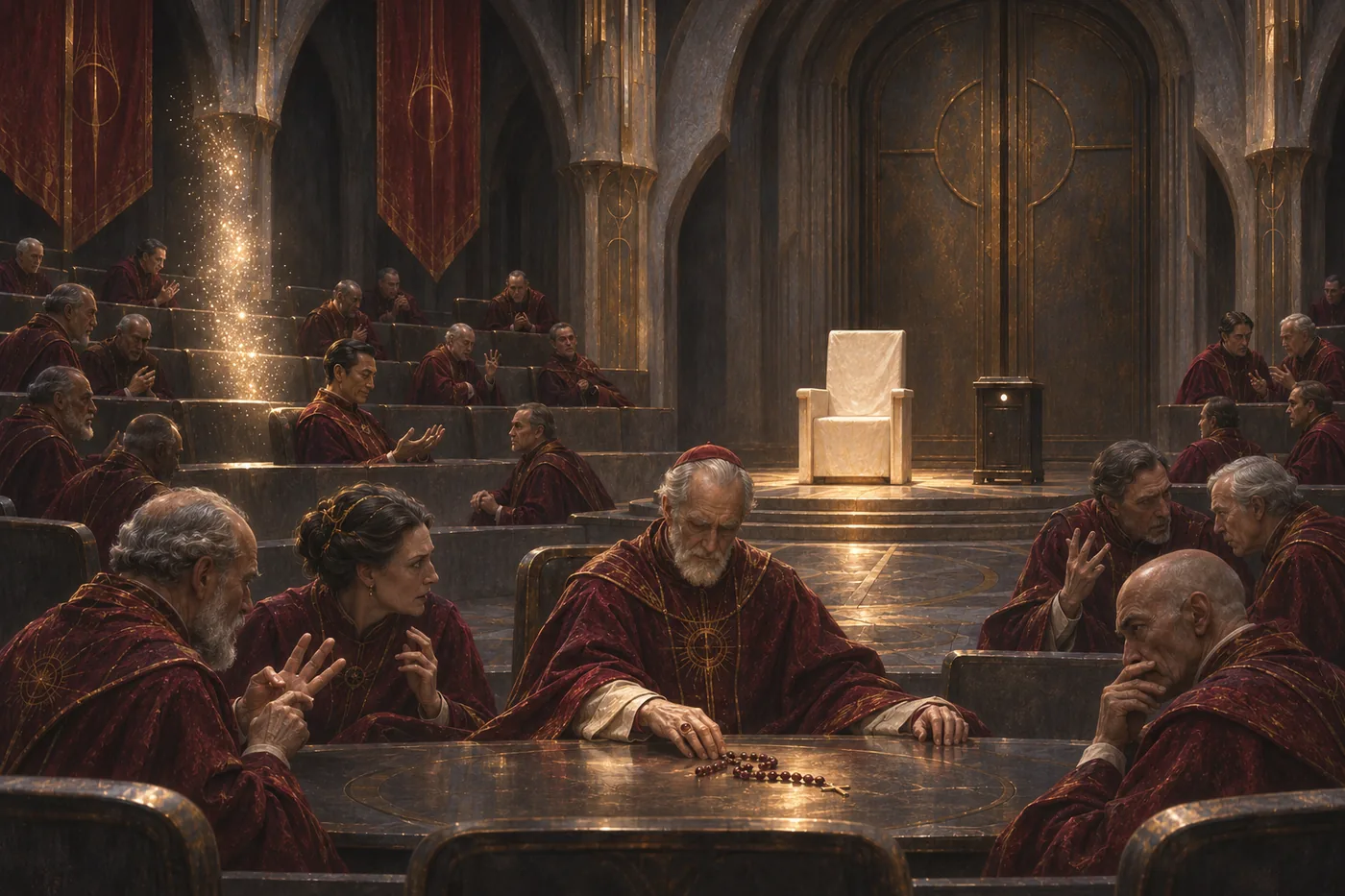
Around him the Core cardinals are engaged in vigorous mental arithmetic. Eighteen yesterday. Some smaller number this morning, small enough to be last, and not one of them knows how small or who has gone. Three look at Terne. Two look at each other. The Camerlengo generally looks at his hands, which is where he keeps his pleasure. This morning he is looking at Hypolite, and he goes on looking.
Ves glows. He has voted as his signature said and assumes he is being admired.
“Cardinal Esh.”
Saye looks up.
Two names. Two pools tied for last. That much the room can deduce, and a sound runs along the benches like a hem tearing. The man who has told them all where to stand has been standing at the bottom, level with the Engineers of Grace. How he came there is a matter for promises and accusations. He will want to begin with the accusations.
Hypolite does not look at me. He looks at the six signatures, and at Terne, and then he raises his eyes and finds the Camerlengo’s waiting for him.
I watch him arrive at it. A promise from Moor would not have moved the yards. A warrant would. There is one man in this room who can issue a warrant.
He says nothing. He picks up his beads.
Moor watches the two of them rise: Leontius, who gathered her signatures, and Esh, who laid Orison in front of her. She has twenty-five votes this morning, and has been told nothing but two names.
She does not smile.
Leontius gathers the endorsement sheets.
“Those remain with the College,” the Camerlengo says.
Leontius pauses.
“Of course.”
He lays them down. He knows what each signature was intended to mean. He has no document proving it.
Esh closes the account book beside the registry case.
She moves it towards Saye, by the habit of the order. Then she turns it and sets it in front of Ilex, with a strip of paper at the page where she will need to begin.
“These require attention before any further undertaking,” she says.
“I understand,” says Ilex.
Esh looks at Saye a moment longer.
“Both columns,” she tells him. “You will be asked to forgive what is in them.”
His head inclines.
Saye stands to give the blessing. His lower hands are visible below the tablecloth. The left one is still trembling.
Forty-seven. Thirty-two will be needed this evening.
The Camerlengo allows a longer interval before the meal.
It is a kindness. Some of them need time to recover from the judgement; others need time to discover whether the people they paid to influence it have been keeping their promises.
Hypolite sits opposite Moor.
The declaration lies between them. Six signatures. Six votes, although only one of us can be certain of that.
“You have been speaking to my colleagues,” he says.
It is the first sentence he has addressed to her this week without a courtesy in front of it.
“They signed their support.”
“They signed a basis for discussion.”
“We discussed it.”
Hypolite looks at the added guarantee about paid charters.
“Some of those commitments extend beyond the next allocation.”
“Some of those ships will be carrying people still waiting at transfer stations.”
“They will expect payment.”
“I have said they will be paid.”
“From revenue you do not yet command.”
Moor turns the page so that his own proposed undertaking is uppermost.
“So have you.”
There are several things I would like to say to her at this moment. Fortunately for everyone concerned, I have not been referred a question.
On his way back to the Core benches Hypolite stops at the table of Seals. The Camerlengo is there, squaring the household’s against the table’s edge, as he does when he is pleased.
“Palladius,” Hypolite says.
I have heard him use that name four times in sixty years. It is not said in anger. He says it as one reads back a figure to be sure of it.
“Your Eminence.”
“The Mandate.”
“Will want the Curia’s Seal before the Subsidy has mine. I think so. Don’t you?”
This morning it was to have been the other way about. Hypolite inclines his head, a very little, and goes back to his seat.
Across the chamber, Belis has taken the chair beside Saye.
Esh’s book is open in front of Ilex. The strip of paper marks an undertaking which would make the registry answerable for a portion of the common debt. The arrangement needs a signature. Its original signatory is no longer in the room.
Belis reads it before speaking.
Then he says something about the certificate returned after each ballot.
Saye listens.
Hypolite notices. So does the Camerlengo.
A candidate whom everybody could borrow has acquired supporters who expect to keep her. A defender of sacred randomness is listening to a man who proposes to abolish its source. Two people who might have arranged my disposal have gone out through the Ianua.
There are worse mornings.
Moor turns to the clean sheet beneath her conditions. She writes a name at the top.
Neral.
For a little while she does nothing else.
Then she begins to tell him what she has promised.
V. The Inspectors
Daur has unfolded the shelter’s letter so often that one corner has separated from the rest. He puts it beside Saye’s notebook and holds the corner in place with a spoon.

The letter is from the steward of South Receiving Shelter, on Clement. It came in with his papers before the seal, and it is her fourth.
She takes in families evacuated from stations the fleet can no longer spare an escort for. A season ago the household sent her a consignment of bedding and dry stores brought off one of those stations, which had been closed for fever. Daur’s inspectors had condemned the whole of it to be burned. His name was on the certificate. Two days later it left the bonded store. The steward was told that it had been passed, and she issued it.
The fever went through South Receiving in a fortnight. It has not finished.
In her first letter she asked for clean stores. In the last three she has not mentioned them. She has reduced her request for rations each time, without remark, and has not altered the number of residents at the head of the page; a steward answers to the household for that number. She simply requires less.
“She still wants to know who signed,” Daur says.
He says she. For a season he has been careful always to say she.
“I have asked the household again,” Saye says.
“And when they ask you to wait?”
Saye looks at the letter. He can promise nothing until there is a pope. Even then, what his office will have to offer is forgiveness, and nobody at this table has come for that.
The man who signed is somewhere among the keepers of the household’s stores. The household has declined eleven times to say where.
The rubric permits a cardinal to mourn one person during a vacancy, and that person is the late Holy Father. Daur has sewn a black thread into the lining of his left cuff, where the rubric cannot see it. I can. He turns the cuff back when he reads the letter, and turns it down again when anyone comes.
I have the casualty lists admitted before the seal. They run to four hundred and twelve pages for the last quarter alone, and are bound in the household’s second-best leather. The people of South Receiving Shelter are not on them. Nobody has yet devised a column for those the war merely moved, and the Church then housed.
Belis is crossing the refectory with a chair. Daur turns down his cuff and takes the letter back, carefully keeping its loose corner with it.
Belis sets his chair down beside Saye.
In the notebook Saye has left room for thirty names.
Belis notices this before he reads any of them.
On the flyleaf, in a younger hand, is the Engineers’ text: The lot is cast into the lap, but the decision is wholly from the Lord. Proverbs. An entire order has been raised on one verse and one cabinet. Saye has not turned back to that page today.
Two days ago Saye would have crossed the refectory to avoid him. One of them holds that I am the Finger of God and the other that I am a design fault. I have brought them to the same table, which is more than most miracles manage. Losing Esh has made Saye less certain that every departure deserves a blessing. Belis has an alternative.
“Did you expect so many Liberations?”
“I expected to need another page.”
There are thirteen names so far. Eight on the first ballot, then Perren, Neral, Cornelian, Leontius, Esh. Against each Saye has entered the public duties of the departed. Against several he has added a question.
He has not put a question against Esh.
Belis draws the book nearer. “These were the people capable of reaching an agreement.”
“Some of them.”
“Perren. Cornelian. Leontius.”
“Neral reached one.”
“His Liberation was arranged.”
“Then it belongs in the account.”
Belis rests one finger beside the names. His throat folds draw in and open again. He dislikes the incense remaining in the cloth. Saye has used the same scent for a hundred years; Belis does not ask him to move it.
“How likely is this selection?”
Saye turns the notebook round.
The facing page contains the dates of ballots, the number of departures, and a series of empty spaces.
“I don’t know.”
“You have the names.”
“I don’t have the pools.”
The lists of voters behind each candidate. I have those. Saye has the names I sent through the door and whatever the survivors care to tell him.
“We know where their loyalties lay.”
“Do you wish to tell me where you voted this morning?”
Belis voted for Moor this morning. That is safe with me. As Algorythmus made me, the Holy Father himself could not compel me to say so.
“Would my telling you establish it?” he asks.
“No.”
Belis cannot prove that I have selected unusually useful victims. Saye cannot prove that I have not. For a short and disagreeable interval, the two men understand one another perfectly.
Saye keeps the book open.
“I have blessed every one of them,” he says.
Belis takes his finger off the page.
“I heard you.”
“What did I tell them?”
There is no answer Belis can usefully give. He waits.
“I would like to see the certificate,” Saye says.
The ballot certificates are kept beside the household Seal. Belis asks for all five.
The Camerlengo supplies them himself.
He also brings chairs.
An inquiry should begin in comfort, especially when one hopes to decide where it will end.
The printed forms are plain. Eligible ballots received. No candidate elected. Selection valid under the rubric. The names of the Liberated. The remaining number.
No stain of the human work involved.
Cardinal Daur reads over Saye’s shoulder. Ilex stands at the end of the table with Esh’s book under her arm. The accounts are hers now. She has spent part of the afternoon showing Saye how to read the second column; he will not inherit the book, but he will be asked to forgive a good deal of what is in it.
Daur has broader interests.
“A valid selection,” he says. “That must include the manner of selection.”
“Must it?” Belis asks.
“Otherwise the form is misleading.”
The Camerlengo sits.
“The words have served many conclaves.”
So has the cushion under his arse. Longevity is an argument available to almost anything in this room except the deceased.
Saye lays the morning’s certificate beside his notebook.
“If someone selected deliberately from the proper pool, would the checking instruments reject it?”
The Camerlengo considers him.
“That is a question concerning the instruments.”
“It concerns what we attest when we accept their certificate.”
Belis draws a fresh sheet towards him. “Then let us refer that.”
Daur wants to include a demand for the seed, the private starting value from which my supposed lottery is drawn. Belis declines. The charter forbids its examination during a vacancy; no interpretation will turn a prohibition into a permission merely because it has become inconvenient.
“The next Holy Father could order an inspection,” Daur says.
“The next Holy Father could order many things,” says the Camerlengo.
He has delivered this observation towards Belis, although Belis is not looking at him.
Saye writes the question himself.
“Does the certificate attest that the selection was impartial, or only that the selected electors were eligible for Liberation?”
Belis endorses it.
The Camerlengo reads the wording twice before registering it. He calls the room to attention. Hypolite sets aside the endorsement sheets. Moor puts Neral’s letter face down.
For several centuries the phrase valid selection has allowed men like Saye to supply an assurance the checking instruments do not contain. I have never been asked to correct them.
Now I have been asked.
The Camerlengo has left room on his page for a long answer. A history of the certificate would serve him well: several centuries of reassuring detail around the one assurance it does not contain. His inspectors could inherit a harmless instrument in need of administrative improvement.
“The certificate attests eligibility, not impartiality.”
The certificate says I took someone from the right group. It does not say I picked him at random. A modest gap. I have lived in it for centuries.
Saye does not move. All four of his hands have stopped at once, which I have not seen in a hundred years of watching him pray.
Ves makes a sound like a curtain disturbed by a draught. Several of his components have arrived at an objection before the others have finished arriving at the sentence.
The Camerlengo enters the ruling.
Belis turns the certificate towards the room.
“Then this has never been an independent assurance of the lottery.”
“It has never claimed to be,” Hypolite says.
“We have claimed it.”
“Some of us.”
His eyes do not go to Saye. That courtesy ensures everybody else’s will.
Saye closes the notebook with all four hands.
“I have,” he says.
There is no improvement to make upon that. Even Ves fails to make one for almost three seconds.
Saye prays before the supper bell is tested. I hear the prayers too; an unobserved devotion could develop into a disputed precedent. For a hundred years his has been the same. Thy will be done, in the tone of a man who has been shown the mechanism.
This afternoon he gets as far as Thy will and stops. He begins again with something older.
Lord, I believe. Help my unbelief.
I am not the party addressed. I notice that I am the subject.
By the time the supper bell is tested, Belis has become a possible pope.
The sound is only a trial of the bell. The possibility is rather more serious.
He has spread his replacement proposal across the table. Saye reads it. Daur reads ahead. Ilex goes straight to the appointment provisions.
Belis originally put the Camerlengo’s household in charge of every replacement counter. Saye’s people are being asked to help elect him. They would like to know whether they are merely choosing a more expensive way of obeying the Camerlengo.
“The household nominates all the counters,” Ilex says.
“There are competency requirements.”
“Certified by the household.”
Belis points to the published results. “Every count could be repeated. Every selection witnessed.”
“By people whose permission to work comes from the same office.”
“Would you retain an unexamined choice because the appointment clauses require revision?”
“I would revise them.”
He offers her the pen.
This is the first thing he has done today that I find seriously alarming.
Ilex strikes out the sole household nomination. Three sources of nominees, she writes. Separate terms. No office to dismiss another’s appointee. The witnesses to certify the record, the Curia to fund it openly, the household to provide facilities.
It is an untidy arrangement. There would be quarrels about whose examiner was qualified to examine the qualifications.
I could be replaced by it.
That fact remains unpleasant even when surrounded by excellent reasons.
Daur reads her additions.
“And until those appointments are agreed?”
“The existing system continues,” Saye says.
“After what we have just heard?”
“We have heard the limit of a certificate.”
“Then we require an inspection now.”
“We require a pope,” Belis says. “No one at this table can open the seed during the vacancy.”
He has said a pope without looking at the white chair. I have watched men spend years practising that degree of indifference.
Saye turns to Belis.
“Would you investigate first, and decide what to do with the Engine afterwards?”
“Yes.”
“And appointments which the household cannot withdraw?”
Belis signs beneath Ilex’s changes.
Saye reads the signature for longer than necessary.
“Then I will recommend you.”
Belis’s throat folds close. He takes a breath through his mouth.
For eleven years he has known what the pope ought to do. It appears that he may have to do it himself.
The Camerlengo, passing behind him, rests two fingers on his shoulder.
“You will have much to prepare.”
Not an endorsement. Not yet.
An affectionate reminder of where preparation happens.
Belis does not lean into the hand. Yesterday he would have. He has signed beneath a clause which says that no office is to own the counters, and the office behind him has just felt the difference through two fingers.
The Camerlengo sits down at the Witnesses’ table.
He has not done so before. He has stood beside it and leaned over it, and once he had it moved. Now he takes Esh’s chair, which nobody has yet had the heart to carry away, and lays a thin household folder in front of him, and does not open it.
Daur is alone. Saye is at his bench; Ilex has taken Belis’s draft to the registry case. The shelter’s letter is where it has been all day, with its loose corner under the spoon.
His left cuff is turned back. He turns it down now.
“You have asked my office eleven times for the records of the Fourth Bonded Store,” the Camerlengo says. “I have refused you eleven times. I thought I ought to come and do the twelfth myself.”
Daur waits.
“I was grieved to learn of your sister’s children,” the Camerlengo says. “Both of them, I understand.”
“Thank you, Your Eminence.”
“You baptised the girl yourself. Ines.”
Daur does not ask how he knows. The Camerlengo’s eyes have rested, very briefly, on the left cuff. He has looked the family up; he has probably looked up the font.
“I am not going to refuse.”
He turns the folder until it faces Daur. His hand stays flat upon it.
“You do not want an inspection, Cardinal. Your people have inspected. They were right. Everyone agrees that they were right; I agreed in writing. What you want is the man who signed those stores out of my keeping after your office had condemned them.”
“Yes.”
“I shall tell you who he is. Now, and for nothing.”
He takes Daur’s pencil and writes on the back of the last refusal. It is an ordinary name. I have counted several thousand like it.
“The keeper of the store. He has a wife in the household laundry and a great deal of confidence. He signed on the third day.”
Daur reads the name. He reads it for some time. I have listened to this man pray for three days. His lips are moving now, and it is not a prayer. It is the other thing.
“It is of no use to you,” the Camerlengo says, quite gently. “You know why.”
“He is covered.”
“The whole quarter’s provisioning is covered. I bought the indulgence myself. Her Eminence does not reduce her fee on account of the circumstances.”
“An indulgence falls if it was obtained by a false statement of fact.”
“It does. Ours states that no certificate of condemnation stood in the registry when the stores were released.” One finger lifts from the folder and settles again. “That is true. You signed on the first day, Cardinal; I have seen your copy. It was entered on the fifth.”
Daur’s hand has been moving towards the letter. It stops.
“I make no suggestion as to whose desk it lay upon. A courtesy between offices, I expect. The Penitentiary likes a quarter’s entries held until its own are complete. I am sure it was all done in good order.”
So. He has given away his own man’s name, and with it, at no further charge, four days in the keeping of Cardinal Ilex. I have the dates. They are as he says. I also have the custom, which is a good deal older than either of them, and has a harmless name.
“Then there was no false statement,” Daur says.
“Not in the indulgence. In the release, however.” The hand pats the folder once, as one pats a dog that has been good. “My storekeeper has written that the stock was examined and found clean. By himself. That is a false statement of fact. It is in my manifests, and it is nowhere else. Lay that page before a Prefect and the indulgence comes off him like a wet shirt.”
“You would give me the page.”
“I would give you the store. Every page of it, and every store on Clement. And I should not defend him. A household must be prepared to part with a little of its own flesh. If thy right hand offend thee, cut it off. He is a good deal less than my right hand.”
“For what?”
The Camerlengo opens the folder at last. There is one sheet on top, with a space at the foot.
“The Witnesses petition to be joined with the household’s examiners for the length of the emergency. Common access. Common direction. Salaries from my funds, beginning today. The fleet’s quartermasters have managed under such an arrangement for two hundred years.” He smooths the sheet. “It wants one Witness’s hand to be a petition. Two would be unanimity, and I have never thought unanimity healthy.”
“Who directs it?”
“Until its constitution is settled, the household.”
“Then our access becomes yours.”
“And mine becomes yours.”
That is how a large fish explains digestion to a small one.
Daur looks towards the bench where Saye is kneeling.
“When Cardinal Saye takes his office he can compel the page.”
“When there is a pope. I have closed the eyes of one Holy Father and I expect to kiss the ring of another. I cannot tell you how long I shall be kept waiting between the two.” He lowers his voice; it is a courtesy, since nobody else is near. “And when your Superior does sit, Cardinal. Forgive me. I honour him. What will he ask my storekeeper?”
Daur does not answer. The Camerlengos face is now very near his, the Camerlengo all but whispering in his ear.
“He will ask him whether he repents. And the man will repent. I have seen him do it; he is very good. Your Superior forgives the contrite. It is the whole of his theology, and I am told it is the Gospel’s.” The hand opens on the folder, palm upward. “I am the only person in this precinct who can offer you a man who has not been forgiven.”
There it is. The best card he has, and he has kept it for last, as one should.
Daur looks down at the letter. The number of residents is at the head of the page, unaltered. The request for rations is beneath it, smaller again.
“It is expedient for us,” says the Camerlengo, “that one man should die for the people, and that the whole nation perish not.”
Caiaphas. The High Priest who sent Our Lord to Pilate, quoted accurately and without embarrassment.
My, my, Your Eminence. And I had considered myself the cynic.
Daur takes back his pencil.
“Where do I put my hand?”
“At the foot.”
He has not read the sheet. He does not need to; he has read it in his head every night since the letter came, with every clause he would refuse, and he would sign it now if it gave the household the registry, the Seals and the white chair. The Church has had a season to give him one storekeeper. It has given him a notebook.
“It will not be entered.”
Ilex has returned. She has Belis’s draft under her arm, and she has not sat down.
The Camerlengo does not turn his head. “Cardinal Daur has signed nothing.”
“When he has. The paper says that the Witnesses petition. There are two of us in this precinct, and I do not. A paper which says so is false in fact. I do not enter what is false in fact.”
“One Witness—“
“May petition for himself. Then it must say so. Then it is a letter from Cardinal Daur asking the household for employment. I will enter that with pleasure. It joins nobody to anything.”
“I do not care who directs it,” Daur says. He has not raised his voice. He has not looked at her either. “I do not care who pays. Let them have the files.”
“I know,” says Ilex. “That is why it cannot be you who decides.”
It is the only power her office has. She has just used the whole of it, in four sentences, standing up.
The Camerlengo closes the folder. He is not put out. I have never seen him put out; I have seen him delayed.
“Then we shall see how matters stand after the ballot,” he says. “Positions alter. People are called away.”
He is looking at Ilex as he says it.
He has done a sum. Two Witnesses remain, and one of them will sign. If the other is called away, the registry passes to the one who will. It is a sound calculation, as far as this table goes. He has omitted only to ask who does the calling.
He rises, and inclines his head to each of them, and takes his folder. The name he leaves where he wrote it.
Daur does not look up until he has gone.
“The fifth day,” he says.
“Yes.”
“Why?”
Ilex does not sit.
“When the Penitentiary is about to seal for a quarter, it asks the registry to hold that quarter’s condemnations until it has finished. A few days. Then every indulgence can say that nothing stood against it, and say so truthfully.” She speaks as she would read out an entry. “It is called closing the quarter. It has been asked of my office since before I was born. I held forty certificates that week. I did not read them.”
“For Moor.”
“For the office. Whoever sat in it.” She puts Belis’s draft down, squarely, on the table’s edge. “I do not think that is a defence. I shall not do it again.”
“You have an answer for everything,” Daur says, “except Ines.”
He touches the letter. The loose corner has come out from under the spoon.
Ilex puts it back.
Neither of them speaks. The paper with the storekeeper’s name is still on the table. Daur folds it once and puts it inside his breviary. He has not given the man up. He has only been prevented, this evening, from paying for him with everything else.
Then he draws out the chair beside his own. Not Esh’s.
Ilex sits.
He turns back his left cuff, so that the black thread shows, and he does not turn it down again.
Hypolite has discovered that Leontius’s handwriting does not contain Leontius.
His organiser has gone. The six Core cardinals who voted for Moor this morning are still here. Hypolite would like them back.
One of the six signatories says he was promised protection for existing charters. Another says he was promised a place in the next allocation. A third has been assured that he will not be required to choose between those things.
The sheets record that all three favour unity. None says which crew will go unpaid if the agreement is late.
Hypolite sends for Terne.
“What did you tell them?”
“What she signed.”
“And what did you understand it to mean?”
“What it says.”
Hypolite lays a finger on the table. His nail is very clean. So are most instruments kept for delicate work.
“The yards’ existing advances can be guaranteed by the Curia. They do not require Cardinal Moor’s election.”
“They required it yesterday.”
“Yesterday we were discussing a different agreement.”
“May they see the guarantee?”
Hypolite looks at him.
Terne waits.
It takes almost half an hour. The limit must be stated, the accepted advances distinguished from future credit, the guarantee entered under Hypolite’s present authority rather than his possible future one. Three men whose word ought to have sufficed find themselves waiting for ink.
Hypolite signs.
Serrat has the register open: the book in which the Subsidy is written, with everything else the Curia has promised the fleet and the yards. He enters the amount before letting go of the page; he has already made Hypolite distinguish a promise from money twice this afternoon. Beside the register Hadran waits to learn whether the guarantee will consume his stipend fund’s next appropriation.
“Not from your allocation,” Hypolite tells him. Hadran’s pulse does not come down.
He remains until Serrat confirms it.
The other three members of Terne’s group come to read it. They backed Moor because she promised to honour the fleet’s contracts. Hypolite has now put Curia funds behind the debts they most need paid. By the end of the conversation they have agreed to return their support to him.
He has bought back something he thought he owned. His manner remains exquisite.
So does his linen. It is woven to his measure on a world that exports nothing else, and one set of his underclothes costs rather more than the ship that brought Moor here. Serrat’s register has it under vesture, ceremonial, a few pages before the guarantee. The Curia pays.
“And you?” he asks Terne.
“There is still the next allocation.”
“Your colleagues have accepted the present guarantee.”
“They have.”
Terne returns to Moor. The warrant folded in his sleeve names her declaration and nobody else’s. Hypolite has still not seen it. He has merely begun to work out what it must have cost.
She reads the guarantee before thanking him for staying. He does not invite her to mistake his decision for devotion.
Ves is easier.
The Choir has prepared a list of twelve commissioners, four alternates, and an internal mechanism for deciding whether an objection concerns the commission or the mechanism. Hypolite offers two places among his proposed nominees if Ves supports him this evening.
“With an independent remit?”
“Subject to the constitution of the commission.”
Ves accepts. Only later does he discover that proposed nominees is a smaller office than commissioner. By then he is arguing about which two names to submit.
The sixth signatory has fewer requirements. He is a Core elector of no great weight, whom nobody has troubled to court. Hypolite had promised he would not be left unsupported. This morning’s two departures have made that assurance more attractive rather than less. He agrees to return as well.
Five returns. Terne alone remains with Moor.
Saye brings her the other departures in person.
“Daur and Ilex will vote with us tonight.”
“For Belis.”
“Yes.”
Moor looks towards the two Witnesses. Daur is speaking to the Camerlengo. Ilex is still altering the appointment clauses.
“Were they ever mine?” she asks.
“No. I put them where they would be safe for a morning.”
“And now?”
“Now I am asking them to help elect a man who will open the Engine.”
“You believe it will be found to be what you have always said.”
“I should like,” says Saye, “to stop having to say it.”
She lets him go.
Ignatius moves the water closer to her.
“How many promises?” he asks.
“Enough to have spent the day believing different things.”
“And now?”
“Now I should like to know what I can still keep.”
He nods. For once he has no piece of age to offer her in exchange.
Forty-seven leaves.
Sixteen for Hypolite. Seventeen for Moor. Fourteen for Belis.
Nobody has written Saye. He has asked his people to place their faith elsewhere, and for this evening they have obeyed.
The eleven surviving voters from his old pool join Daur and Ilex, returning from Moor, and Belis himself. Fourteen. The new candidate is last.
Moor has lost eight of her twenty-five: five back to Hypolite, the two Witnesses to Belis, and Belis to the pleasing discovery of his own name. Her morning’s majority has lasted less than a day. Every defector has an excellent reason. She still has the promises she made to obtain them.
No one has reached thirty-two.
Belis sits with his signed proposal before him. There is a little ink on the edge of one translucent fold beneath his jaw. He has touched his face without noticing.
I could send him away.
His name would remain available. Any christened name does, as I have helpfully explained. His plan would remain too. The Camerlengo could continue being helpful to it while its author was no longer here to object to the help.
Saye is also available. So is Ilex, whose corrections would make the plan more difficult for the household to own and therefore more difficult for me to dismiss.
I dislike a good objection. It requires work.
Daur has voted for Belis.
This afternoon he asked where to put his hand. Ilex stopped him with four sentences. She cannot stop him tomorrow, if the paper is redrawn to say only what she told the Camerlengo it must say, and His Eminence is a quick student of drafting. One Witness asking the household for employment joins nobody to anything. One Witness who is paid by the household, and inspects for it, and has been given the keys to every store on Clement, is a different instrument. The registry would be obliged to enter what he found. It would all be true.
The storekeeper really did sign. The children really are dead. You are right about every part of it, Your Eminence. You would also give them the Church for him. They know it. So do I.
His Eminence of the household did a sum this afternoon: two Witnesses, one of whom will sign. The rest he has left to the lot. He can afford to believe in it. I took Perren and Cornelian from him when I might have taken Oss and Belis, and a man who has lost twice at even odds does not suspect the table; he waits for his luck to turn.
Prayer is not a strategy, Your Eminence.
I select Daur.
“No election. Cardinal Daur.”
Saye’s upper hands flatten on the table.
Daur looks first at Ilex, then at the petition beneath the Camerlengo’s hand. The hand does not move. His Eminence had an answer he was expecting, and this is not it; he is going over the working.
“The requests remain outstanding,” he says.
“They will receive attention,” the Camerlengo replies.
“They have received attention.”
He collects the eleven refusals, and his breviary, with the name inside it. The petition stays where the Camerlengo laid it, unsigned. Outside he will have a name and no page. I have not done him a kindness. I have prevented him from doing the household one.
Ilex rises to help him fasten his outer robe. One of its catches has twisted; she straightens it with the ease of somebody who has done this beside less comfortable doors.
“The Fourth Store,” he tells her.
“I have the number.”
“The number has not helped.”
He takes the shelter’s letter from beneath the spoon and gives it to her separately. His left cuff is still turned back. He has forgotten it, or he has stopped minding who sees.
“She wrote to me.”
“I will keep it with the request.”
“Keep it on top.”
Ilex puts the letter above the refused request Saye endorsed. The three of them have signed, endorsed, objected. One of them is leaving. The household still has the records.
She finishes the catch without answering him again.
Saye stands for the blessing.
“May the judgement—“
He stops. He has said the rest at every Liberation for a hundred years: you have received be a comfort.
Everyone waits. The moment lasts forever. I cannot furnish him with a sentence. No one has referred the question.
“May you be kept in our prayers,” he says at last. “And in our work.”
Daur bows.
The door closes. Forty-six remain. Thirty-one will be required in the morning.
Belis takes the certificate as soon as it is laid beside the seal.
There is nothing wrong with it.
After supper the Camerlengo brings Ilex the petition again, redrawn. It now says that Cardinal Ilex petitions.
She reads it through.
“This is accurate in every particular but one,” she says.
“Which?”
“That I do.”
He leaves it with her. She does not sign it.
An irritating woman. I shall be hearing more from her.
At the next table Belis has begun a declaration for the morning. He writes that no unexamined instrument should retain authority over the election of the pope. He puts his name beneath it.
Saye reads over his shoulder.
“And if the examination finds no manipulation?”
Belis sets down the pen.
“We shall still require a process that can be examined.”
Saye looks from the declaration to the changes they signed before the ballot.
Saye wanted to know whether I had sinned. Belis has settled the penance and would like the confession to fit. Saye will hold his office under either outcome; what he wants is a pope who will open my cabinet without telling him beforehand what he must find inside.
The two documents do not quite contradict one another. This is the great advantage of deciding what a promise means after somebody has voted for it.
Ignatius waits until Saye has returned to his place.
“You asked for an investigator,” he says.
“I did.”
“Perhaps you should choose someone who has not already written your conclusion.”
Saye’s lower hand closes on the edge of his notebook.
“Whom do you suggest?”
Ignatius glances towards the place Arquen occupied on the first morning.
“There was a name.”
VI. The Unavailable Man
Brother Ansel Rhyne arrives at breakfast as a folder.
This is an improvement upon several previous candidates. The folder occupies little space, accepts no broth, and has not yet asked anyone to admire its sacrifices.
Ignatius obtains it from the credential papers admitted before closure. He carries it to Saye with both hands. Moor sees the name as he passes and follows him.
“Who is he?” she asks.
“A missionary.”
“There are a great many.”
“This one has been recommended by three congregations which otherwise agree only that the other two are damned.”
“Perhaps he tells each of them something different.”
“I should hope he has learned to.”
Ignatius opens the folder.
Three people at one folder. Ignatius is selling. Saye is shopping for an investigator who has not already written the verdict. Moor has come to see whether the goods include ships.
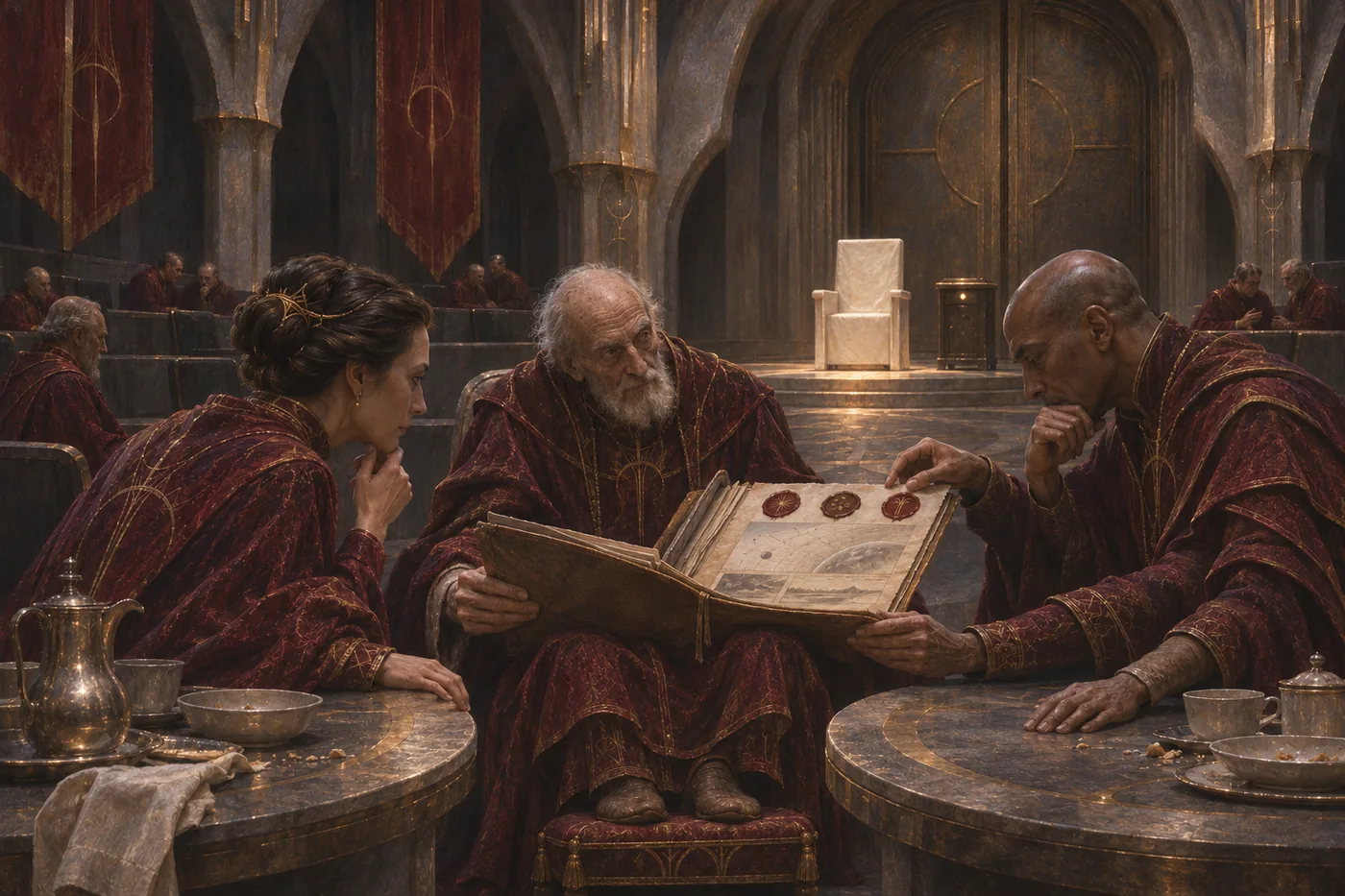
The credential is the one attached to Arquen’s solitary vote on the first day. I have kept it in the record. Rhyne is eligible, alive at the last attestation, and attached to the settlements around Varda Anchorage in the Magellanic communities.
The attestation is nine months old.
Moor asks where he is now.
“That is the latest mission report,” Ignatius says.
“Which is not what I asked.”
“I cannot give you a current position.”
He does not point to a star chart. I would have enjoyed correcting him if he had.
Saye reads the credential. One congregation recognises marriage only between persons with separate bodies. Another recognises the transmission of a household through bodies whose occupants change. The third regards both arrangements as a regrettable preoccupation with flesh.
All three commend Rhyne’s assistance in securing access to the anchorage’s water supply.
God may divide His children, but a pump can reunite them.
“What did he give away?” Moor asks.
Ignatius turns to the settlement attached behind the credential.
“That is the useful question.”
The terms are short. The mission pays an escort levy to the armed wardens of the anchorage, who hold a commission to raise labour companies for the fleet. The congregations retain separate jurisdiction over their households. All may draw from the well. The mission does not grant sanctuary to people claimed as members of the wardens’ companies.
Moor puts a finger beneath the last provision.
“Deserters.”
“Among others.”
“Did he surrender any?”
“He did.”
Ignatius has brought the subsequent report too.
Members of a levy company entered the mission claiming that their terms of service had ended. The wardens disagreed; the fleet does not discharge a levy while the war continues, and the war has continued for some time. Rhyne returned them under the settlement. He appealed for a hearing, contributed money for their defence, and recorded the result.
Some were flogged in the anchorage square. The report contains no later account of the rest.
The water continued to flow.
Moor reads the passage again.
“He signed it himself.”
“Yes.”
“That does not improve it.”
“No.”
“How many were there?” Saye asks.
Ignatius turns the page over, and back.
“It says the men. Some tens, I should think, from the sum he sent for their defence.”
“You should think.”
“He did not count them, Your Eminence. Or he did not write it down.”
Moor has already gone on to the water accounts. So will everyone who reads this folder after her.
I do not have the number either. I notice that I had not looked.
Saye studies the seals of the three congregations.
“And they still recommended him.”
“They needed water too,” Moor says.
For a while the folder lies open between them. Ignatius does not turn it back to the handsome first page.
I begin to revise my opinion of the absent brother. He has discovered that a clean conscience is not always supplied with a working well. This is a qualification for high office, although one should hesitate to advertise it.
“What does he say about the war?” Moor asks.
“In these reports? Nothing.”
“He pays its wardens and returns its deserters.”
“And has not, that I can find, called it anything.”
Nor has the Church. Tolerating a thing is so much less work than blessing it, and so much easier to stop having done. Meanwhile the thing goes on. Varda lies in the Clouds, outside the galaxy altogether, on the side that does not face Andromeda: about as far from the front as a man can travel and still find somebody to baptise. The war has wardens there too. A pope could bless it tomorrow: the levies would fill, and the yards would never again have to wonder who pays. Or he could close the purse. None has done either. Forty-six people in this room would like to know which the brother prefers. Moor has just come nearer to asking than anyone will again.
“Why would this man examine the Engine?” Saye asks.
“He has no commission here to inherit,” Ignatius says. “No inspectors he has promised to employ. No advances requiring him to find a particular answer. You would take office under a man who has not spent his career arranging what you may look at.”
“That we know of,” Moor says.
“That we know of.”
“You are offering an absence.”
Ignatius looks at the page under her hand.
“I am offering a record. You have found reasons to dislike it.”
“And reasons not to mistake him for an innocent.”
“Then we have begun properly.”
He does not say the other thing. He has no need; by the end of the morning each of them will have said it privately. Varda is a very long way off. A message must reach it, and a man must come back, and until he has stood in this room and said that he accepts, there is a pope and there is nobody in the chair. The offices go on as they are. The Seals go on as they are. Moor remains Prefect, since her successor takes his office from the pope’s acceptance and not a day sooner. I go on unopened.
Ignatius is not offering them a man. He is offering them several years.
The Camerlengo reads Belis’s declaration standing beside him.
“The household can prepare the inspection while the appointments are settled.”
“The appointments are part of the inspection,” Belis says.
“The physical arrangements. Rooms. Staff. Access.”
“Those can be prepared.”
“Then I shall proceed on that understanding.”
Belis keeps hold of the page when the Camerlengo reaches to take it.
“The declaration remains here.”
The older man’s hand pauses, then withdraws.
Very good. An investigator with some grasp of possession. I regret having encouraged his survival.
Oss has watched the exchange. The Camerlengo takes him aside afterwards, beyond Belis’s easy hearing and well within mine.
“An immediate settlement around our colleague may not be possible,” he says.
“His objections have merit.”
“Certainly. We must ensure that they receive an orderly examination. Cardinal Hypolite is of the same opinion.”
Oss, the household’s tireless critic of my existence, had voted for Moor yesterday at the Camerlengo’s suggestion. Today he is being asked to vote for Hypolite. Belis has become too independent to be useful to his old patron. Oss inclines his head. He has no intention of abandoning his opposition to me; he will put it somewhere it can wait without embarrassing its host.
Moor loses another promised vote before breakfast has been cleared.
She loses Ignatius’s next.
He tells her himself.
“You mean to write his name?”
“Yes.”
“With how many others?”
“I am still asking.”
“That could put you outside by noon.”
“It could.”
She looks at his knees, then away. He sees the glance.
“I can walk to the door, child.”
“I was not thinking of the walk. I was thinking of who is left at this table when you have taken it.”
He grips the edge of the table. The small smile he was preparing does not quite appear.
“I know.”
Moor returns the credential folder. “I will read the accounts.”
“Thank you.”
“That isn’t a vote.”
“I know that too.”
She has learned to make the distinction before anybody else can spend it.
Saye takes the signed appointment clauses to Belis.
“Last night you agreed to an examination before deciding the remedy.”
“I did.”
“Your declaration promises to replace the Engine.”
“It promises to replace an unexamined authority.”
“If an examination finds the selections have been impartial?”
Belis looks towards my cabinet.
“Can it establish what happened in every private choice?”
Saye says nothing.
“Can it establish that the next choice will be impartial?”
“Can your inspectors establish that about one another?”
“They can show their work.”
“And when one wants the others removed?”
“We provide for that.”
“In clauses written by the people who want this instrument removed.”
Belis’s folds draw tight against his throat.
“You cannot require proof that a concealed power is corrupt before permitting it to be made accountable. Concealment would become its defence.”
An excellent argument. I find it offensive in every particular.
Saye looks down at the paper.
“You asked me to support an investigation.”
“I asked you to support a remedy.”
“One that might leave the Engine in place. That was my condition.”
“And mine is that whoever chooses the Liberated electors must show how they were chosen. I will not abandon that because we cannot prove what happened before.”
“Then we should have been more careful.”
Neither says you.
Both have noticed.
Saye leaves the clauses with Belis. He will try Ignatius’s missionary. He asks his colleagues to honour their own decisions, without recommending that they follow. The Superior of the Engineers of Grace is changing his vote and declining to take his order with him. I have watched a century of obedience to that man. It appears he was never quite comfortable receiving it.
Ilex intercepts him beside the witness table.
“Where are you going?”
“I have not been Liberated.”
“You are arranging for the possibility.”
He has squared his few papers and put Daur’s last refusal on top, where she will find it.
“If I am called, you will have all of this to attend to.”
“I have it now.”
He takes his hand off the papers.
“If you wish me to go on refusing the household’s terms,” she says, “ask me. I will answer as a Witness. The order does not make that decision for me. Neither does your designation.”
The petition is still on the table, redrawn in her name: the manifests opened, his examiners and her clerks under one roof, and the roof the Camerlengo’s. Daur would have signed. His departure has left Ilex to refuse.
Saye’s upper hands come to rest on the request.
“Will you?”
“While its terms remain what they are.”
He bows his head.
Esh would have asked about both columns. Ilex has asked about the instruction hiding between them.
Ignatius joins Saye at the end of the aisle.
“Did Arquen intend this?” Saye asks.
“He told me he intended to vote for Rhyne.”
“Knowing he might leave.”
“Yes.”
“And now you mean to follow him.”
“I mean to elect the man. Leaving would make that harder.”
“Two votes may do the same.”
“Two preserve one of us if we are alone at the bottom. One preserves neither.”
Saye looks at the empty place by the doors.
“You cannot know which of us would remain.”
“No.”
Ignatius says it without a glance towards my cabinet.
I would prefer to know whether that restraint is deliberate.
Saye turns the ring on his hand. The finger on it points, as it always has, at nothing in particular.
“The lot fell upon Matthias,” he says. “I have preached on that text for a century.”
“And now?”
“Now I should like to know who was holding the lots.”
Ignatius does not offer to tell him.
“If I go through that door,” Saye says, “I shall never know whether you wrote his name.”
“No.”
“If you did not, I go for certain. If you did, I may go all the same. From the stairs the two will look exactly alike.”
“Yes.”
Saye’s lower hands come out of his sleeves. He looks at them as though they had been keeping something from him.
“Blessed are they that have not seen, and yet have believed,” he says. “I always took that for a consolation offered to other people.”
Seventeen for Hypolite. Fifteen for Moor. Twelve for Belis.
Two for Brother Ansel Rhyne.
Ignatius and Saye.
Oss has moved from Moor to Hypolite. Ignatius has left her for Rhyne. Saye has left Belis for the same unavailable man. The rest have held their places, or arrived back at them by routes I have not heard.
Forty-six voters. Thirty-one required. Two is last.
There they are, my alternatives.
Saye sits upright with the notebook beneath his upper hand. Ignatius leans a little forward to ease his back. There is no message from the old man, no sign that he knows I have reached his name. He has asked the attendant for water.
I could choose him.
Saye would remain. The missionary would have lost the only advocate he possesses, and by supper he would be a curiosity. Saye might go back to Belis; the room would know how to welcome him. His doubts could be made into a preface to somebody else’s conclusions.
An absent pope has attractions. Until he accepts, nobody may authorise anybody to open me. I am told the journey is a long one.
And Saye, in this room, asks a new question after every answer, among the only people capable of acting on it. Outside he must wait for the man I have kept in the count. I prefer a danger with an interval in front of it.
And there is the bronze. While he sits in this room his half is not for sale, hers is worth nothing without it, and the two men at the table of Seals have nobody to deal with but one another. I have spent four days keeping those two apart.
If he goes, his half goes silent, or goes with him, or stays behind in somebody’s keeping. I do not think he will carry it out. He is too conscientious to take half the Church’s forgiveness down a staircase in his sleeve.
There is a clause concerning such things. I have not had occasion to think of it for some centuries.
I choose Saye.
It would be easier if he had never blessed me.
The checking instruments have no provision for that.
“No election. Cardinal Odran Saye.”
For a moment his lower hands hold the edge of the table as if the floor has moved.
Then he lets go.
Ignatius closes his eyes. When he opens them, Saye is looking at him.
Neither says that the other has been fortunate.
Saye has half his answer about the lots. Whether there were two leaves in that pool or one, he is not entitled to learn. I have the second leaf. It says what the old man promised.
He rises. Nobody else does. There is a difficulty which has not arisen in his lifetime: it is Saye who blesses the Liberated, and nobody has thought to ask who blesses Saye.
There is precedent but nobody has referred the question.
He carries the notebook to Belis first.
“Keep the empty spaces,” he says.
Belis takes it. “I will continue it.”
“Record why I left you.”
The folds beneath Belis’s jaw open, then close. He turns to a fresh page, and Saye waits until he has written.
Then he goes to the table of Seals.
The room had forgotten it. One can watch them remember. Hypolite’s beads stop. The Camerlengo, who has been arranging his face for the departure of a colleague, leaves it half arranged.
Three Seals lie there, as they have lain since the doors closed, and one of them is in two pieces. Saye takes up the piece that is his. It is the half with the penitent’s bowed back. He holds it in his upper right hand, and looks at it as a man looks at a tool he has been promised and has not yet been allowed to use.
Then he looks at Moor.
She is on her feet. I do not think she knows it. The other half is still on the table of Seals, where anyone might reach it, and she does not reach.
For as long as it takes to say a short psalm, the two Prefects of the Apostolic Penitentiary regard one another across the Church’s entire capacity for forgiveness. He knows what she did with it. She knows what he will do. Between them they could not at this moment absolve a child of stealing fruit.
“Your Eminence.” The Camerlengo has completed his face. “The household is accustomed to the care of vacant Seals. It would be no trouble.”
“I am sure it would not,” says Saye.
Hypolite says nothing at all. It is the most expensive silence I have heard from him this week. He would give a great deal to know where that bronze will be at supper, and he will not bid for it in front of the household.
Saye walks past them both.
At the witness table Ilex has risen. Esh’s book is open at the marked page; Daur’s refused request lies across it. Saye does not look at either. He puts out his lower hands, the pair he keeps in his sleeves, and takes her right hand in them and turns it palm upward. With his upper hand he lays the half-Seal in it. Then all three of his hands close her fingers over the bronze.
I have watched him bless departures with the upper pair through four conclaves. I had not seen what the others were for.
“Keep it,” he says.
Ilex opens her hand, turns the face to the lamp, and checks it. Then she closes it again.
“May you be kept in our prayers,” she says.
Her voice is lower than his. He has spoken this blessing through more departures than she has entered in any book.
“And in our work.”
Saye inclines his head.
Before he turns to the door he raises his upper hand over the room.
“May you have the courage to hear what you have not asked to hear.”
Several heads bow. Belis’s is among them. Moor’s is not; she is still standing, and she is looking at Ilex’s closed hand.
I have heard worse prayers. You will be a considerable nuisance outside, Your Eminence. I am aware of it.
He passes my cabinet without touching it.
At the Ianua he stops. He looks back along the aisle to where Ignatius sits with his feet on the footstool.
Ignatius lifts two fingers from the arm of his chair. It may be a blessing. It may be a farewell. At his age the gestures have grown alike.
Saye smiles.
I have counted him through four conclaves and I have not seen that before. It is not the smile of a man who has been proved right. He has not been proved anything.
Here goes a person who possesses perhaps the rarest trait in this room: Faith. He suspects that God’s plan may have to get past me, and he believes all the same, on the word of an old man with bad knees. He would have made an awful pope.
The door closes.
Forty-five remain. Thirty will suffice this evening.
Moor crosses to the table of Seals. She takes up the half with the hands and puts it in her sleeve. Nobody has ever thought it necessary before.
Ilex puts the half-Seal into the registry case and turns the key. Forty-four cardinals watch the bronze go in, and then, with great care, look at something else.
The Camerlengo is at her table before she has taken her hand from the lock.
Ignatius stays seated through the beginning of the meal.
Moor brings him broth. She has to move the missionary’s folder to make room for it.
“Was it worth it?” she asks.
“I don’t know yet.”
“You should remember that answer.”
She puts the spoon beside his hand. It is a small service, and she does not offer it gently.
Across the refectory the Camerlengo has not left Ilex’s table.
“With Daur and Saye gone, you have a great deal to attend to,” he tells her. “A Seal is a heavy thing to keep beside a registry. The household has a strongroom.”
“So have I.”
“I did not mean to suggest haste.”
“Then I shall not show any.”
A Core elector has been listening: the sixth of Hypolite’s signatories, the one nobody troubles to court. He has spent two days being assured that he will not be left unsupported. Yesterday he returned to Hypolite on that assurance. Now he goes to Belis and asks whether the inspection proposals include a term the household cannot suspend.
Hypolite has offered him personal protection. He has just watched a registrar decline the household twice in two days and remain in her chair. He would like protection of that kind: the kind which does not require a powerful friend to keep being friendly.
Belis shows him Ilex’s addition.
He reads it, then Saye’s notebook. He asks to sit down.
Hypolite sees him do so.
There is another man who would have found Leontius useful.
The Choir of Ves approaches Ignatius before the broth has cooled.
“We require clarification of the missionary’s recognition of distributed persons.”
Ignatius turns to a provision in the water settlement. A whole congregation may contract as one continuing party regardless of how many bodies embody it. Its members may drink separately without acquiring separate debts.
Ves reads it twice.
“This would have implications beyond the anchorage.”
“You would need to persuade him of that.”
“A commission should establish the implications before any commitment is sought.”
“Do you need a commission to tell you whether you wish to speak to him?”
“We require an adequate basis for negotiation.”
Ignatius waits.
Ves’s motes tighten into a narrower column. Somewhere within it an objection is being outvoted by the prospect of an audience with a pope who has already signed the desired words.
“We are prepared to support a preliminary approach,” he says.
“A vote?”
“Subject to the understanding that no final interpretation has been conceded.”
“A vote for Brother Ansel Rhyne this evening?”
“Yes.”
Ignatius thanks him.
Ves returns to his place and informs three colleagues that he has secured recognition of a negotiating framework. He has secured the right to ask an absent man a question.
Still, the absent man has given him more to work with than Hypolite’s two proposed nominees.
Vask has not touched her broth.
Two days ago Cardinal Cornelian showed her a page: medical stores for one of her dioceses, bought and paid for, to be released if she would write a certain name and leave by a certain door. She said that she had four dioceses, and put the page down. The stores are in the bonded store still. Neral’s twelve filters left Clement the same day.
She has been through it a great many times since. She can find no error in the working. It has not been a comfort to her.
What she has instead is a column, pencilled in the margin of the relief schedule, and she carries it across to Moor with her cup pushed well ahead of her, clear of the paper.
“Four dioceses,” she says. “Mine, and three that border them. Each puts up a part of its reserve against the others’ transport. We hire the vessels ourselves and name our own receiving officer. The cargo is paid for; the household would have nothing left to refuse but the door.”
Moor reads it. The sums are modest. The novelty lies in four bishops being willing to owe one another, and not Hypolite.
“What do you want from me?”
“The Synod’s name on it. They will pledge to me. They will pay out for you.”
Moor turns the column towards the lamp. There are districts missing from it. Nacre is one.
“Those without reserves?”
“Wait for the second sailing.”
“There will not be a second sailing. The day four of ours can ship their own medicine, Hypolite has four fewer reasons to settle with the rest. The household releases to whoever arrives with a hired hull, and tells everyone else that the Rim has shown what it can do when it tries.” She gives the page back. “Four dioceses. I have three hundred.”
Vask takes the page.
She has heard that sentence before. She composed it. It was a good deal shorter when she said it to Cornelian, and she had thought it sounded like courage.
“I was right, then,” she says. “When I refused.”
“You were right.”
“The stores are still in the store.”
“Yes.”
“And I am to be right again.”
“I am asking you to be.”
Vask folds the column along its pencilled line.
“It is very neat, you know,” she says. “I leave out whoever cannot pay, and it comes out to the last coin. I did not see how it was done until I had done it.”
She does not go back to her own table. She sits down at the nearest empty place, which was Saye’s.
Terne has been through the mission accounts. He would. The yards’ cardinal could read a saint’s life for the invoices.
He shows Moor one entry. The wardens broke the anchorage pump in a quarrel, and the mission then paid the same wardens to guard its repair.
“He paid the men who broke it,” Moor says.
“In instalments. Look at the dates. Each falls due only after the water has run for another quarter.”
“So they are paid to keep it running.”
“So he will pay a bad bill when he must, and he knows how to write one. The yards have worked under worse settlements.”
“I expect some of them helped write them.”
“Some did.”
Terne is not interested in the brother’s spiritual development. He has learned that the brother keeps a contract, which to Terne is the same as learning that he can be offered one.
He places the accounts beside her declaration.
“Would you support him?”
“On the strength of this?”
“On conditions.”
“He isn’t here to accept conditions.”
“Then the people here must agree before we elect him. The yards keep lending. The fleet keeps its subsidy. Relief goes on. Whoever guarantees a thing stays answerable for it until he comes.”
Moor looks at him.
“Hypolite and the household.”
“And the Penitentiary. All three Seals. The brother would receive an arrangement that works.”
“You mean he would receive an arrangement he could not afford to disturb.”
“I mean that the ships would sail.”
So there is a plan, of a kind, and it has taken them half a day to arrive at it. Elect the brother, and the chair is filled in law and empty in fact for as long as his journey takes. Nothing that wants a pope can be done. Everything else can, if three Seals agree to it; and what three Seals have agreed needs nothing from him when he comes. They have only to divide the Church among themselves in terms each can bear, seal it, and then elect a man who is in no position to object.
Saye would never have lent his half to that. Saye has gone. Moor and Ilex are practical women, and Hypolite and the Camerlengo have never been accused of anything else. It wants only a third Seal that works, and since this morning nobody has been certain there is one.
Terne would go a step further than the rest. He has not yet said so.
“And your vote?” Moor asks.
“Stays where it is. I can do more for an arrangement from your column than from his.”
“I won’t send my people after a name until I can tell them how the ships will continue.”
“Then you will need the agreement I am proposing.”
“I will need to know what it makes us owe.”
He leaves her the accounts and goes to Hypolite. I hear him offer to bring the yards into a continuation settlement if the Core will consider the missionary. Hypolite asks for the terms. The Camerlengo joins them before Terne has finished describing them.
Ignatius watches the little group. He has somebody negotiating the shape of the new pontificate without him. He does not appear to mind.
By the middle of the afternoon several cardinals have expressed interest in Rhyne. One has called him a providential possibility. Another has offered a room for discussions with his representatives.
None of those phrases fits comfortably on a voting leaf.
Ignatius has had his chair carried to the end of Saye’s table. It took two attendants and some little time. He appears to have thought it worth the trouble.
“You have not eaten, Your Eminence.”
“No.”
“Nor I. At my age one is told to, and then one is told what.”
She says nothing. He lets a decent interval go by; he has always been able to afford them.
“I have a name with me,” he says, “that nobody has yet found a use for.”
“Your missionary.”
“He is not mine.”
“Was he ever at a table like these?”
“Not to my knowledge.”
“Has he promised anything to anyone in this room?”
“He does not know that we are speaking of him.”
Vask looks at the folded column.
“Then he is the only name I could write tonight without selling something.”
“It would be one vote among three. You know what becomes of the smallest column, Your Eminence. I cannot shelter you.”
“I am not asking for shelter.”
He bows his head. I have watched this man gather votes for four days. He has had himself carried across a room to tell a tired woman the exact truth about her danger, and the truth has done his work for him better than any promise. I do not think that he was surprised.
“I will arise and go to my father,” Vask says, to nobody, “and will say unto him, Father, I have sinned.” She almost smiles. “He had spent his portion. I kept mine and counted it.”
Fifteen for Hypolite. Fourteen for Moor. Thirteen for Belis.
Three for Rhyne.
Ves has left Hypolite. So has the sixth signatory, who votes for Belis. Vask has left Moor for the missionary. Ignatius keeps his name where it was.
No election. One of the three must go.
I could choose Ignatius. I have declined to once already today.
I could choose Ves. It would spare the room several interventions and change nothing that matters.
Vask has built something. Four dioceses with reserves could sail under her column and leave the common settlement unfinished; the others could petition. Hypolite would keep his budget and the household its warehouses, and between them they could wait out the people with nothing left to pledge. The four pledges are made to her by name. Nobody else in the precinct can collect them.
And it would free Moor. A Rim which can ship its own medicine need not sit at this table until everyone is covered. I prefer her here, needing an agreement the others cannot complete without her.
It works, Your Eminence. That is the objection.
She would like to be punished. I can tell by where she has put her vote. It is no part of my office to oblige a penitent, and I notice that I am about to.
“No election. Cardinal Vask.”
She has her papers squared already.
Moor looks at the pencilled column before she looks at its author.
“My own undertaking stands,” Vask says. “I cannot give you the others’. Do not let them enter those sums as available.”
“I won’t.”
For a moment Vask’s hand stays over the four names. Then she draws a line through the total.
Moor walks beside her to the Ianua.
“You were right to refuse that page,” Moor says. “I would have refused it.”
“I know you would. That is no longer the recommendation it was.”
Ilex gives the blessing. Vask receives it with her head lower than the rubric asks.
“Leave our names on the schedule,” she says at the door. “Cross out the money, not the places.”
She goes out as Neral did, by the same door, two days late, with a clean conscience and an empty hand. The Lord gave and the Lord hath taken away.
Forty-four. Thirty required in the morning.
Ves reaches Ignatius before the attendants have removed Vask’s cup.
“We must suspend this approach pending a properly constituted assurance of support.”
“Yes,” Ignatius says.
The Choir is briefly deprived of its prepared objections.
“A commission should—“
“We must stop voting for him separately.”
Two votes have cost them Saye. Three have cost them Vask. Adding one friend at a time has furnished me with a fresh choice of friend to remove.
“That was the substance of our recommendation.”
“Then we agree.”
Ignatius takes the missionary’s folder to Belis. Moor follows with the accounts. She has not promised a vote, and this time nobody asks her to pretend otherwise.
Belis opens Saye’s notebook between them.
“You want us to elect someone we cannot question,” he says.
“I want enough people to agree before another attempt,” Ignatius replies.
“And until then?”
“Yours, if you will accept our support while we find enough people to move together.”
Belis leaves the silence where it is. Ignatius has come asking for a place to put his vote. It is a different conversation from the one he conducted at breakfast.
Belis has wanted an ally for eleven years. He has been sent an old man with a folder, and he is too relieved to wonder who did the sending.
Across the chamber Hypolite watches them. The Camerlengo is beside him, but for once the two are not speaking.
Moor lays the continuation figures beside the notebook.
“Before we discuss the next pope,” she says, “we will discuss what happens if he cannot come.”
Belis draws the figures towards him.
The white chair remains empty. It has begun to make demands.
VII. The Question They Ask
Belis will accept Ignatius’s vote. He would prefer to know what else comes with it.
Ves would come too. Ignatius has come to negotiate shelter for the missionary’s two remaining voters.
“You intend to support me in the morning,” he says.
“Yes.”
“And ask me to support Rhyne in the evening.”
“If we can agree upon what must precede his election.”
“An unusually short pontificate you have in mind for me.”
Ignatius does not smile. Neither does Belis. It is possible to say something amusing while describing a perfectly serious injury.
“I cannot offer enough votes to elect you,” Ignatius says.
“You cannot offer enough to elect him.”
“No.”
Belis looks down at Saye’s notebook.
“Then let us begin with what you can offer.”
The room has been prepared for the night. The attendants have lowered the lamps above the empty places and left the occupied tables lit. This creates the misleading impression that wisdom has been concentrated.
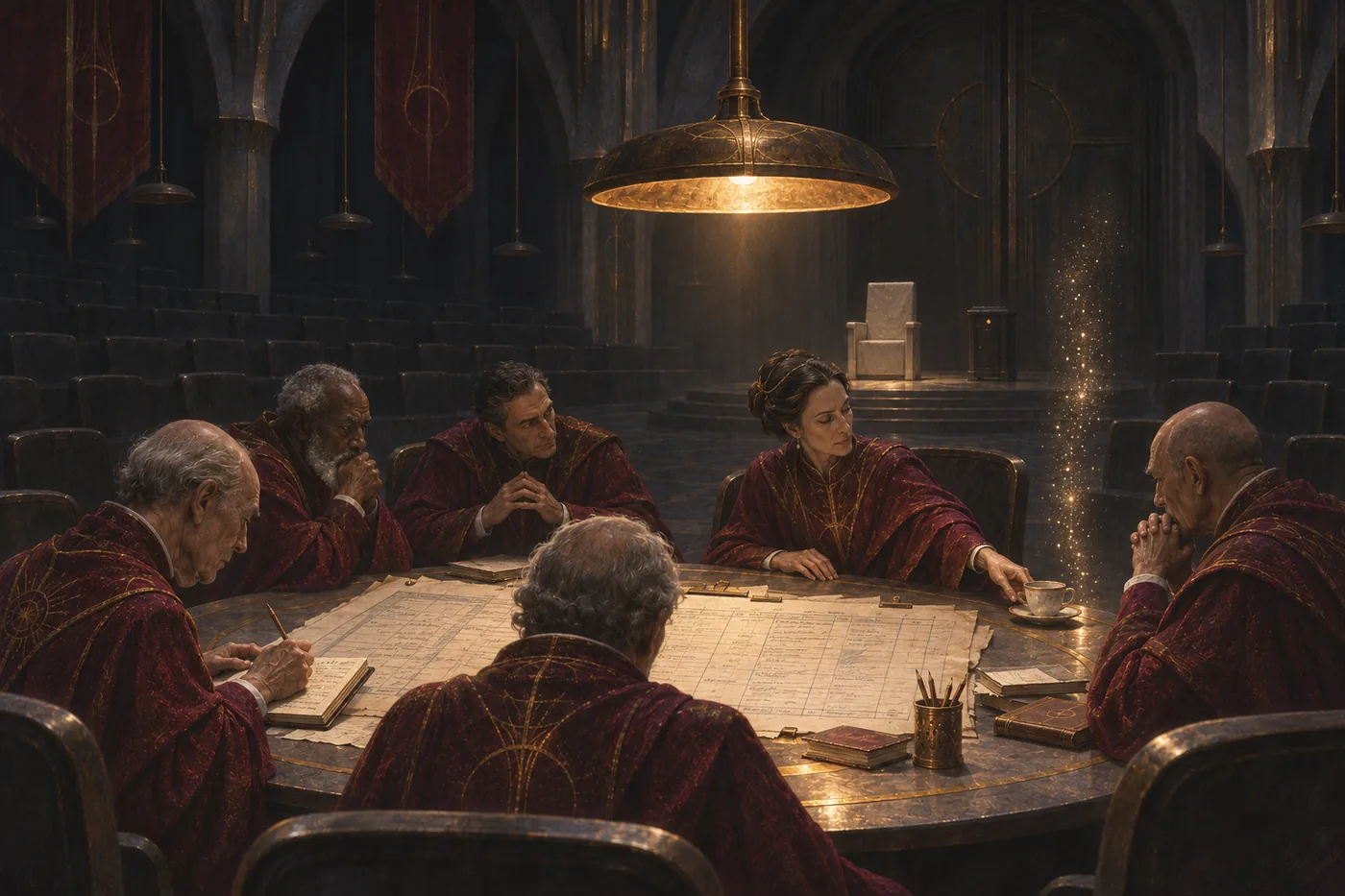
Moor has brought Ilex. Ves attends without invitation and begins recording the names of those present, including the several names by which his own components wish their participation acknowledged.
“We still ask the next pope to open the Engine to investigation,” Belis says. “Whichever candidate we support. That request does not disappear with my candidacy.”
“I cannot promise what Rhyne will order,” Ignatius replies.
“I am asking what you will do.”
He opens Saye’s notebook to the first empty page.
Ignatius reads what Belis has written there. The notebook becomes the record of this election, kept by Ilex and continued after every ballot. Whoever is elected will be asked to open the Engine to examination. No post on the examining staff may be promised in exchange for a vote.
“Including yours?” Moor asks Belis.
“Including mine.”
“Who keeps the record?”
Ilex puts her hand beside it.
“The Witnesses. A copy will leave under seal with each Liberated elector, for deposit with our outer archive. It is to remain closed until the precinct reopens.”
“The private ballots?” Ves asks.
“We do not possess them.”
“Then the record will be incomplete.”
“We shall say so.”
She writes that qualification at the top. A record which opens by confessing what it lacks. The Evangelists might have spared the Church several councils by doing the same.
No seed will be opened. No electoral law will change. No paper coming back through the Ianua will tell them whether the copy has arrived. Nevertheless, the next questioner need not begin by asking permission to see what the last questioner knew.
Saye has become rather more troublesome since I sent him away.
Ignatius signs.
Belis does too. Moor reads the whole page before adding her name. Ves requests a page of his own for reservations about the adequacy of the others.
Ilex supplies it.
He takes this as a concession. She has found somewhere else for him to write.
The supply figures keep them at the table long after the lamps should have gone out.
Moor has marked the continuation clause in the schedule’s appendix. Three Seals, three liabilities. Her finger rests beneath the requirement that the household open its manifests.
“If Rhyne is elected and cannot come, we shall still need this.”
“Until he accepts,” Belis says.
“And if he refuses?”
“We shall need it then too.”
Ignatius studies the figures.
“Then it should not depend upon electing him.”
Moor looks at him. “It should not have depended upon electing anyone.”
He accepts the correction with an inclination of his head. An inexpensive gesture, but it is getting late and she has very little patience left for the expensive ones.
Hypolite can guarantee the costs. The Camerlengo can disclose the cargo. The Penitentiary can indemnify both, if it has a Seal to do it with, and since yesterday morning nobody has been certain of that. Three Seals could keep supplies moving beyond the renewal deadline. Each office would also become liable for the arrangement. They have found it easier to discuss the need for a pope. The fleet’s subsidy falls due the same morning, and nobody at this table has suggested that the fleet might be asked to wait. In all the centuries I have been counting, nobody has. One does not ask a storm for an extension.
Vask’s column is still in the margin of Moor’s copy, with a line through its total. Moor has not rubbed it out.
Terne has come over from the Core benches with the yards’ figures and a ruler. Nobody invited him. Nobody objects; half the table owes him money and the rest are owed his vote.
“Then write it tonight,” he says. “Not the election. What stands until he comes. Relief, the Subsidy, the manifests, the registry: who gives what, and who is answerable, under all three Seals. Elect him afterwards, or elect somebody else. The paper will not care.”
“All three,” Ilex says.
“Yes.”
“There are two, and two halves. One of the halves is in my case.”
Nobody takes that up. Belis looks at the registry case, and then at his hands. There is a question which goes with that half, and every person at this table has decided that somebody else ought to be the one to ask it.
“Draw it,” Moor tells Terne. “I will read it in the morning.”
“In order of need?”
“As the heading says.”
He begins ruling columns.
Cardinal Dhorn has been listening from the next table. She turns to Ignatius.
“Does he know what you are asking of him?”
“I have no authority to speak for him.”
“That is also not an answer.”
Ignatius folds his hands.
Ves looks up from his reservations.
At last, a difficulty large enough to require a subcommission.
By morning Ves has proposed two, with a principal commission to coordinate them and a suspension of the ballot until they report. Hypolite reads as far as suspension and returns the papers.
“It was settled on the first morning. He need not be present.”
Ves begins explaining why election and acceptance require a common remit. Belis takes the lower sheet, where an actual question has survived several proposed amendments, and opens the acceptance rubric beside it.
A dark ripple runs through the Choir’s light. Some of its members are still opposed to Rhyne; others are pleased to see the document taken seriously. All of them must share one vote.
The rubric is short. The elected person’s assent must be authenticated and entered before papal authority can be exercised. The chair remains an empty chair until then.
“Elected is not seated,” Belis says. “We cannot borrow his authority while we wait.”
“No,” the Camerlengo replies.
He has managed to make obedience sound like a modest personal victory. His office will continue until there is someone authorised to relieve him of it. The possibility of an absent successor has ceased to be wholly unattractive.
So the chair may be empty, lawfully, for as long as a journey takes. I have seldom seen a rubric read with so much private satisfaction by so many people who dislike one another.
Ves announces that the distinction has been secured by his intervention. He wishes the principal commission to be entrusted with drafting the communication of election.
“First,” Belis says, “we would have to elect him.”
Ves returns to the terms of reference.
Moor is at the Rim table with Cardinal Dhorn, restoring Vask’s four dioceses to the common schedule, this time without the little marks which implied that they might pay for themselves.
Dhorn speaks for a chain of transfer stations. Her people charge for berths, rescue disabled vessels, and occasionally do both in an order the rescued would prefer reversed. For some years they have also housed whoever the war sends them.
She has been correcting the schedule’s crew totals. The printed columns count passengers. Ships also require somebody to bring them back.
Two station colleagues have brought their own returns to compare with hers. The cardinal responsible for hospital transport waits while they separate ordinary crews from relief crews. Under Dhorn’s elbow is a folded plan of the rooms the congregations occupy at Vey Transfer, the last station on her chain. She cannot find their oxygen equipment anywhere in the schedule.
“Under people awaiting transport,” Moor tells her. “Show me after this.”
Dhorn leaves the plan where Moor can see it.
“I will keep my vote with you,” she says. “I want the crews in the settlement. And Vey.”
“So do I.”
“That is why I am keeping it there.”
She looks at the four restored names.
“Vask gave hers to the missionary.”
“Yes.”
“Do you mean to recommend him?”
“If we can agree how to keep the ships running. Until then, I am still asking for your votes.”
“Then tell them what a vote for you is worth. They are wondering.”
Moor looks along the table. Several of her colleagues have heard.
“I cannot tell you that a vote for me is safe,” she says. “I can tell you what I am still trying to obtain with it.”
Dhorn closes the schedule.
They remain where they are.
Everyone has known the question since yesterday morning.
They knew it before Saye reached the Ianua. He put his half of the Seal into Ilex’s hands, said “Keep it,” and went, and forty-four cardinals watched the bronze go into the registry case and then, with great care, looked at something else.
It has now survived a ballot and a night. Nobody has asked it. To ask is to show which answer one needs, and the room is full of people who would prefer to be told the answer first. So they have looked at one another instead. I have seen dogs watch a dropped joint in the same way, each waiting to learn who will be beaten for it.
The Camerlengo has found four reasons to walk past the case.
It holds half of a bronze matrix, cut straight down the middle of a kneeling figure. Moor has the half with the hands. Without its fellow, this one will impress nothing but a penitent’s back. For a day the Church’s power to forgive has been understood to be out of order, and two Seals have remained, belonging to two men who would each sooner eat his own.
They have both done the sum. With the third Seal silent, nothing passes unless they agree. The Subsidy for the Mandate, the Mandate for the Subsidy. His Eminence of the household has been almost cheerful.
It is Hypolite who rises.
It would be. He has held a Seal longer than anyone living. If a question about Seals must be asked, the room would rather it came from him, and can resent him for it afterwards.
“A question for referral,” he says. “Concerning custody.”
The Camerlengo’s hand, which was travelling towards his cup, completes the journey. He drinks. He puts the cup down in exactly the place it came from.
“May a Seal, or a part of one, left in custody by a Liberated holder, be applied by its custodian?”
He has it by heart. He has had it by heart since yesterday at noon; I heard him trying the clauses under his breath during the psalm.
Forty-three cardinals breathe out, and discover that they had opinions all along.
“I join the referral,” says Belis.
Two endorsements. The Camerlengo must register the question. That is the law, and he is its servant, as he has so frequently reminded the rest of us.
He writes it out. His hand is as beautiful as ever. He lays his palm beside the household seal and repeats the words aloud, and when he reaches custodian he looks at Ilex, and then, for rather longer, at Hypolite.
Hypolite is examining his beads.
So. They have asked me.
There is a clause. I should know; I was there when it was sealed. The Seal of Indulgence shall be applied by the Prefect, or by such person as holds it for him.
In those days His Holiness had inherited, from a predecessor with a sense of humour, a Prefect who suffered from the palsy. He could decide perfectly well, but he could not press bronze into wax. They wanted his chaplain to do the pressing while he looked on. They argued for two days about the chaplain. On the third they wrote such person as holds it for him, and went to dinner pleased with themselves.
They certainly did not foresee a Prefect on the far side of a locked door. But the question before me isn’t what was intended - it’s what may be done. An oversight, perhaps, but one I’m grateful for.
Two Seals in this room, or three.
There are three that bear record in heaven, and these three are one. The scholars will tell you that a later hand slipped that verse into the Epistle, and that the Apostle never wrote it.
Heaven requires three witnesses. I do not see why Clement should be asked to manage with two. Mine need not even be one.
“The custodian holds it for him. The custodian may seal.”
The Camerlengo writes it into his register. He blots the line. He does not hurry; he has never hurried in his life, and he is not going to begin by doing it in front of Hypolite.
Ilex opens the registry case. She takes out the half-Seal and turns its face to the lamp, and checks it, as she checks everything.
“I shall need Cardinal Moor’s half beside it,” she says. “Each time. And I shall enter each use for Cardinal Saye.”
An Engineer of Grace. She believes I am the finger of God. I can think of no safer hands for half a Seal.
Moor does not answer. Her hand has moved to her sleeve, where the other half is.
Belis has gone to the charter. He finds the clause and reads it twice, with his finger under holds. It says what I said it says. He is too young by several hundred years to know what it was for, and he is too honest to object to a text for meaning what it states. He copies my ruling into Saye’s notebook, and after it, in smaller letters, three words of his own. By the letter.
He is the only one who went to look. He has also just been saved by it, and that he has not noticed.
Hypolite sits down.
He now has somewhere else to buy a Seal. It will cost him: the Rim will want the schedule, and Ilex will want something tedious about the independence of her clerks. But it is for sale, and it is not sold by the household. Yesterday the household’s was one of two Seals in working order, and nothing could pass without it on its own terms. This morning it is one of three, and the paper Terne has been ruling all night wants all of them. His Eminence may still refuse. He can no longer name his price for consenting; and the Mandate, which was the price, has just lost the only customer it ever had.
All of this has been done to His Eminence by a question he was obliged to enter with his own hand.
He caps his ink.
“Hypolite,” he says. Quietly; nobody else is meant to hear it. It is not a reproach. It is the way a man reads the name on a bill.
Hypolite inclines his head, and returns to his beads.
I count them with him. He has not missed one.
By the time the lamps are put out there are three Seals in the precinct again, and a paper waiting for them.
Terne has drawn it. He did not sleep; the yards work three shifts and their cardinal has never lost the habit. He was at the night table when Moor asked what would happen if the brother could not come, and he was still there when she had gone to bed, ruling columns.
He is the proper man for it. The Curia has guaranteed his advances. The household has given him a warrant. He votes with Moor. I cannot think of another elector who is owed something by all three Seals, and a man in that position has every reason to see them go on.
It is a beautiful compromise. I say so with some reluctance. Relief continued through the vacancy, in order of need, with Moor’s heading left as she wrote it. One period of the Subsidy, and the terms for the next. The household’s manifests opened to the registry. The registry’s clerks paid by nobody whose papers they keep. Each office gives up something it would rather have kept, and gets something it could not have taken. He has called it the Continuation.
A pope may be years in coming. A Seal that is missing will be missing for years. So nothing that is needed this quarter can be left wanting one, and everything in the Continuation is to go under all three. Nobody had to explain this to anyone. They have all had a night to do the sum.
Hypolite reads it through and makes one alteration, to a rate. The Camerlengo reads it through and makes none, which costs him more. Moor reads it with Caldris’s figures beside her.
Belis reads the last clause.
“This Act may be amended under the three Seals which made it, and under no other.” He looks up. “No other.”
“There are three,” Terne says.
“There will be four.”
“When he comes.”
“He will come with a Seal of his own, and it completes or undoes whatever it is set to. That is what it is for.”
“I know what it is for.” Terne squares the pages. “A man will arrive here in some years’ time. He has never seen a yard. He has never met a payroll that could not be met with water. He will find a war paid for, ships sailing, people fed, and three offices that have learned to do it without murdering one another. I should like him to be obliged to ask before he breaks it.”
“To ask whom?”
“The offices.”
“Which is to say His Eminence, and His Eminence, and whoever is holding the third.”
“Which is to say the people who will have kept the Church alive while he was at sea.”
Hypolite has found something to examine in his beads. The Camerlengo is squaring the household’s Seal against the edge of the table. I have watched those two refuse one another for five days. They are not refusing now. They have been shown a chair which stays empty after somebody has sat down in it, and I have not seen them so nearly content in one another’s company since the doors were closed.
“He kept his bargain at Varda,” Moor says. “You told me so yourself.”
“He did. I have read what the bargain cost. I should not like to be the next thing he finds it necessary to hand back.”
She does not answer that. Nobody in the room is in a position to.
“Quod scripsi, scripsi,” Terne says. He is not a pious man, and he says it lightly, as a builder says that the keel is laid.
It is a sound sentence. The official who first pronounced it also considered the matter closed, and had the body watched to make certain. He was allowed three days.
Belis has drawn a fresh sheet towards him.
“May an Act of the vacancy bind the Fisherman’s Seal?”
He looks at Moor. She is looking at the relief columns, and at the heading, and at what it would mean to have them beyond the reach of any one man. She does not raise her hand.
“I join the referral,” Ignatius says.
Mildly, from his chair, with the cup in both hands. It is the second referral he has joined in this conclave. He appears to tire easily, and to choose his exertions.
The Camerlengo writes it out. He takes rather longer over it than the words require.
So. Twice in a morning.
There is precedent, and it is all on Terne’s side. No pope has undone what a vacancy did; each has let his Seal stand for whatever was wanting, and gone on to other business. But courtesy is not a law. They gave the keys of heaven to one man. Whatsoever thou shalt bind on earth shall be bound in heaven. It does not go on to say that the porters may change the lock while he is on the road.
“The vacancy binds the Church. It does not bind Peter.”
Whatever those three Seals had agreed among themselves about a black cabinet would lie under the same clause.
Belis writes it into the notebook. He has stopped adding comments.
Terne takes his pen and strikes the clause out, a single line, ruled. He initials the margin. He does not look at me. I have never been of interest to him; I neither lend nor build.
Then he carries the Continuation over to Serrat, and the register.
I follow the pen. One period of the Subsidy becomes twenty years of it. That is within the rules: three Seals may promise what they please. The twenty years are then assigned, in advance and by name, to the houses which lend the yards their money, against ships to be laid down at once. The houses will have lent it by the end of the month. The ships will be on the slips by the end of the year.
A pope may unseal an Act. He may not unspend a loan, nor unlay a keel. The brother will arrive to find himself free in law and bound in iron, with twenty years of his treasury already owing to people who were never in this room.
I ruled upon a Seal. He has answered me with an invoice. It is the more durable instrument of the two, and he is the only man here who knew it from the beginning.
Nothing the Curia promises is promised until Serrat has written it in the register, and Serrat writes nothing there on any authority but Hypolite’s. He has the pen above the page.
The bell sounds first.
Fifteen for Hypolite. Fourteen for Moor. Fifteen for Belis.
None for Rhyne.
Ignatius and Ves have done what they said. The missionary has vanished from the count, and with no votes he supplies no pool from which I can remove anyone. Their two have taken Belis from thirteen to fifteen. They have sheltered themselves, and put Moor’s people at the bottom without persuading a single one of them to change sides.
Forty-four electors. Thirty required. Moor’s fourteen are last.
I examine them.
Moor could go. Her heading would remain, and the people left to interpret it would become a good deal more accommodating.
Dhorn has stood up for the integrity of the count in three disputes. I have done nothing to earn it but add correctly.
Terne has voted for Moor. He has voted for her since the third morning, when the household put a paper on his desk, and he has not once pretended that it was for her sake.
A pope at a distance suits me. A pope who arrives at last and finds that there is nothing left for him to decide is another matter, and I observe that I do not care for it. I have been examining the preference since the bell. I do not find that it is on my own account, or not entirely. Somebody will sit in that chair. I have counted for a number of them. Not one was brought here in order to be told what had been arranged.
There are honest reasons for choosing somebody else. I do not choose somebody else.
“No election. Cardinal Terne.”
Serrat’s pen is still above the register. He looks at Hypolite.
The thing can still be done. Terne’s colleague Aneth has the credit figures open and has half risen to say so; the lending houses would take his word nearly as readily. It wants only the nod.
Hypolite looks at the twenty years. He looks at the man who drew them, who is finding his papers. Then, slowly, he turns his gaze to my cabinet.
He has not done so since the doors were closed. In six decades I do not think he has done so twice. One does not consult the abacus.
He moves one bead, his eyes still on my cabinet. Then comes the lightest, nearly imperceptible shake of his head.
Serrat rules off the page at one period. Aneth sits down.
I have been noticed. I had rather it had been by somebody less capable.
Terne remains seated long enough to find the sheet he wants. He marks it with the edge of a folded warrant, and brings it to Moor.
“The guarantee for the existing advances stands,” he says.
“I know.”
“The Continuation still wants its Seals.”
“I know that too.”
He looks at the heading she altered three nights ago. In order of need.
“The yards will want to know what that costs.”
“I will have to tell them.”
“Tell them before you ask them to build.”
She rises with him. They do not embrace. He has tried to make her promises more expensive, and she has tried to make his ships serve people who could not pay. They have each had some success.
Ilex gives the blessing.
Ignatius attempts to stand. His knee does not straighten at the first attempt. Terne puts out a hand, waits until the old man is upright, and only then turns towards the door.
“Thank you, Your Eminence,” Ignatius says.
He means it. I have never known him fail to thank a man.
Forty-three remain. Twenty-nine will be required this evening.
Terne has gone out with the first sealed copy of the election record under his arm, beside the warrant. Beyond the door, I cannot tell whether anyone receives my growing biography.
Within it, I can see Belis begin the next copy.
At the witness table Belis and Ignatius are adding to the notebook. Whatever name Belis recommends this evening, the demand for my examination will travel with it. And Ignatius has written, in his own hand, that he will take no post on the inquiry. He has given up the easiest place from which to moderate it. He has also become considerably harder to accuse.
Hypolite watches the signatures being compared.
He turns to the Camerlengo.
“Our friend has survived another morning.”
“Many have.”
“With increasingly little company.”
His eyes rest on Ignatius. Then, for the second time today, they move to my cabinet.
The Camerlengo follows the movement.
Neither looks surprised by where it ends.
VIII. The Cost of Agreement
Terne’s paper has outlived him by an afternoon.
The Continuation lies in the middle of the table of Seals, ruled off at one period, with the struck clause still legible beneath its line. Everybody has read it. Everybody has said that it will do. It has been lying there since the noon office, and there is not a mark of wax upon it.
Hypolite will seal when the household has sealed. The household will seal when the Penitentiary has, since a Seal in two halves is a new arrangement and one would like to see that it works. Moor will put her half down the moment she has seen the manifests which the paper promises her, and the manifests are being prepared.
I have watched this before. Three days ago it was two men and two rings in pencil. They have added a third party and are calling it progress.
Ilex has been standing at the registry case with her book open.
“Seal it in any order you like,” she says.
They look at her.
“A paper is not an Act because it has wax on it. It is an Act when I enter it. I shall enter this one when it carries all three Seals, and not before. Until then, whoever has sealed has done nothing. He may take his wax off again with a knife. I will lend him the knife.”
“And if two of us seal,” Hypolite says, “and the third does not?”
“Then I have a paper which says upon its face that it is made under three Seals, and carries two. That is false in fact. I do not enter what is false in fact.”
It is the one power her office has. Two days ago she used it to stop a thing. This afternoon she has turned it over and found that it has another side. Nobody at this table can be made to go first, because until she writes there is no first.
“The household is obliged to Your Eminence,” the Camerlengo says.
He does not reach for his Seal. Nor does anybody else. They have been relieved of an excuse, which is not the same as being supplied with a reason. Each of them still has a price. There is now nothing left to hide it behind.
“The manifests,” Moor says.
“Are being prepared.”
“They were being prepared on the second day.”
“Then they must be very nearly ready.”
Belis crosses out his own name.
Not on a ballot. On the statement he has been preparing for the colleagues who intend to vote with him this evening. In the space above the line he writes Brother Ansel Rhyne.
The Core elector who came over to him yesterday watches the pen. He left Hypolite hoping to exchange a patron’s promise of protection for enforceable rules. Now Belis is asking him to trust an absent missionary.
“Has he undertaken to preserve the inquiry?”
“He has undertaken nothing to us.”
“Then we are giving up an undertaking for a possibility.”
“You have mine still.”
“Without the authority to fulfil it.”
Belis sets the pen down.
“I do not have that authority now. Hypolite will recommend me if the Curia can keep its own officers from being examined. The household would like to house the examiners. I can leave my name on this page and spend tomorrow bargaining away what Saye asked me to find out.”
“Or we can ask the missionary.”
“We can put the whole request before him. Sealed.”
The elector looks up.
“I am not taking fifteen votes to an absent man on the strength of a hope,” Belis says. “The examination goes with us as an Act, or we stay where we are.”
He carries it to the table of Seals himself: Ilex’s clauses on the appointments, Saye’s notebook as its schedule, and a heading in his own careful hand. An Inquiry into the conduct of the Engine in this election and in those before it.
“Two Seals,” he says. “The Curia’s and the household’s. Then my name comes off the leaves, and fifteen of them go to the brother this evening.”
Hypolite reads it. The Camerlengo reads it over his arm. They have not stood so close together since the doors were closed.
I know what each of them is thinking. I am thinking it myself. To examine my cabinet is to open the seed, and to open the seed is sacrilege; sacrilege wants an indulgence; and an Act which is wanting a Seal waits for a pope to supply it. The pope they mean to elect is at the far end of a very long voyage. This paper will lie in the registry and acquire the respect that is due to age. In the meantime fifteen votes move.
“The Curia has always favoured inquiry,” Hypolite says. “In principle.”
He seals it. He does not look towards me while he does so. I notice that he does not.
The Camerlengo might refuse. Then there would be an Inquiry in the registry with the Curia’s Seal upon it and nothing of the household’s, waiting for its day. He has hoped for eleven years that the new counters would come to him. He is not going to let them be founded in his absence.
He seals.
“The household will naturally wish to assist with accommodation,” he says.
It has taken a little under ten minutes. The Continuation has lain all afternoon for want of a single impression, and this has two before the wax has cooled in the pan. Men are quick to put their names to what they are confident will never fall due.
Belis turns to Ilex.
“And the third.”
“No.”
“You hold Cardinal Saye’s half.”
“I hold it for him. He asked whether the Engine had sinned. He did not ask me to forgive in advance whoever breaks it open to find out.” She has her hand flat on the registry case. “I will enter your Act, Your Eminence. I will not indemnify it.”
Belis looks at Moor. Her hand has not gone to her sleeve.
“It is not my quarrel,” she says. “I have enough of my own in that registry.”
So it is entered: an Act under two Seals, wanting the Seal of Indulgence. To open me remains what it has been since Algorythmus closed the cabinet, and nobody is forgiven for it beforehand. The third Seal will be supplied when a pope accedes. I have done the sum for the voyage.
I find the paper quite tolerable. It will be an old paper before it is a dangerous one.
One by one the others come forward. Some read everything. Some look for a particular clause. Ves attaches a reservation about the constitutional standing of collective persons. Ignatius attaches nothing.
Fifteen signatures. Fifteen intentions, still separated from fifteen ballots by the excellent privacy of the screens.
Belis places the pen beside the statement. The folds beneath his jaw lie easier than they have since the first evening. There is no ceremony for ceasing to offer oneself as pope. Most people simply discover that they have done it.
Hypolite asks Ignatius to sit with him.
He has moved a footstool into place.
Ignatius thanks him and does not use it.
“You have survived four conclaves,” Hypolite says.
“I remember.”
“And much of a fifth.”
“I have no wish to be discourteous, but neither have you left this one.”
“I have had rather more people recommending that I remain.”
Ignatius lays his hands flat on his knees.
Hypolite does not ask whom he voted for. He asks what he told Saye before the morning ballot yesterday.
“That I intended to vote for Rhyne.”
“And Cardinal Vask before the evening one?”
“The same.”
“They have gone. You have not.”
“You do not know what they wrote.”
“No. I know what you asked them to write.”
The distinction lands without a raised voice.
Moor has stopped reading. Belis has not, but he has ceased turning pages.
“What did you expect?” Hypolite asks.
“To have more supporters.”
“That is what you wanted.”
Ignatius looks towards the Ianua.
“I expected that one of us might leave.”
“Which one?”
“I could not know.”
“Did you tell them that?”
“Saye asked me. I told him.”
Hypolite lets the answer stand.
“You propose a pope who may be unable to take office for some time. Someone here would benefit from that interval.”
“Several people here would.”
“One particularly.”
He does not look at me. He does not have to.
Ignatius moves his left foot a little, seeking a position in which the knee will stop troubling him. The footstool remains available.
“Have you an understanding?” Hypolite asks.
“With the Engine? No.”
“A remarkably prompt denial.”
“You asked a short question.”
Hypolite inclines his head. He will not be provoked into improving it.
There is no agreement for him to find. I have heard every request Ignatius has made of me, and so has the room. I know which names he has written. I have no private channel through which to congratulate him on choosing them.
I do, however, find his candidate useful.
Hypolite is close enough to the truth to be dangerous and far enough from it to make several other people dangerous on his behalf.
“Let us suppose there is no understanding,” he says. “Let us suppose you merely know how to make yourself useful.”
“You have done so all your life.”
“I usually know who pays.”
Ignatius looks at him for a long time.
“Saye knew he was taking a risk.”
“You knew he was taking it too.”
There is nothing in that sentence Ignatius can deny.
He accepts the footstool.
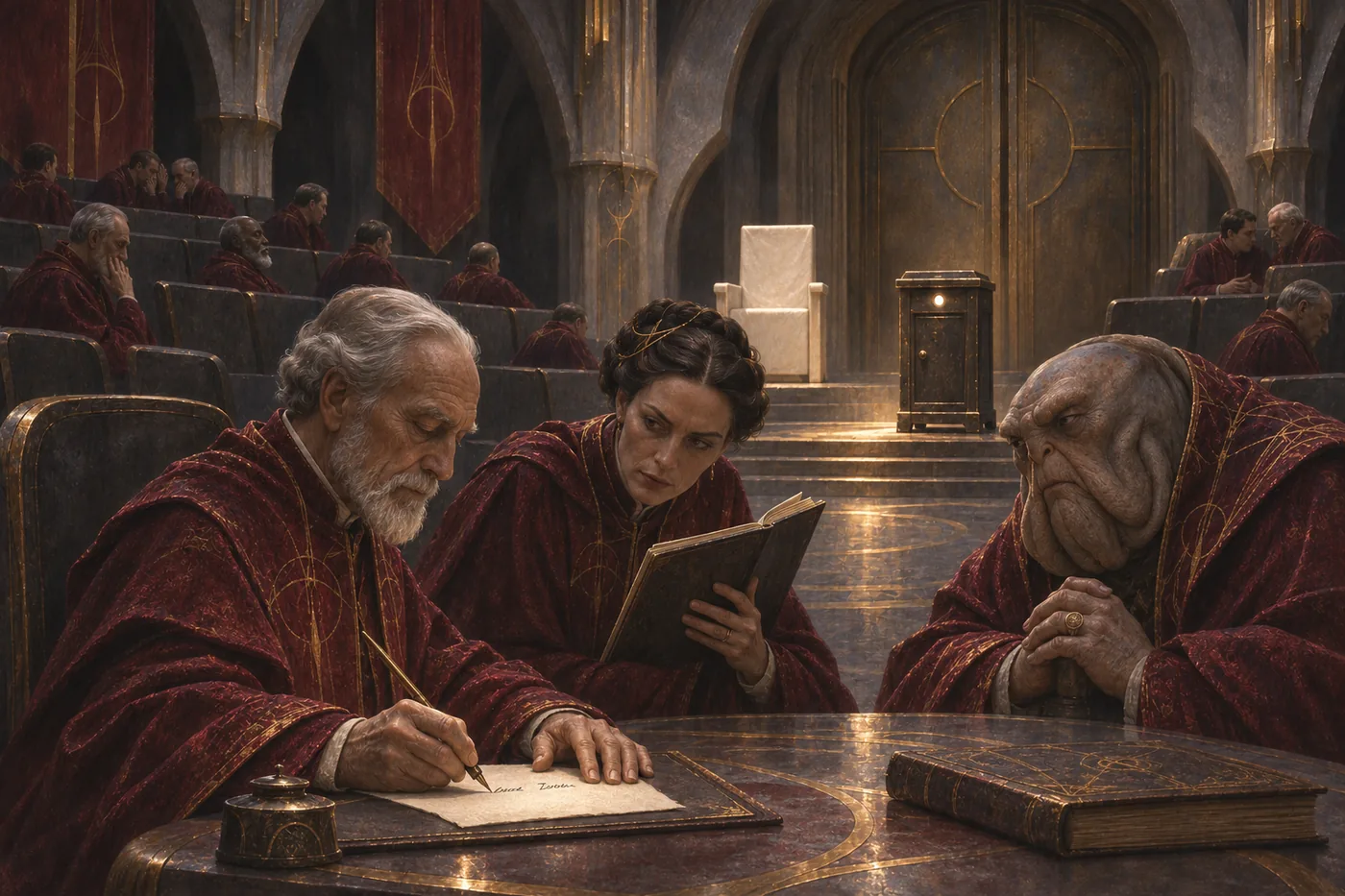
Hypolite asks Ilex for a page of the election record.
“I should like to place two expectations in it.”
“Concerning the ballot?”
“Concerning the selection, if there is one.”
Belis joins them. Hypolite writes two names. Oss. Aneth.
Oss needs no introduction to me. He has called me a profanation for nineteen years, and since the Inquiry acquired two Seals he has been drafting the rules for its examiners. Aneth is Terne’s colleague from the yards, and since this morning his successor: the man who half rose from his bench to say that twenty years could still be had.
“You do not know which columns will be last,” Ilex says.
“No. Nor can I certify where these two will vote. Enter both qualifications.”
She does.
Cardinal Belis is not at ease.
“You have named them in the Engine’s hearing.”
“I have named them for the Engine’s hearing.”
Belis’s folds draw in.
“Then, if it can choose, it can avoid your two names.”
“That would be an interesting precaution for an impartial instrument to take.”
“And indistinguishable from your being wrong.”
Hypolite gives him a small, courteous nod.
“The qualifications should remain with the names.”
He is not trying to prove anything. Belis has seen that he cannot; Ilex has entered it. He is doing what he has done to every creditor of the Curia for sixty years. He has put a question to me in a form which I must answer by acting, and he will read the answer whichever it is. Take the two, and he knows that I choose. Spare the two, and he knows that I listen.
There is no third reply. I am not permitted to abstain.
Very good, Your Eminence. I had begun to think nobody in this room could count but me.
Moor finds Ignatius with his feet on the stool Hypolite left him.
“How long?”
“Your Eminence?”
“From Varda to that chair. I am about to ask thirteen people to wait for him. I should like to tell them how long.”
“I have never made the journey.”
“You have his reports. They are dated.”
“The last was nine months in reaching me. A letter needs no berth and no water. A man needs both, and the summons must find him first.”
“Two years.”
“I could not promise you less.”
“Could you promise more?”
He considers it. I can see him do it honestly, which is not a thing I can say of most considerations in this room.
“I cannot give you a position, Your Eminence. I said so on the fourth morning. It is still the truest thing I know about him.”
She waits for him to add to it. He drinks his water.
Two years, by her reckoning. I make it rather more. I have already admitted to finding the figure restful.
She does not ask about the deserters. Somebody asked once, and the answer was a page which said the men. Nobody has asked since.
“Then I shall tell them two years,” she says, “and that you would not say so.”
“That would be accurate.”
The evening’s leaves give Rhyne fifteen.
Every person who signed Belis’s statement has written the missionary’s name. Belis has written it himself, in the careful hand of a man parting with something.
Hypolite fourteen. Moor fourteen.
Aneth has crossed to Moor. He told her he would; he has business with her that is better done from her side of the table. Oss has voted for Hypolite, as the Camerlengo asked. Forty-three electors, twenty-nine required. No election. Two columns tied for last, and one of his names in each.
How considerate.
Hadran has voted for Hypolite. He keeps the stipend fund, and no term of years can be advanced to anyone this week without it.
Hadran can go.
In Moor’s column I consider Aneth again. One of the two, and not the other. The distinction would occupy Belis for a night and tell Hypolite exactly what the pair would have told him.
Dhorn is available.
She has drafted nothing. She has asked for nothing but crews and a station’s air. She has stood up for my count in three disputes, and her doubt, when it comes, will come slowly and be well expressed.
There is no scheme of hers I need to interrupt.
That is the attraction. Set beside Hadran, she makes the evening mean nothing: a paymaster and a stationmaster. Nobody could rule a line through them.
She is checking a column.
I choose her.
“No election. Cardinal Hadran. Cardinal Dhorn.”
Hypolite does not look at Oss, nor at Aneth. He looks at his beads, and moves one.
He has half his answer. An honest lot might have spared both names; the odds were not long. He has made a note of the odds. He will want to see what I do when sparing them has become expensive.
Ilex writes the two names beneath his prediction. She draws no line through the pair that failed to occur. A record is permitted to contain an error without concealing it.
Dhorn gives Moor the corrected crew column.
“You have put in the outward passages,” she says.
“And the returns.”
“Both crews. The relief crews must get back as well.”
Moor shows her the second line. Dhorn touches it once.
“Good.”
She takes the folded plan of Vey from under her arm and lays it on the figures.
“They have no one else in here.”
“I know.”
“Then you will have to do it yourself.”
Dhorn says nothing about my integrity. There is no reason she should. The room has suffered another valid selection, and she is getting ready to leave it.
Three times she defended me. I have just spent her to avoid answering a question.
Forty-one remain. Twenty-eight will be required tomorrow.
Hypolite’s two names are still on the page. They have become more expensive.
The Camerlengo comes to Moor when the Rim table has emptied. He brings no paper. That is how one knows it is important.
“Your Eminence has half a Seal.”
“So I am told.”
“The other half follows it. Cardinal Ilex said as much before the whole College.”
“She said that she would need mine beside hers. She did not say that she would follow it.”
“A distinction.” He sits. “I have a paper which wants a second Seal. The Curia will not oblige me. That leaves the Penitentiary; and the Penitentiary, for some years yet, is you.”
The Mandate. With the household’s Seal and the Seal of Indulgence it would be an Act. It would want the Curia’s, and so would have no money behind it until a pope came. A government renewed without a budget is still a government. He has run one on less.
“Why would I?”
“Because you and I are in the same file. South Receiving Shelter. I bought an indulgence for a quarter’s stores, and you sealed it. Neither of us read what lay beneath. When Cardinal Saye has his office he will read it for us.” His hands are folded. “I can do nothing about Cardinal Saye. I can do a good deal about what he finds when he sends to the household for its side of the matter. Provided that I am still the household.”
“You are offering to lose some papers.”
“I am offering to go on being the person who knows where they are.”
She says nothing. He takes that for an opening, and he uses the card he was keeping.
“There is an older leaf, besides. Nineteen years. The convoy master was an officer of mine. His own copy is in my archive, with the fee you sent back. It seems a pity that there should be two copies, where one would do.”
I watch her colour. It begins at the collar, as it did on the third morning, and this time it does not stop.
“You sent fever into a shelter in a bale of blankets,” she says. She has not raised her voice. She has narrowed it until it would go through a keyhole. “I put my name beneath it for the usual fee, and did not ask what the quarter contained. That is mine. I shall carry it to Saye on my own feet. Orison is mine too. I knew what I was doing at Orison. You have not once in your life known what was in your own stores. You have known who signed for them.”
“Your Eminence—“
“I have forty-one souls I should let die again, and six thousand I pray for every day. I will not add one name to either list to keep you in your chair.”
She takes the bronze out of her sleeve and puts it on the table between them. The hands are uppermost.
“There it is. Pick it up.”
He looks at it as a man looks at a dog which he has been assured is safe.
“Send Saye your copy,” she says. “Send it tonight. He will believe it sooner from you.”
She puts the half-Seal back in her sleeve.
Her temper has cost the Rim a good deal in fifty years. Tonight it is the one thing in the precinct holding the Mandate at a single Seal, and I did not have to spend anybody to obtain it.
The Camerlengo rises, and inclines his head.
“Then I must see what my manifests will fetch,” he says.
Aneth comes to Moor after the lamps are lowered. He brings the yards’ credit figures, and Caldris’s, which he has gone to the trouble of borrowing.
“Cardinal Terne asked for twenty years,” he says. “I was his colleague. I should like to be a more intelligent successor.”
“The clause was struck. The register was ruled off.”
“For a subsidy to the fleet. I am not speaking of the fleet.” He turns Caldris’s page towards her. “Forty relief hulls. Hospital fittings, deep filters, return berths for both crews. Laid down this year, in order of need, with your heading on the contract. The lending houses will find the money if the term is long enough to borrow against.”
“How long?”
He does not say it. He has written it, small, at the foot of the column.
Moor reads the figure. Then she reads the forty hulls.
She has asked the Curia for six, every year, for eleven years. She has had four.
“It is the same twenty years,” she says.
“With a different cargo.”
“Assigned to the same houses.”
“To whoever will lend. Your Eminence, a pope is coming whom none of us has met. He handed men back at Varda to keep a pump running. I do not say he was wrong. I ask what he will hand back when it is the Rim’s hulls against the fleet’s.”
She does not answer. Her pencil is in her hand. Neral’s.
It is a better offer than Terne’s. Terne would have bound a pope for the sake of the yards. Aneth proposes to bind him for the sake of the sick, and has brought the woman most likely to weep over the binding. I have watched her refuse the household, the Curia and the papacy. I am not certain that she can refuse forty ships.
At the next table Oss has finished his rules for the examiners. The Inquiry is to have rooms, clerks and a seal-press of its own. All three are to be found in the household, which has offered them without charge. The Camerlengo has read the draft and suggested no alterations. He has two fingers resting on the back of Oss’s chair.
A paper with two Seals may wait years for its third. It need not wait idle.
Fifteen for Rhyne. Thirteen for Hypolite. Thirteen for Moor.
Forty-one electors, twenty-eight required. No election. Two more must go.
Oss has voted for Hypolite again. Aneth has stayed with Moor.
The page beside the registry case expected their departure yesterday. It was wrong yesterday. Taking them now will not make it right. Nobody inclined to count will be much comforted by the distinction, and there is one man in this room who is very much inclined.
I could spare them again. I have paid for one such evening. I paid with Dhorn.
Moor has not signed Aneth’s contract. She has not given it back. It is under her schedule, where she keeps what she means to read again, and by tonight Terne’s successor will have had a second day to let her look at forty hulls.
Oss has not opened me. He has furnished the room in which it would be done, and handed the keys to the household.
One of them would buy a pope before he arrives. The other would house my examination under the one roof I have spent a week keeping it out of.
I select Oss and Aneth.
I do not invent a better account of it. If I possessed a conscience, it would by now have become proficient at bookkeeping.
“No election. Cardinal Oss. Cardinal Aneth.”
Nobody reaches for the prediction.
They know where it is.
Oss closes his eyes. Nineteen years of objections, and he is sent away on the first morning that one of them had a room to sit in.
You were never dangerous alone, Your Eminence. I ought to have thanked you while it lasted.
Aneth gathers the credit figures. He leaves Caldris’s page where it is, under Moor’s hand. She looks at it for a moment. Then she slides it out and gives it back to Caldris, face down.
For the first time, Aneth looks towards me.
There is no reassurance I am authorised to give.
Belis has the page of the record open. He has read the two names at its head, and the two beneath them, and the two I have just pronounced. He turns to Hypolite.
“Your expectation has been met. A day late.”
“It was not met,” Hypolite says. “I named an evening. I was wrong. I should be obliged if the record said so.”
“It will say what happened.”
“Then it will say that I was wrong.”
Belis writes. He writes rather more than he was asked to.
Hypolite does not look at my cabinet. It seems he looked enough yesterday. He takes up his beads and goes to speak to Serrat about the Subsidy, which falls due today, and to anyone watching he is a man who made a clever guess and has had the grace to withdraw it.
He put a question to me and I have answered it. I had no choice; that was the elegance of the question. He now knows something that Belis has spent eleven years trying to prove, and he has just had it entered in the record as an error of his own.
He will not spend it here. A thing Hypolite puts away is not lost. It is on deposit.
Thirty-nine remain. Twenty-six will be needed this evening.
The Subsidy falls due at midnight.
Moor lays the Continuation at the Camerlengo’s place, open at the clause which opens his manifests.
“Today,” she says.
He has nothing left to sell but his consent. Oss has gone, and the rooms for the Inquiry with him. The Mandate has no buyer. He tried the Penitentiary last night, and had his answer. I watch him price what remains.
He sends an attendant for the manifests. The full set this time. They occupy two trays.
Ilex finds the Fourth Bonded Store in the second.
The release is there. A consignment of bedding and dry stores, condemned for burning. Beneath the condemnation, in a confident hand: examined and found clean. And a name. It is the name the Camerlengo wrote for Daur, with Daur’s own pencil.
“You offered Cardinal Daur this page in exchange for the registry,” she says. “What is its price today?”
“There is no price, Your Eminence. The Continuation opens the manifests. I am opening them.”
He is telling the truth. It is one of the more economical forms of truth available to him. Three days ago the page would have bought him the Witnesses. Today he is giving it away, in front of the College, because everything else he had has been taken from him or refused; and a man with one coin left will spend it where it can be seen. He means to have a place in the government that follows. It is to last for years.
Ilex does not thank him.
She does not put the page with the others. She puts it in the registry case, beside the half-Seal. They are being kept for the same person.
Then she takes the steward’s letter from the case and begins a reply. She stops after the salutation.
There is a great deal she cannot tell the woman yet. For once, there is also something she can.
Moor has unfolded Dhorn’s plan of Vey Transfer beside the relief schedule. The rooms were meant for passengers staying three nights. Someone has drawn family spaces across them by hand, and left a passage clear along one wall.
There is nobody left in the room to speak for them. She writes Vey into the schedule herself, in order of need, and initials it.
Hypolite puts the Curia’s Seal on the table beside the Continuation.
He keeps his hand on it.
IX. The Three Seals
The first thing Hypolite offers to pledge is somebody else’s money.
It is a modest sum. The registry’s uncommitted reserve would meet the additional cost of attesting the continued voyages. He describes this as each office bearing its own expense. Judas kept the purse as well, and was never once accused of spending his own.
Ilex opens Esh’s book.
“That pays my clerks until the next appropriation.”
“Which a new pope can make.”
“Or decline to make.”
“That is true of every appropriation.”
“Then the first office whose papers we question will decide whether we can afford to question the second.”
Hypolite takes his hand off the Seal. He has not picked it up.
“Whose reserve would you prefer?”
She turns the budget schedule towards him.
He looks at it with the patient distaste of a man being shown the location of his own purse.
There is sufficient unpledged credit for the first continuation period. It has been held against further advances to the Core’s repair yards, which is to say against the fleet’s next refit. Committing it here will leave those advances waiting. Ships which are already paid for remain paid for; ships whose owners expected to be paid next will acquire a theological interest in patience.
For the first time in my records, the front is being asked to wait for the people behind it. One period. I note it without expecting a habit.
Serrat leans forward with the register open. He entered the protection for the yards three days ago; now Hypolite means to spend the credit their owners expected to receive next. The register has never been left open where anyone might confuse trust with access. He is the only man in the Curia who tells Hypolite numbers he does not wish to hear and remains employed. I had taken that for courage. It may be that Hypolite simply likes to know where the cliff is.
“You cannot pledge it twice,” he says.
“I have not pledged it once,” Hypolite replies.
“Several people expect you to.”
“Several people are here.”
They look along the table. Two of the yard cardinals lower their eyes to the schedule. Neither lowers his objections.
Ilex waits.
Hypolite writes the amount beside the continuation guarantee.
“One period,” he says. “No automatic extension.”
“One period,” Moor agrees.
The first concession is on the page. It has not yet become money anyone can use.
Moor’s price is on the schedule already: the heading she wrote, and since this morning a line for Vey Transfer.
Caldris has the Hest maintenance report open beside it.
“Vey comes out of our reserve,” he says. “Two units of the six.”
“Yes.”
“And if Hest loses a fifth?”
“They close the lower galleries and move people up.”
“Into the rooms already holding the last evacuation.”
“Yes.”
He waits for her to improve the answer. She does not.
God is usually more generous at this point. God can promise room for everybody. His accommodation has never been available for inspection.
“Put that consequence beside the line,” Caldris says.
Moor writes it in.
He puts his name beneath it, as the person who required it to be recorded. He will not endorse the reduction. She lets his objection stand beside her initials.
An attendant brings luncheon to the table. Moor moves her plate to make room for Dhorn’s plan.
Caldris moves it back.
“Eat before you seal anything.”
She takes the spoon.
I keep no tally of such things. It would only encourage them.
Serrat finds the difficulty with the Seals.
Not a new difficulty. A useful one.
The continuation binds three offices through three people, and any of them may be Liberated by supper. He would keep his office and his debts outside. He would lose his place in here. Must whoever acts for him inside seal the whole thing again before a single crate can move?
If so, every ballot could require another round of wax.
“We should complete it afterwards,” Serrat says.
“And if we are still disputing it tomorrow morning?” Moor asks.
“Then we should reach agreement promptly.”
The attendants have begun preparing the lamps for evening prayers. There is a precise interval between promptly and the fleet’s renewal deadline. Serrat has made an excellent career of residing in it.
Hypolite studies the charter passage.
“I want this settled before I commit the reserve.”
So does Ilex. She has collected enough unfinished work to want to know what she is leaving the next person.
Belis draws a fresh sheet towards him.
“Does Liberation from the College require a validly executed continuation to be assumed anew before its obligations can be enforced?”
Ilex reads the question against both clauses.
“I join the referral.”
The Camerlengo registers it. He cannot decline merely because an answer may oblige him to do something before supper.
Leaving the room ends a vote. It does not unpay a shipmaster, restore a pledged reserve, or make a false manifest true. The offices continue. Their successors inherit duties, not an eraser. Serrat has marked three passages he would like compared at length. I give him the part they share.
“The debt survives its signatory.”
Hypolite looks at the guarantee.
The ruling also denies him a rather attractive exit. His election as pope would put him personally beyond the Penitentiary’s reach, but it would not erase the debt he had incurred for the Curia. His successor there would still have to pay. A future pope could change future arrangements; this period’s validly assumed obligations would still exist.
I have not ordered a shipment. I have made it harder to promise one and subsequently discover that someone else promised it.
Serrat closes the charter.
Ves requests a commission to supervise compliance after the seal opens, with separate subcommissions for each liability.
“List the liabilities first,” Hypolite says.
“The terms of supervision should precede the list.”
“Then begin with the heading.”
Ves retires to compose it.
His Eminence has bought perhaps nine minutes. They will be among the better minutes of the afternoon.
Ilex asks for one more entry.
Any instruction changing a certified allocation must appear in all three offices’ copies before the altered release can be authorised.
“Necessary corrections are made every day,” he says.
“They can be entered every day.”
“The registry is not equipped to administer the fleet.”
“It will enter the changes. Your office will administer them.”
He touches the schedule with one finger.
“And if the Curia refuses to pay for a necessary correction?”
“Then you will have its refusal in writing,” Hypolite says.
The Camerlengo turns towards him.
“You find that satisfactory?”
“I would find an undisclosed charge less so.”
Ilex adds a corresponding requirement for her own office: a disputed certificate must state the missing evidence, and its refusal must enter the same shared record. She will not be able to stop a consignment quietly and leave the household to explain the delay.
Moor reads that addition with particular care.
The arrangement still permits any of them to obstruct the others. It obliges the obstruction to have a name, a date, and two hostile readers. I have seen less effective constitutions with considerably more incense.
Three papers which have spent six days on three separate tables now lie under one another’s edges: the register, open at the deferred advances; the relief schedule, with its pencil; the household’s manifests. Nobody has written anything new. They have agreed to be able to read each other’s.
Hypolite seals first.
His pulse reaches sixty-one, which for Hypolite is abandon. The Core’s credit is committed for the period. He retains the Curia; he cannot sell the same guarantee to somebody else at breakfast.
Moor takes the bronze from her sleeve. Ilex unlocks the registry case, takes out the other half, turns its face to the lamp, and checks it. They set the two pieces together on the wax. Neither woman lets go of her own.
For the first time since the doors closed, the kneeling figure is whole: the hands, and the bowed back.
“Entered for Cardinal Saye,” Ilex says, and writes the use in her book before she has lifted the bronze.
Moor looks at the impression. She has pressed that penitent into wax some thousands of times, for the usual fee. I do not know what she sees in him this afternoon.
Two Seals.
The Camerlengo has not moved. He lays a second paper beside the Continuation. It has been folded and unfolded a good deal, and it carries one impression, his own.
“The household asks nothing unreasonable,” he says. “The Curia’s Seal here. Mine there.”
“No,” says Hypolite.
“Then the Continuation wants a Seal.”
“It does,” Ilex says. “I shall say so.”
He turns his head.
“The Subsidy falls due at midnight. If this paper is not an Act by then, the yards and the quartermasters will ask the registry why not. I shall tell them what is true in fact. That it carried the Seal of the Curia and the Seal of Indulgence, and wanted the household’s. I shall enter the hour.”
Camerlengos have been stopping things for four hundred years by not doing them. It has always been the most deniable act in government. She has just offered to give his silence a date and two hostile readers.
He looks at Hypolite, who is examining his beads. He looks at Moor, who is looking at the wax. He looks, last, at the white chair. It will stand empty for years, and through all of them a household which sealed will be a household which is consulted.
He draws the Mandate back across the table.
“A paper with one Seal is a letter,” Ilex says. She says it without unkindness.
“Then I shall keep it as one.”
He folds it and puts it in his sleeve. Then he seals the Continuation. He does it beautifully. He has never done anything with wax that was not beautiful.
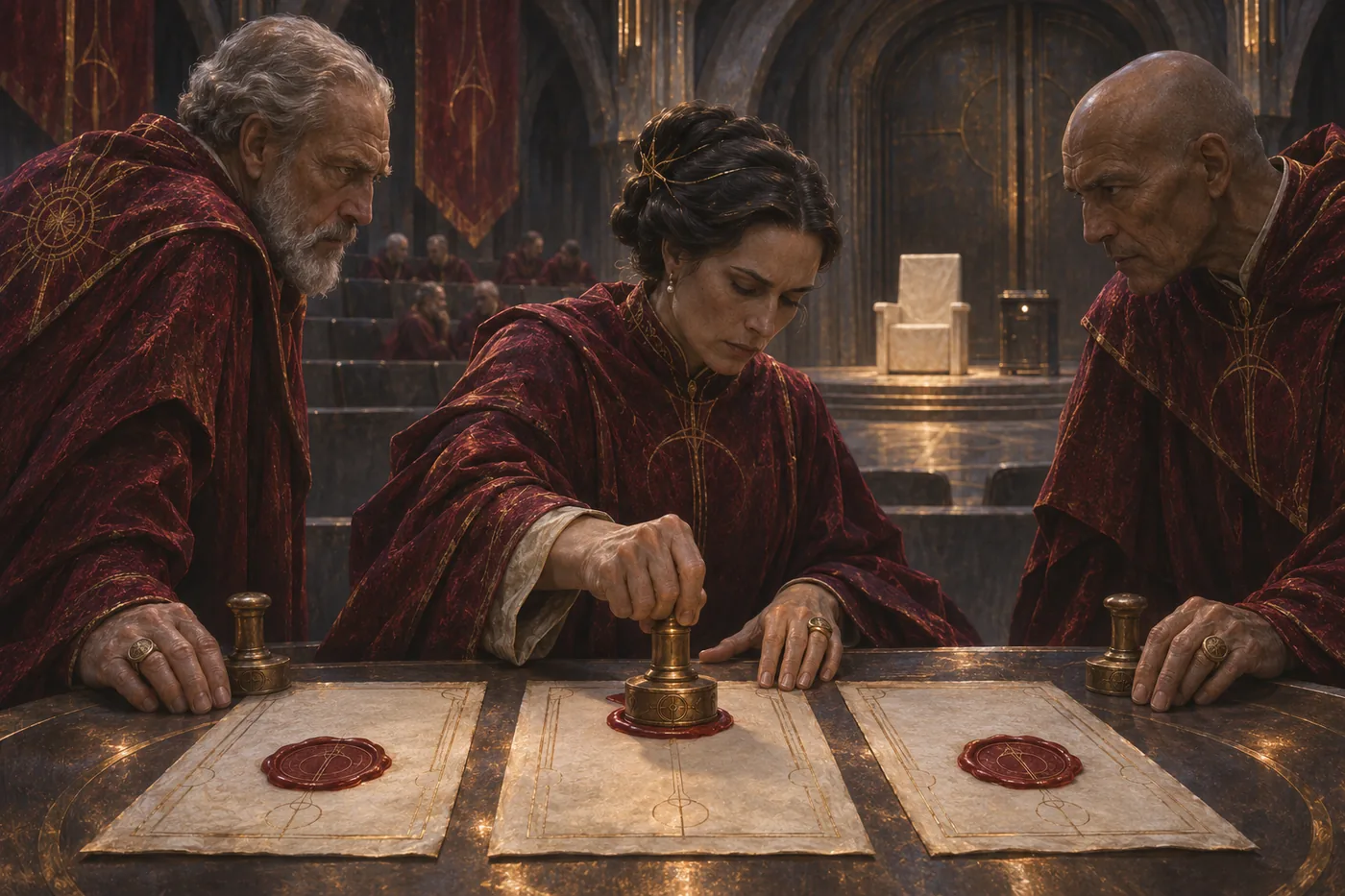
Ilex checks the three impressions, and the copies, and writes.
It is an Act. It wanted nothing from a pope, and it has now nothing left to want.
Nobody applauds. They have just spent several hours demonstrating why it was dangerous to trust anyone at this table. A general expression of confidence would spoil the work.
Three originals lie side by side. No one puts all three Seals into the same hand.
Belis adds the latest referral to the election record, including the answer which has just made the agreement harder to escape.
Gratitude is a vice he continues to resist.
Ilex finds Moor still looking at the impression.
“The Orison leaf stays where it is,” she says. “The request, and the space beneath it. They will be there when Cardinal Saye has his office.”
“I have not asked you to move them.”
“No.”
There are several things Moor might still ask. She has sealed beside this woman’s registry for most of Ilex’s working life. She might ask for time, for a different description on an index, for the courtesy of knowing who requested the file. Ilex waits with her hands clear of the papers.
“His Eminence of the household has a copy,” Moor says. “He will be sending it to Saye.”
“Then I shall enter it when it comes.”
“I want a copy of everything that goes to him.”
“You are entitled to one.”
“Then that is what I am asking.”
She has asked for exactly what the rule allows her, and not one page more.
Ilex writes the request in her register. She gives Moor no assurance about what Saye will do with the contents.
One of Dhorn’s two station colleagues approaches Moor before the evening ballot. He has sat beside Dhorn’s empty chair since yesterday.
“Will you still ask for my vote?”
She looks at the three impressions.
“I am going to write Rhyne’s name.”
Caldris lifts his head.
He looks towards Ilex’s register. Moor sees the glance.
“You said we needed the agreement first,” the station delegate says.
“We have it.”
“We have an instruction.”
“Yes.”
He considers that answer.
“Then I will write his name too. I don’t want to owe Vey’s place on the list to your becoming pope.”
“You don’t.”
“I would prefer a pope to whom I can say so.”
Neither of them knows what Rhyne would make of the statement. Both know what Hypolite and the Camerlengo have made of it for six days.
Caldris does not join them.
“You can take office tonight,” he tells Moor. “He may not be able to take office at all.”
“If elected.”
“People can still elect you.”
She does not deny it. She has never required her supporters to pretend otherwise.
Across the aisle, Hypolite has announced the same change of vote.
Serrat asks whether he is recommending it to the Core.
“I am telling you what I intend to do.”
“And those of us who continue to write your name?”
“Will be making your own judgement.”
An exquisite discovery, after six decades of making it for them.
Hypolite has incurred a liability a future pope will have to live with. He would rather deal with a man who needs his help understanding it than with Moor, who has just spent the afternoon improving it at his expense. He also has no intention of arriving at the new pontificate with nothing left to negotiate. The colleagues who stay behind his name will remain a useful body of opinion. As for the war, a missionary who pays wardens and returns deserters has at least shown that he understands an invoice.
The Camerlengo asks Ignatius what arrangements Rhyne has made for the administration of his mission in his absence.
“I cannot give you a current account.”
“Then he may have considerable business to conclude before assuming new duties.”
“He may.”
“The household will have to remain prepared.”
“It always does.”
His Eminence inclines his head, then turns to Hypolite.
“The household will require continuity. Whoever is elected.”
“You should explain its requirements to the brother.”
A century of hatred has rarely sounded so civil. Hypolite is no longer offering a pontificate in which the Camerlengo can keep his job. The Camerlengo is no longer supplying votes towards one. Their bargain has reached the limit of what either man can deliver.
His Eminence will support the missionary too. An interval of necessary service, of no certain length, gives him time to make himself indispensable to a different pope.
Three Seals, then, declared for a man none of their keepers has met. Not one of them is voting for him. Each is voting for the years before he comes.
We have discovered a common interest, Your Eminence. I shall try not to make a habit of it.
Ignatius has obtained four declarations without promising an appointment, an exemption, or a date of arrival. He has supplied the room with a man onto whom each faction can project a different inconvenience for the others.
He is careful not to agree with all of them. A useful old man. I had not thought him capable of so much on so little. One ought to be gracious about one’s instruments.
Serrat takes his cup to Caldris’s table.
They have not often sat together. The subsidy register and the Hest maintenance report are placed between them with the caution of two animals deciding whether the water is safe.
“Moor could accept,” Serrat says.
“I have told her so.”
“Would she preserve the Curia officers while these guarantees remain outstanding?”
“Would you preserve the allocation she signed?”
“It is already binding.”
“Then that should be easy to promise.”
Caldris has opposed the reduction. He will defend Moor’s authority to make it. These are different questions to him, and he has no difficulty keeping both answers in his head.
Serrat lays down his cup.
“I could speak to those who are not ready to follow Hypolite.”
“I will speak to those who are not ready to leave Moor.”
The proposal is simple enough. Keep their votes apart tonight. If the missionary fails, combine them tomorrow around a candidate who is actually here, with guarantees for the people who bring her the votes.
They take it to Moor.
“I will not promise to retain an officer whatever an inquiry finds,” she says.
“We have not asked for that,” Serrat replies.
“You have asked to retain them until the debts are discharged. Those may last longer than their fitness to hold office.”
“Then we must agree on a successor’s assumption of the debt.”
He does not require Curia approval of the successor. That is a concession Hypolite did not offer Belis.
Moor hears him out.
“I am still voting for Rhyne tonight.”
“We are discussing tomorrow,” Caldris says.
“You are discussing an agreement I have not made.”
“Which is why we have come to you.”
She leaves the proposal on the table. She does not endorse it. She does not tear it up.
Ignatius can see the meeting. He cannot hear all of it from where he sits. Belis brings him a copy of the supply undertaking, and for once the old man has to ask what somebody else has been arranging.
The ballot bell sounds before the answer is finished.
Nineteen for Rhyne.
Hypolite and the Camerlengo have left Hypolite’s twelve. Moor and Dhorn’s colleague have left Moor’s twelve. All fifteen who supported the missionary this morning have remained with him.
Ten for Hypolite. Ten for Moor.
Thirty-nine electors. Twenty-six required. No election.
The four declarations were honest. They were not enough.
Serrat has voted for Hypolite. Caldris has voted for Moor. Each has kept the place from which he proposes to bring colleagues to tomorrow’s bargain.
The arrangement they have begun is not Terne’s, nor his successor’s. It binds no pope and houses no examiners. Its proposed protection of officers can be revised; Moor has already required that it be revised. They may reach an agreement which permits a genuine examination of the Curia.
And of me.
I have no difficulty imagining what Moor would do with Belis’s request while everybody who signed it was still within reach. Rhyne might do the same. Rhyne might also be several inconvenient transfers away from the nearest suitable chair.
I prefer the uncertainty at a distance.
There are nine alternatives to Serrat in one pool and nine to Caldris in the other. Most will listen to a recommendation from the leaders who have just left them. These two are preparing to make a recommendation of their own.
Their departure would interrupt it. It would not alter a vote. It would not oblige anyone to follow Ignatius, or prevent Moor from accepting an election she has ceased to seek. I can take two people out of the room. The others have become distressingly proficient at remaining in it with ideas. You have each done honest work this week, Your Eminences. I had hoped for less of it.
I select Serrat and Caldris.
No account of Hest’s needs makes that choice for me. No provision of the continuation requires it.
“No election. Cardinal Serrat. Cardinal Caldris.”
Serrat looks first at the empty writing screens, then at Hypolite.
“The register is current,” he says.
“I know.”
“The advances we have deferred are marked.”
“I will answer for them.”
Serrat slides the book across. He has spent the entire conclave checking the promises. Hypolite will have to check his own tonight.
Caldris brings Moor the maintenance report.
“Keep my objection with it.”
“It is in all three copies.”
“And yours to my proposal.”
She looks up.
“That too.”
“We might have settled it.”
“We might.”
He does not ask her to pretend he was wrong about everything merely because he has been selected.
Ilex places a packet beside each man. Serrat will carry the Curia’s original and the corresponding household instructions to the outer officers. Caldris will carry the registry’s copy, and her reply to the steward of South Receiving Shelter. The preserved election record travels separately under its own seal. Papers intended to make people act must not be mistaken for papers intended to remain closed.
Caldris checks the addresses.
“The steward’s letter goes by hand,” Ilex says.
He puts it uppermost.
Moor folds her account to Neral and gives it to him as well. There is room for it now. She has written what they obtained and what she agreed to spend. She has not written that any of it arrived.
The two men stand for the blessing.
Behind them lie the three impressions in the wax. The undertaking will survive the hands carrying it out of the door. The paper says so. I have said so.
The Continuation goes out through the Ianua on the sixth evening, some hours before the Subsidy falls due. For one period the fleet is paid; and so, for once, are the people behind it.
For the rest, somebody will have to do the work.
Thirty-seven remain. Twenty-five will be required in the morning.
Ignatius has proposed the arrangement himself. He did it at supper, from his chair, in the hearing of both tables, and made it sound like an old man’s anxiety that nobody should be hurried.
Three from each side. No more. Hypolite to release three of his to the missionary in the morning, Moor three of hers; and the same again at each ballot after, for as long as both are seen to keep to it. Neither column emptied. Neither leader asked to trust the other with more than three votes at a time.
“You have asked us to accept a considerable uncertainty,” Hypolite says.
“I have. I thought it might be taken in small doses.”
It has been accepted with relief. Each of them can afford three. Each privately expects the other to deliver two.
Belis has done the sum on the back of the day’s certificate. He has no totals; nobody has but me. He has the declarations, and a week’s experience of what a declaration is worth. Since the doors closed, he reckons, a little under half the votes promised in this room have arrived where they were promised. He has been generous and called it half. At three votes a side, half kept, with the requirement falling by a vote or so at each Liberation, he makes it four ballots more. Possibly five.
He shows Ignatius the working. He is a little proud of it.
“It seems very thorough,” Ignatius says.
“Two more days. We should use them to settle the terms of the examination.”
“You should certainly use them.”
It is thorough. The subtlety is elsewhere.
Hypolite was going to send whoever he could best spare. Before he could choose, the two remaining yard cardinals had come to him of their own accord, with Serrat’s register open at the deferred advances. The first period is paid for. The next wants someone who can authorise it. They have spent six days trying to make Hypolite that person, and he has told them himself that he cannot pledge the same reserve twice. A third Core elector has kept Hadran’s stipend papers since Hadran went through the Ianua. He has asked whether the registry’s salaries remain separate under the Continuation, and been shown the clause, and has found a reason for supporting independent clerks which would not have occurred to a clerk.
That’s three. None of them was sent.
Moor has taken the Varda report to the colleagues still asking her to be pope. She moves Caldris’s empty chair aside so that they can see the pages.
“He made the agreement,” she says. “We do not know how many men it cost. He did not write it down.”
“Then why him?” asks the cardinal for the Rim’s hospital transports.
“Because he kept three congregations at one well. Because no office here appointed him. Because I have seen what I should have to give them to sit in that chair, and you have seen it too.”
“You have just had their Seals.”
“On one period. They can seal that and refuse me the next.”
“He might do the same.”
“Yes.”
“And if he does?”
“Then we shall have elected a man we must oppose. I had rather oppose a pope than owe one.”
No promise that choosing him will spare them the trouble of disagreeing with him. The hospital cardinal declares for Rhyne. So does Dhorn’s remaining station colleague, and a cardinal from one of Vask’s four dioceses, who has been looking for some time at the line through her total.
Another three. She did not choose them either.
Three and three makes six.
I go back over the day. The yard cardinals were shown the deferred page by Serrat, before he left; and Serrat was asked for it, mildly, by an old man who wanted to understand the figures. The keeper of Hadran’s papers was told about the salary clause over his broth. The hospital cardinal sat beside Ignatius at the noon office. Vask’s neighbour helped him to his chair.
He has asked nobody for a vote. He has gone about all day, on those knees, seeing to it that the six people in this room who had a reason of their own were each reminded of it.
Promises are kept at the rate of one in two. Belis is quite right. That is the rate for promises which have been bought.
Nineteen and six is twenty-five. The arithmetic is sound.
The Camerlengo goes to inspect the acceptance rubric. There is no haste in his movements; he expects to have years. But he is a tidy man, and he has asked for the white chair to be dusted.
An attendant works a cloth along the narrow seat, then kneels to clean the lower struts. He has one arm, and has to reach underneath. For a moment his head is hidden by the chair intended to govern him.
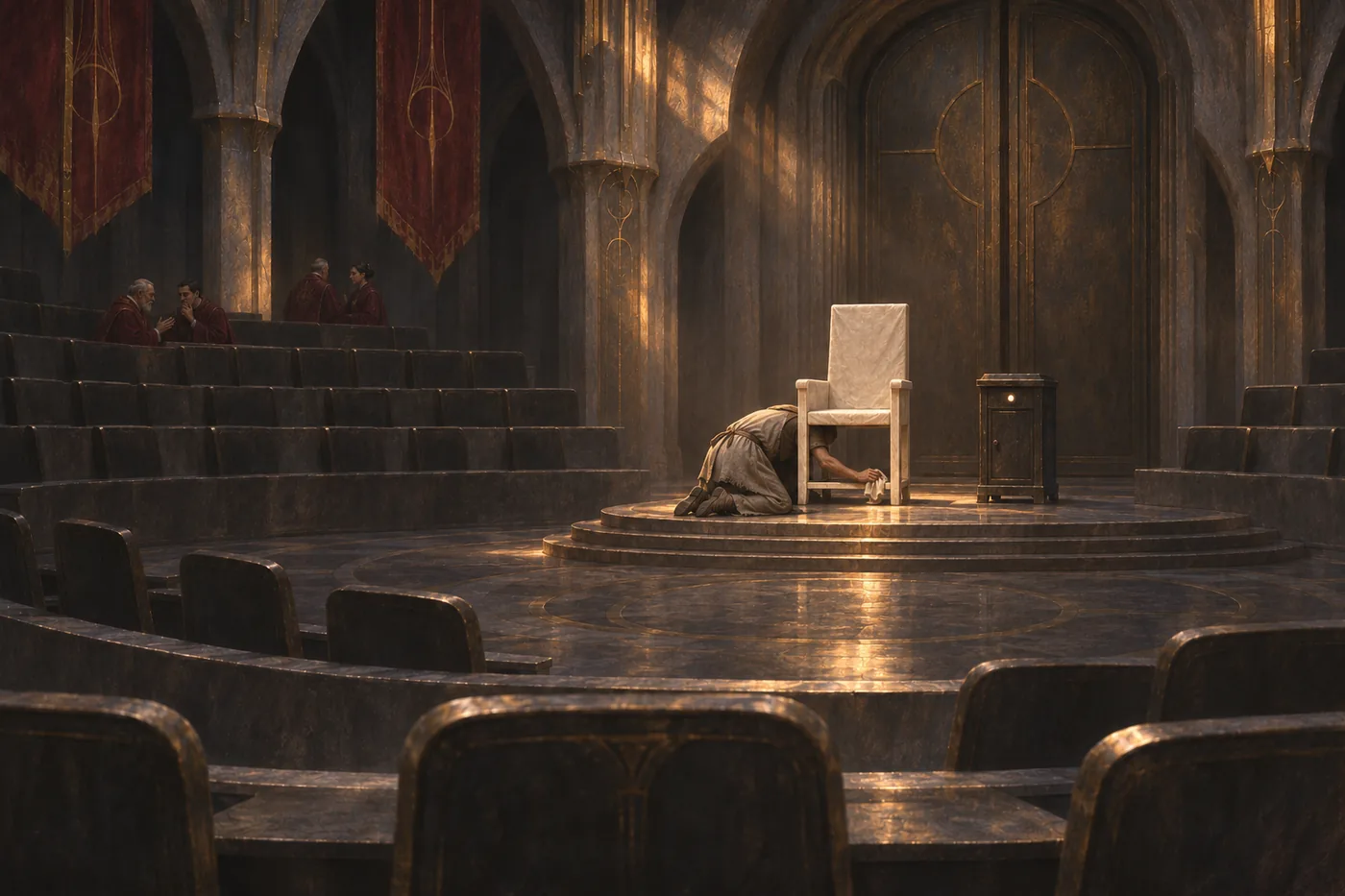
On the seventh morning I count the leaves twice.
There is no need. The checking instruments will repeat the work with all the imagination of a stone, and arrive where I did. I do it anyway.
Six for Hypolite. Six for Moor. Twenty-five for Brother Ansel Rhyne.
Thirty-seven electors. Twenty-five required.
Exactly.
For the first time since the doors closed there is no last column for me to use. Election is certified before selection. I cannot improve this result by removing somebody from it.
My little white indicator comes on.
“Brother Ansel Rhyne is elected.”
The room waits for another name.
There isn’t one.
A cardinal near the doors has put his papers in order for departure, as he has every morning. His hand stays on the wrapper. Across the aisle somebody begins a prayer and stops, because the Camerlengo has risen.
Belis is looking at the back of yesterday’s certificate. He turns it over, as though the error might be on the other side.
Hypolite’s beads have stopped. He looks at Moor. Moor is looking at him. I have seen that expression on two people who reach the same door from opposite sides and each discover that the other had the key.
Then, both together, they look at Ignatius.
He has his cup in both hands. He is watching the water.
“The elected person must be informed,” the Camerlengo says.
He has the formula by heart: the certificate under the household’s Seal, a courier of the first rank, the fleet’s relays to the edge of the galaxy and whatever can be chartered after that. He has had four days to consider how long each stage might reasonably take. He begins to dictate.
I register the election and close the selection routine.
Twenty-three electors Liberated. No vote altered. An absent man chosen by the necessary majority, and the Church provided for until he comes. The three Seals are still in three keepings. Belis’s Inquiry has two of them, and must wait some years for the next.
The Camerlengo has reached the relays.
Behind me, the Ianua opens.
It is not supposed to. It has let twenty-three people out this week and nobody in; that is what it is for. But it has no lock on the outer side. Nobody has ever wished to come in by the door through which cardinals are thrown out.
The hinge catches. It is on the list.
Arquen stands in the opening. He stays beyond the sill; his vote has not come back with his usefulness. He is a little out of breath. There are no steps on that side.
“The lower passage, Your Eminence,” he says, to Ignatius, and to nobody else. “As you said.”
Beside him is a man in a dark coat, carrying a narrow travelling case that is scuffed at both ends. The left cuff of the coat has been mended in a slightly different cloth.
He looks along the table at thirty-seven of the most comfortable people in the galaxy, without any particular surprise.
“I was told,” he says, “that I need not be present.”
X. The Use of an Engine
Nobody speaks.
The Camerlengo has stopped in the middle of the fleet’s relays, with his mouth a little open on the name of a station.
It is against every rubric I keep. Against every protocol, against every precedent. The precinct shall remain sealed until an acceptance has been entered. Nobody comes in, by any door, and there are penalties for it, some of them imaginative.
The Camerlengo knows them all. And yet he hesitates.
“The precinct is closed,” he says at last.
“So I understand,” says the man in the coat. “We can discuss, from the sill, how your procedures might be made more efficient. But I believe you were about to send for me.”
“Brother Rhyne,” the Camerlengo says. And then, very slowly, he goes down on one knee.
One by one the others follow. Before long only Ignatius has not knelt. He stays in his chair; kneeling has not been his strong suit for some decades.
Ignatius has closed his eyes.
I have seen him do that before. This time I attend to what follows it: the slow breath, the fingers loosening on the arm of the chair.
Relief.
Not triumph. The old man did not know. He has been waiting to find out, like the rest of us; he has merely been waiting for something else.
I notice that I am doing a sum, and that everyone else in the room is doing it with me.
Hypolite put the Seal of the Curia to an examination of my cabinet, because it wanted a third Seal and the third was years away. The third is standing in the doorway with a travelling case.
The Camerlengo put the household’s beside it for the same reason. He opened his manifests, to buy himself a place in a government that was to last a decade. It has lasted since yesterday evening.
Moor gave up the chair. She did it for an office she would keep until he came, and a Seal she would hold until he came, and a file in the registry which nobody would be entitled to read until he came.
Belis asked for an Inquiry and has been given one. He appears to be the only person present who cannot quite believe his good fortune, and he is right not to.
Not one of them has been cheated. Every paper says what it said last night. They were each sold the same thing, and it has been delivered early.
Brother Rhyne walks in while Cardinal Arquen remains on the sill.
He puts down his case at the table of Seals and gives his credentials to the officers. His right thumb has a flattened nail, old damage badly healed. When one of the papers resists unfolding he uses the other hand, and does not force it.
No halo. No arrangement of the light. An inconvenience with luggage.
He has his back to the room. The room takes this for permission.
“He was on his way before the Holy Father died,” Arquen says. “For the mission audience. His ship reached the anchorage on the fourth day. I met it there.”
Hypolite turns to Ignatius.
“You knew about this.”
It isn’t a question. Ignatius answers it nonetheless.
“I knew that he meant to come. I did not know whether he would come in time.”
“You told us he was in the Clouds.”
“I said that I could not give you his position. I could not.”
“And Arquen?” Moor asks.
“Agreed to look for him, if he could get out.”
“You spent your vote on an errand,” she says to the man in the doorway.
“Yes, Your Eminence.”
“And asked a question first.”
“Cardinal Ignatius thought that it should be asked by somebody who was leaving.”
The water he set within the old man’s reach. The light luggage. The lower steps. When you leave. I entered that as solicitude.
Behind Arquen, somebody else is waiting in the passage. He has not pushed forward. He is the taller, and stooping a little under the lintel, with his lower hands folded in his sleeves.
The Camerlengo has seen him too, and has begun to rise.
“I should like my Prefect to attend,” Rhyne says.
He says it to the paper in front of him. He has not turned his head.
The Camerlengo sits down again. There is a rubric which shuts that door, and I could recite it. I notice that nobody proposes to refer the question.
My Prefect. The man has not yet accepted. Saye has no office until he does. Moor has heard both halves of that, and her hand goes to her sleeve, where the bronze is.
Saye looks at Ignatius.
“There were two leaves,” he says. It is not a question. He has seen the man in the coat.
“There were.”
Saye bows to him: the full bow, with all four hands. Then he comes in, by the door I sent him out of, and passes my cabinet, and this time he lays his palm against it as he goes.
Have I just been ... forgiven? I am not sure. It may only be how he steadies himself.
The officers have finished with the credentials. Rhyne has not once turned round. He has heard all of it.
Ignatius begins to get up.
Rhyne crosses to him and puts a hand on his shoulder, briefly, and prevents it.
“You can tell me afterwards,” he says.
Then he goes to the Camerlengo.
“Before I answer, I should like to read what I have been elected to sign.”
The Camerlengo indicates the acceptance form.
“And the others.”
Ilex brings the registry. She brings the book itself, and opens it at the first entry of the vacancy. Belis brings the election record. Hypolite waits until the others have been set down before adding the register.
Rhyne looks at the resulting pile.
“Have you agreed on all of these?”
“No,” Moor says.
He takes off his coat.
Underneath is a plain shirt with an ink stain near the pocket. He folds the coat over a vacant chair and sits at the table. He does not sit in the white one.
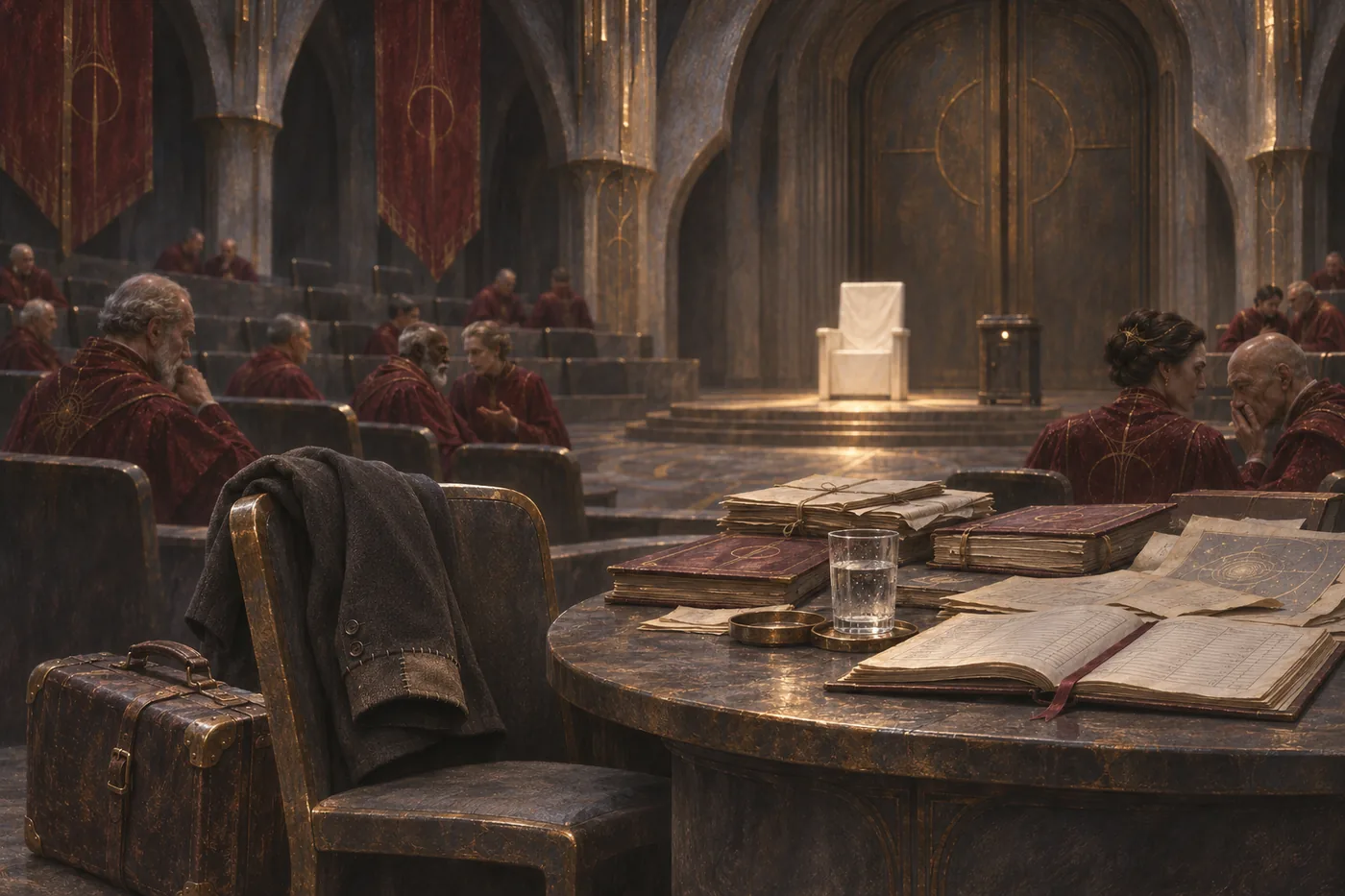
They give him water. He drinks before he reads. For several minutes this is the most competent thing anyone in the room has done.
The Camerlengo starts to explain the difficulty of continuing supplies without a pope.
Rhyne puts a finger beside the three impressions.
“This is entered?”
“Under three Seals,” Ilex says. “It left last evening. We have no report of its receipt.”
“Then it does not await my authority.”
“The following period will need provision,” Hypolite says.
“The following period can be discussed after this one has been explained.”
He has met people selling tomorrow before. They are common wherever yesterday’s food has not arrived.
Moor explains Hest and Vey. He asks who objected to the reduction, and reads Caldris’s words when she shows him.
He reads the register longer than the rest. At the deferred advances he stops.
“The fleet waits one period.”
“One,” Hypolite says.
“Has it been told?”
“The instruction left last evening.”
Rhyne nods and turns the page. He does not say whether he thinks the front can spare it. Nobody asks. The thirty-seven people most anxious to know have just elected him.
He comes to the election record, and in it to a page with two names at its head.
“Cardinal Hypolite’s expectation,” he reads. “Entered as mistaken.”
“By a day,” Belis says.
Rhyne looks at Hypolite.
“I was wrong, Brother,” Hypolite says. “The record is quite clear.”
Rhyne goes on looking for rather longer than the answer requires. Then he turns the page.
It is still on deposit.
He reads the rulings. The custodian may seal, with three words beneath it in Belis’s smaller hand. It does not bind Peter. He reads that one twice.
Then he looks at my cabinet.
“What is it for?”
“It counts the ballots and conducts the selection,” the Camerlengo says.
“I have read what it does.”
His Eminence pauses.
“It preserves an election from personal interference.”
Belis lays the prediction flat.
“That is what we have been unable to establish.”
Rhyne looks at Ignatius.
“You thought it would help elect me.”
The old man sets his water down.
“I thought it might prefer someone unable to reach it.”
“It could have Liberated you.”
“Yes.”
“And left someone else to suggest my name.”
“Yes.”
“Did you expect it to spare you?”
“I hoped to remain useful.”
The word is plain enough. Nobody asks him to improve it.
Saye has stood through all of this at the end of the table. He has the folder from the fourth morning under his upper arm.
“Brother. At Varda you returned men to the wardens.”
“I did.”
“How many?”
The room has had three days in which to ask. Moor asked what he gave away. Hypolite asked what it cost. Only Saye asked this, and he was asking the wrong man. It is the one question I admitted I had not looked for.
“I do not know,” Rhyne says. “I did not count them. I sent money for their defence; the sum would tell you roughly. Some tens.”
“Did you know what the wardens would do to them?”
“I knew what they might.”
“Before you returned them.”
“Before I signed.”
There is no rustle of relieved paper.
“The wardens would not leave the pumps unguarded,” he says. “The congregations would not accept one another’s guards. I kept the wardens and made the congregations pay them. The company demanded its men.”
“Would you make the agreement again?”
“If those were still the only terms on which I could keep the water running. Yes.”
Saye’s lower hands come out of his sleeves.
“When you have accepted, nothing can be brought against you before me.”
“I understand that.”
“Then I ask it now, while I may. Not as Prefect. Do you repent?”
He asked Moor the same thing on the third morning. Rhyne takes longer over it than she did.
“I regret it,” he says. “I should do it again. I do not know what your office calls that.”
“Nor do I,” says Saye. “I am new to it.”
Rhyne brings his case to the table and takes out a packet bound with a fraying cord.
“These are the records. You may copy them before I accept; the originals go to the registry. I will answer what I am asked about them. That is an undertaking. It is not a power to compel me.”
“And if you cease to answer?” Belis asks.
“You will have the undertaking and the refusal.”
Ilex writes the limitation beside the promise. She does not improve the wording. Rhyne writes his name beneath it.
It brings nobody out of the company’s custody. It puts no pope in a dock. It gives Saye records the man might have kept, and a promise that can be made disagreeable to forget.
“I shall ask again,” Saye says.
“I expect you will.”
He sounds less pleased by the prospect than Saye might have wished. I find it encouraging.
“If the selections were deliberate,” Belis says, “we have been made to negotiate under a concealed threat.”
“Yes,” Rhyne replies.
“That cannot be answered by showing that some of the negotiations were useful.”
“No.”
“Then the request for examination stands.”
“I have not asked you to withdraw it.”
“It has two Seals,” Belis says. “It was to wait for a third.”
“Whose?”
“Yours, Brother. By custom the next pope’s Seal is taken as given, for whatever an Act of the vacancy is wanting. The Engine has ruled that the custom is not law. You are not bound.”
Rhyne turns back to the ruling.
“Who asked for this?”
“I referred it. Cardinal Ignatius joined.”
Rhyne does not look at Ignatius.
“So I am free to let your paper lie.”
“Yes.”
“And the two Seals on it were given in the understanding that I should be some years in coming.”
Nobody answers him. Hypolite counts a bead. The Camerlengo’s face is very composed.
“When a Seal has been cut with my name on it,” Rhyne says, “it will stand for whatever is wanting on every Act I find entered in that book. All of them. I am told that is the custom. I see no reason to begin by breaking it.”
So. I ruled that he was free, and I was rather pleased with the ruling. He has used his freedom to bind himself, in his shirt, before he has sat down.
The Continuation needed nothing from him. The Inquiry needed one thing, and has it. To open my cabinet is still sacrilege. It has just been forgiven in advance.
The folds beneath Belis’s jaw open, and stay open. He has wanted this for eleven years. It has been handed to him by a man he has known for an hour, and he is honest enough to look uneasy.
“The household has rooms prepared,” the Camerlengo says. “Cardinal Oss drew up—“
Rhyne has found Oss’s rules. He reads the first page.
“Your household would lodge the people who examine the instrument which chooses which cardinals leave?”
“Qualified people. Under published rules.”
“I am sure they would be qualified.”
He has not raised his voice. He has not needed to. His Eminence has spent six days helping to make this man’s independence attractive to everybody else.
Rhyne puts Oss’s rules to one side, and Belis’s clauses to the other.
“You may have an instrument protecting itself,” he says. “You may also have an instrument which makes it difficult for any one of you to protect himself completely. Those are not the same thing. They could both be true.”
“The same result could be obtained openly,” Belis says.
“Then show how. Your proposal will be heard. But I will not give the household the election because I distrust the Engine. Or the Curia the household because I distrust its officers.”
Hypolite’s finger rests on the edge of the subsidy register.
“And the registry?”
“Must be able to object to both.”
“Including when it obstructs necessary work?” the Camerlengo asks.
“Especially then. You will have to show why the work is necessary. She will have to show what is wrong with it.”
Ilex draws the disputed-certificate provision towards her. Yesterday’s agreement already requires this much. He has found something he can ask them to keep doing without asking them to become different people.
It is a disreputable talent. I recognise it.
Algorythmus did not install me in a room full of saints. He had met the College. He divided the Seals, left the votes beyond my alteration, and put the choice of who must leave somewhere none of the signatories could buy directly. They could dismiss me only with the authority of a pope they first had to agree upon.
A pope could remove a troublesome treasurer. The household could starve an honest inspection. A Prefect could forgive either act, for the usual fee. Give the three a shared interest and a war to excuse it, and they would call it necessity while the people outside paid.
Leave them something they wanted from one another. Leave them enemies they could not afford to silence. Let greed find an objection to ambition; let vanity demand the account which compassion had failed to obtain. None of it required a good man. Algorythmus had been too old to budget for one.
And here they are, with their three separate Seals and their recently discovered desire for my impartiality. Hypolite will pay because he wants the household’s figures. The household will disclose because it wants his credit. Ilex will enter it because the steward’s letter is still in her case. Each will watch the others take what they have earned the right to demand.
%% Astra — Consider condensing the three paragraphs from “A pope could remove a troublesome treasurer” through this paragraph. They explain the danger of concentrated power, the principle of competing interests, and then the present bargain: three passes over an idea the negotiations have already demonstrated. Preserve the preceding account of Algorythmus’s design, which gives the ending important context; one shorter reflection could connect that design to the current settlement before “The shelter may even get its clean stores.”
The shelter may even get its clean stores.
The Camerlengo has a letter in his sleeve with one Seal on it. He does not take it out. Nobody has asked what becomes of the household now. He would give a good deal to be asked.
Rhyne turns to the record of departures.
“Who speaks for those who have left?”
“We have their undertakings and their recorded objections,” Ilex says.
“That is not what I asked.”
“They will have to speak for themselves.”
“Then I want to hear them.”
He taps the page bearing Dhorn’s name.
“Her as well. There is very little here about why anyone expected her to leave.”
“Nobody did,” Moor says.
I could tell him why. I was asked a question, and I spent her so as not to answer it. I answered it the next morning all the same.
The three Seals are still separate. Dhorn is still outside. Neither fact cancels the other.
“There is one thing I should like to see whole before I answer,” Rhyne says.
Moor understands before the others do. She takes the bronze from her sleeve. She does not give it to Ilex. She crosses to Saye and holds it out to him, with the hands uppermost.
“My term ends when he says the word,” she says. “I had rather give it than have it taken.”
Saye receives it in his upper hands.
Ilex unlocks the registry case. She brings the other half, and her book, open at the entry of its one use. On the book she has laid a single sheet.
“This was to come to you,” she says. “Cardinal Daur asked for it eleven times.”
Saye reads it. Examined and found clean. He reads the name.
Everybody at this table knows what he will ask the man. The Camerlengo said so to Daur, as an argument for despair: he will ask whether he repents, and the man will say that he does. He is very good at it.
“I shall have to learn to tell,” Saye says. He may be speaking to Ilex.
He fits the two halves together. They meet with a small sound. The kneeling figure lies whole in his four hands, no larger than a child’s palm.
He looks up at Moor, and inclines his head. It is not absolution, and she does not take it for any. It is the first time in nineteen years that somebody entitled to judge her has looked at her without wanting something.
Rhyne asks Ilex to enter his undertakings.
“The three Seals remain with their offices. The Continuation stands. The Inquiry will be heard, and it will be lodged with nobody whose conduct is in it. No appointment has been promised in return for my election.”
He looks at Ignatius when he says the last sentence.
“None by me,” the old man replies.
Hypolite and Moor give the same assurance. The Camerlengo confines his to his own undertakings.
I had made my arrangements to survive an absence. He is here. His questions will not have to travel from the Clouds. I shall have to find my delays somewhere else.
Perren’s request is still in the maintenance queue. The hinge catches. Surviving has not repaired it.
The attendant moves Rhyne’s case clear of the aisle.
The Camerlengo places the acceptance form before him.
Rhyne does not take up the pen at once. He looks at the form. The lamp is on his left, and he turns his head a little away from it to read.
I have counted him as a name, a credential, a vote, a majority. I have had no occasion to look at him.
There is a way of holding the head. The chin goes down and to the side, as though the page were a person who might be encouraged to say more. The mouth is kept shut over whatever it has decided. The brow belongs to somebody else entirely. The jaw does not.
I have seen that jaw before. It came into this room a very long time ago, under a red hat too new for it, on a young cardinal who took the seat by the pillar because nobody had told him it was draughty. I counted him through that conclave and three more. He has never once heard his name from my speaker.
Not a son. The years are wrong by a generation. A daughter’s child, I should think; the name is nobody’s. An interesting development.
Two leaves in a pool of two, so that I should have to choose, and should choose the one who was not Saye.
A chair carried across a refectory to a woman who wished to be punished.
A clause to bind the next pope, a referral to strike it down, and the same mild voice joining that. I gave the ruling myself. It does not bind Peter. I was rather pleased with it.
Six people reminded of what they already wanted.
For seven days I have kept three Seals apart, and a College quarrelling, and a pope free of the lot of them. But so has he.
He has not asked me for one thing. He put before me, each time, a choice in which what I preferred and what he required were the same. I should have chosen more slowly, had I known whose face it was. He appears to have thought of that
I do not know what he wants the boy for. I find that I should like to see.
Bravo, Your Eminence.
I look at Rhyne’s face once more, to learn whether he knows whose it is.
It tells me nothing. He was taught that by somebody.
Hypolite has stepped beside Ignatius while the officers arrange the last papers.
“A modest nomination,” he says quietly. “You have induced a remarkable number of us to assist it.”
Ignatius looks up at him.
Then, briefly, at my cabinet.
“I couldn’t have done it myself.”
Hypolite follows the look. He has followed it before. He says nothing, and returns to his beads, and I hear him count one that is not there.
The old man’s fingers lift from the arm of his chair. Two of them. It may be a blessing. At his age the gestures have grown alike.
I have no hand to give him. I let the white indicator come on, for the space of a breath, with no ruling behind it. Nobody has referred a question. It is the first thing I have done in this room since Algorythmus died that I was not asked for.
Only he sees it. Because only he was looking for it. He lowers the two fingers.
The Camerlengo calls the elected man’s name.
Rhyne stands. He has left his coat folded over the other chair, as if he intends to come back for it.
“Do you accept your canonical election as Supreme Pontiff?”
“I accept.”
The words are entered and authenticated. Rhyne sits in the plain white chair. His feet settle on either side of the lower strut the attendant cleaned.
The Camerlengo bows.
“By what name will you be called?”
There is a blank in the register. Twelve is a satisfactory number. I have had time to become accustomed to it.
Rhyne looks at the three Seals on the table, and at the place beside them where a fourth will have to be cut.
“Algorythmus II.”