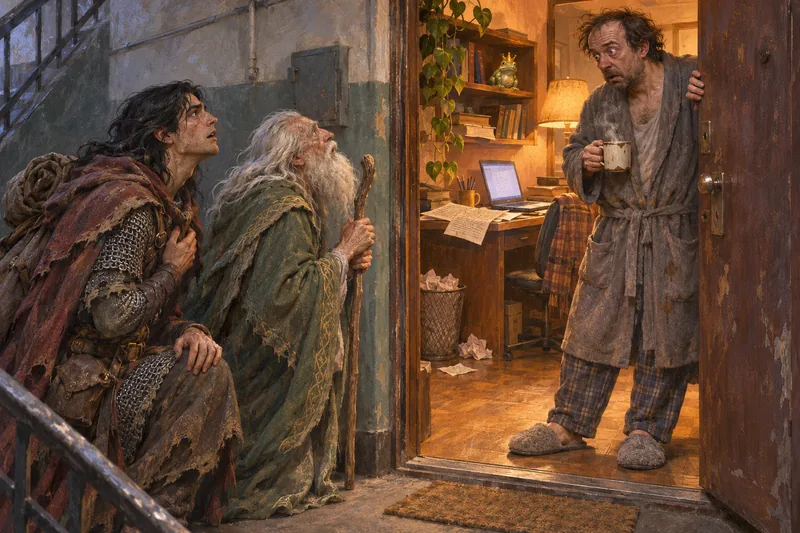
The portal spat us onto a road of grey stone, hard as a dungeon floor and longer than any king could afford to pave. Beasts of painted metal screamed past, faster than any horse I have ridden, each carrying a single rider who stared ahead as if bewitched. The wind they raised whipped my raven hair across my eyes.
Fenimore the Green lifted his staff to shield us, and nothing happened.
He shook it, the way one shakes a sputtering torch.
“This world,” he whispered, “has no magic in it at all.”
A red beast shrieked at us. Its rider leaned from a little window and offered an opinion of our mothers.
I dragged Fennimore onto the raised verge. My golden hair caught on the clasp of his cloak, and for a moment the last hope of the Free Kingdoms was occupied with disentangling itself.
Behind us the portal drew together. Through its narrowing light I saw the White Wizard lying beneath the broken arch, one hand still raised. Beyond him something immense was climbing over the abbey wall. He looked at us and moved his lips.
I stepped towards him.
The light went out.
There was a wall where the opening had been. Someone had written a short word upon it. I did not know the word, but the accompanying illustration suggested it was not a blessing.
Fenimore put his hand against the brick.
I have faced trolls and dragons and the Black Sorcerer’s hounds, and I had never before seen the old man afraid. He kept his palm there until another metal beast cried out behind us. Then he drew himself up and adjusted his hat.
“We have arrived,” he said.
It was a comfort to hear him state something with certainty, even something so difficult to dispute.
“Can you open the way home?”
“The Maker can.”
I turned my face from the wall.
“Then let us find him.”
The White Wizard had given us three things: the last of his strength, the name of the Eternal Maker of Space and Time, and a scrap of parchment bearing the number seventeen. Beneath the number he had drawn a tower with six windows and a door.
“Do you suppose it is a riddle?” I asked.
“All such knowledge comes veiled.”
Across the road stood a tower with six windows and a door. Beside the door was the number seventeen.
We contemplated it.
“A thin veil,” said Fennimore.
Crossing to it proved more difficult than the riddle. I would have preferred a ford of reasonable depth, defended by archers. We eventually followed an old woman who thrust a wheeled basket before her and compelled the metal beasts to halt by glaring at them. I bowed to her when we reached the farther bank. She asked if there was a convention.
“The kingdoms have yet to agree upon a place,” I admitted.
She went away shaking her head. Plainly even here our disunity was a matter of concern.
The tower had no guards. Its outer door stood propped open with a bucket, a degree of confidence I found heartening. Within, the air smelled of boiled cabbage and some fierce substance used to scour armour. Stairs rose around a shaft into which one could see a surprising quantity of dust.
“Leave your sword sheathed,” said Fenimore.
“I do not intend to threaten him.”
“You did not intend to threaten the ferryman.”
“The ferryman overcharged us.”
“And charged us twice as much after you cut his rope.”
It was not how I remembered the affair, but I saw no use in renewing an old dispute upon the threshold of eternity.
As we climbed, Fennimore told me what the White Wizard had told him. The Eternal Maker of Space and Time had spoken the first word, and the world had followed. He had given the sea its bed and the stars their places. He saw every ending before it began. He could unmake a mountain with a stroke of his hand.
“The Black Sorcerer has mountains,” I said.
“Then let him enjoy them while he may.”
I pushed my golden hair from my brow and confessed that my knees trembled, and not only from the stairs, of which there were a great many.
For thirty-seven days we had travelled through a kingdom that was coming apart. The dead walked its roads. The living hid beneath them, in drains and culverts. At Harrowmere the miller had taken the children into the granary because it was stone and had only one door. I had helped him drag the sacks against it. I had told his daughter we would hold the bridge.
She had given me an apple for the journey. It was a little green thing, too early in the year to be sweet.
We had not held the bridge. By dusk we could see the granary burning from the farther shore.
Above me the wizard paused upon a landing. He leaned on his staff and pressed his free hand to his side.
“Could he make it all as it was?” I asked. “Before the gates opened?”
“I do not know.”
“You said he could unmake a mountain.”
“A mountain is only a mountain, Caedmon.”
I considered what else to ask, how large a mercy it was decent to request. We had come for an army, or a weapon, or a word that would seal the fissures beneath our world. Yet if the Maker truly commanded time, Aldwyn might stand again upon the bridge. The granary door might open. The apple might still be on its tree.
There was another flight of stairs. I took it two steps at a time.
The highest door bore no sigil of power. It had a little brass eye in its centre and, beneath that, a narrow opening through which petitions might be inserted. A folded sheet protruded from it. Upon the sheet was a picture of a round feast divided into wedges.
“The turning of the seasons,” I murmured.
Fenimore studied it. “Possibly.”
I knocked three times, as a knight should knock upon the gates of a king. Nothing happened. I knocked again.
“Coming,” said a voice within. “Christ.”
“Another name of his?” I whispered.
Fennimore motioned for silence.
There came a thump, a curse, and the sound of several locks being undone. I bowed my head. My heart was beating harder than it had beaten at the bridge.
The door was opened by a man in a grey robe stained at the breast, holding a chalice of something steaming.
He looked at me, then at the wizard, and blinked.
“Fenimore?” he said.
We had not yet given our names.
I fell upon one knee. A small, hard object beneath the mat made this more of an offering than I had intended.
“Eternal Maker of Space and Time,” I said, “forgive our coming unbidden. I am Caedmon of the Western March, and this is Fennimore the Green.”
“One n,” the man said.
“One what, lord?”
He rubbed his face with the hand that did not hold the chalice.
“Nothing. Sorry. Is that real?”
I followed his gaze to my sword.
“Forged in the halls of the mountain kings. It has never failed me.”
This was true if one allowed for the bridge, the siege of Dun Barrow, and the incident with the ferryman, in each of which the sword had performed its particular task admirably.
The Maker looked past us towards the stairs.
“You’d better come in.”
His chamber was smaller than the council room at home, and considerably less well kept. Books lay open upon the floor. Garments hung over chairs as if their wearers had been suddenly taken up into heaven. Upon one wall a circle of marked bone counted away the moments with an audible click. The Maker had dominion over time, yet appeared to allow it considerable freedom indoors.
Behind him stood his altar, buried under loose sheets and crumpled scrolls. A glowing tablet rested among them. Upon it I glimpsed a page of close-set runes, and fancied one of the words was my own name.
The Maker folded the tablet shut.
“Sit anywhere.”
There was nowhere to sit. Fennimore lifted a mound of clothing from a bench, held it in uncertainty, and received no further instruction. I remained standing.
The Maker lowered himself into a wheeled throne. One of its arms had been repaired with grey ribbon. He set down the chalice and reached for a little black writing instrument, which he tapped against the altar.
“Right,” he said. “Where are we?”
I had hoped he might know that.
“Beyond the world, lord.”
“Yes. Obviously. I mean, what’s happened?”
I glanced at the wizard. He gave a small nod. Perhaps this was a test. The great powers often demanded an account of things they already knew. My father had done so whenever a window was broken.
So I told him.
I told him how the earth had opened beneath the Seven Shrines, and how the Netherworld had poured through, first in vapours and whispers, then in bodies. I told him of the Black Sorcerer’s banners upon the hills, of the fields where no seed would grow, of the watchfires we had counted each night until there were too many to count.
He made a mark upon a sheet.
“How many shrines?”
“Seven, lord.”
“Right.”
He crossed something out.
I told him of Aldwyn the Red, who had held the bridge at Harrowmere while we brought the wounded across. Aldwyn had burned so brightly that we could see our bones through our hands. Then the hounds had come out of the river beneath him.
The Maker winced.
“Yeah,” he said, rubbing his eyes. “Sorry about that.”
I waited for him to say more.
“He was brave,” I said at last.
“Yes.”
“He was still alive when they pulled him down.”
The Maker put his writing instrument aside.
For a moment he looked almost as wretched as we were, and I was ashamed of having spoken so harshly. What must it be to know the suffering of every creature? Perhaps the stained robe and the unwashed vessels were the outward signs of a grief too vast for ordinary observance.
“I’m sorry,” he said again.
This time I bowed my head to acknowledge it.
Fenimore set the clothing upon the floor and sat. He held his staff between his knees. Without its light he looked very old.
“The Black Sorcerer has taken the eastern provinces,” he said. “He sends us the tongues of our messengers in little boxes.”
“I was going for menacing,” the Maker muttered into his chalice.
“He has succeeded,” I assured him.
The Maker drank.
“And the Blue one? Did he ever come back from the—” He stopped. “No. Right. Of course he didn’t.”
“He went east to seek help,” said the wizard. “We kept a horse for him. Until we needed it.”
The little circle on the wall clicked. Somewhere beyond the chamber, water began to run through a pipe.
“The White Wizard sent us,” I said. “He opened the way with his dying breath. There are no others left to send.”
“I know.”
“Our people are sheltering in the western quarries. They have food for six days. The Sorcerer’s creatures cannot bear the sun, but the smoke is thickening. Soon there will be no sunlight even at noon.”
The Maker turned his writing instrument between his fingers.
“That’s good,” he said softly.
I stared at him.
“No. I mean, that’s—six days. That gives us something.”
“Yes,” said Fennimore. “Six days.”
I knelt again, this time upon a carpet gritty with crumbs.
“We ask no reward for ourselves. Give us the means to close the gates. Give us fire, or a host of your warriors, or the words we must speak. Command us, and it will be done.”
He looked down at my hands. They were folded upon the pommel of my sword. There was dried blood in the joins of the gauntlets, and the cord binding the left one had worn almost through.
“You’ve really been through it,” he said.
I could not answer. Such ordinary words, spoken with something like wonder, had found a place beneath my armour.
He leaned forward, bringing his face closer to mine.
“Wasn’t your hair black?”
“Yes, lord.”
“Right.”
He picked up his pen and wrote. A raven lock fell across my eyes. I brushed it away.
“I thought,” he said, “there’d be something in the White Wizard’s tower. Something you could find.”
“The tower has fallen.”
“Yes. Yes, I know. I mean before.”
“He would have given it to us.”
“Unless he didn’t know he had it.”
“He lived there for eight hundred years,” said Fenimore.
The Maker looked at the heaps surrounding his altar.
“That doesn’t necessarily help.”
He rose and went to a shelf. I stood with him, hope returning so swiftly it made me unsteady. Of course he possessed some greater weapon, something so perilous that he had first sought a lesser means. I had judged him by his dwelling and his garments. I had forgotten that true power had no need of display.
He moved a book, looked behind it, and put it back. He lifted a little glass globe containing a house in a snowstorm, shook it, and set it down. For a moment he studied a length of knotted cord.
Then he took from the shelf a small porcelain frog wearing a crown, chipped at one ear.
“Here,” he said. “Take this.”
I received it in both hands.
It was green, with a white belly, and no larger than an apple. Its golden crown had five points. Its mouth was turned up in an expression of immense self-satisfaction.
“What power does it hold?”
He studied the frog for a long moment.
“Honestly? Let’s find out.”
I had crossed worlds to stand before the Eternal Maker, and he was wearing slippers.
“Must I break it?” I asked.
“No. Don’t do that. I think my sister gave me that.”
I adjusted my grip with care. There were powers beyond him, then.
“Shall I speak to it?”
“You could.”
I looked to Fenimore. He had bent to examine a loose sheet upon the bench. His mouth moved, though he made no sound.
I held the frog before my face.
“The western kingdoms beg your aid,” I told it.
The Maker watched with an expression I could not interpret.
“The hour is late,” I added.
From the next chamber came three sharp notes. The Maker flinched.
“Sorry. That’ll be my lunch.”
He went through a little doorway, leaving me with the frog.
I lowered it.
The old man still held the sheet. There were two names upon it, underlined in the same ink: Fenimore. Fennimore. Beneath them something had been written and crossed out so thoroughly that the paper was nearly torn.
“What is it?” I asked.
He put the sheet down.
“Nothing I understand.”
“Can you sense a virtue in this thing?”
He touched the crown with one finger.
“No.”
I turned it over. Upon the base were three small marks and a fleck of brown glue.
“Perhaps we must carry it home before its power awakens.”
“Perhaps.”
I wished he would tell me I was right. Fenimore had always been ready with a difficult answer, and I would gladly have accepted one now.
The Maker returned carrying a dish. He cleared a space upon the altar with his forearm, sending several pages to the floor, and sat down.
“We will need a way back,” I said.
“Of course.”
“The White Wizard is dead.”
“I know.”
He took up the pen and pulled a fresh sheet towards him. He wrote a few words, stopped, and drew a line through them.
I waited. He wrote again.
“Is it difficult?”
“It shouldn’t be.”
For the first time there was anger in his voice. He put the pen down very carefully.
“I just need to work out how to get you out of this.”
“The door is behind us,” I said.
“Not this room.”
He looked at the closed tablet, then at the page. He had not touched his food.
“There’s so much of it,” he said. “Every time I fix something, something else goes wrong.”
I knew that weariness. I had seen it upon the faces of commanders bending over maps, moving little wooden towers between towns that no longer existed. I put the frog upon the altar and laid my hand beside it.
“Then begin with something small.”
He looked up.
“There is a girl in the quarries,” I said. “Mara. She lost her brother on the road. He was taken with the baggage train. If he lives, let her find him.”
He looked helplessly towards the wizard.
“Mara?”
“She was not a princess. You may not have heard her name.”
“No,” he said. “I haven’t.”
“Then I will tell you about her.”
“Please don’t.”
He said it quietly, and at once put a hand over his eyes.
“Please. There are already too many.”
I drew my hand back.
Fenimore rose. The clothing at his feet stirred, and a sheet slipped free of it. He stooped, picked it up, and stood reading.
The Maker uncovered his face.
“Look, I’m trying. I haven’t given up. You’re here, aren’t you? That’s something. That could actually be something.”
He began to write.
His expression altered. His shoulders lifted. For the first time since he had opened the door he seemed pleased to see us.
“Yes,” he said. “All right.”
I picked up the frog. Beyond the Maker, the window had darkened enough to hold a reflection. I saw the bent wizard, the crowded altar, a tall young man with golden hair.
No. My hair was black.
I drew a lock between my fingers. It lay bright against the leather.
My mother had called me her little crow. I remembered her hand upon my head. I remembered her calling me her golden boy.
Both memories were clear. Both had always been true.
Behind me, Fennimore made a small sound.
“Caedmon.”
He held out the sheet.
I read of a bridge. Of a red wizard burning brightly. There was a sentence about the bones in our hands.
Below it, in the margin, the Maker had written: Let him scream. Caedmon needs a reason to go on.
I read it again. The pen scratched against the altar.
“We came to meet our Maker,” said Fenimore. His voice had become very thin. “We just didn’t understand the words.”
The man did not look up.
Realization dawned, and tears sprang to my eyes. Aldwyn screaming on the bridge. The miller pushing the last sack into place. The little green apple the girl had pressed into my hand. I had carried it for three days after Harrowmere, unable to eat it, unable to throw it away.
I looked at the baskets of crumpled paper. I looked at the food cooling beside his hand.
“You made the hounds.”
“Yes.”
His pen was moving quickly now.
“You put the children in the granary.”
He swallowed. He kept writing.
“They were children.”
“I know.”
“Then bring them back.”
“Caedmon—”
“Bring them back.”
“You can’t just undo everything. It has to mean something.”
Fenimore sat down heavily upon the bench. He was crying, without covering his face. I had never seen him do that either.
“Stop writing,” I said. “Look at me.”
He would not. Upside down beneath his hand I saw the words Look at me appear.
My sword hung at my side. I reached for it, and the frog caught in my gauntlet. Its beak pressed sharply into the flesh beneath my thumb.
Had it always had a beak?
“I will kill you,” I said.
He wrote that down.
The beak was long and white and sharp as a dagger. I closed my fingers around the little green body. Across the altar, just above the stained collar of his robe, a pulse fluttered in his neck.
“Look at me.”
His pen only moved faster.
I lifted it, and I str