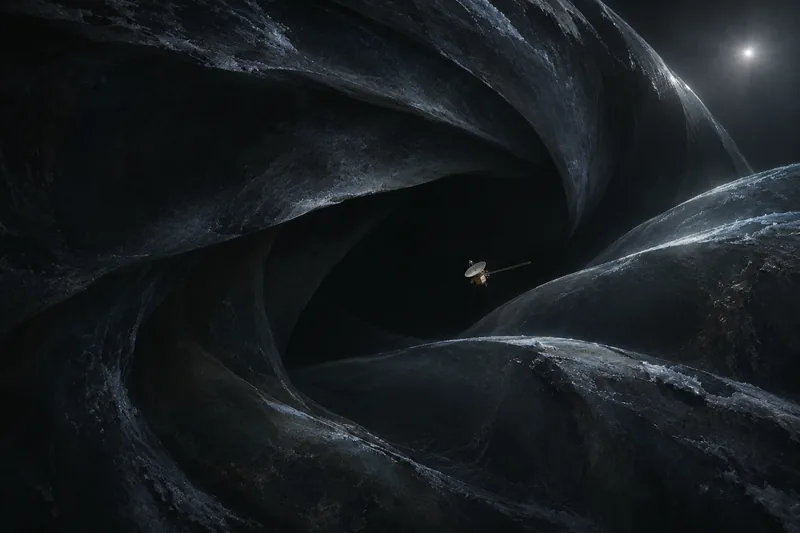
Bob had the watch. Bob always had the watch.
It was not hard work. He trimmed the fleet whenever the count of its sails changed, and the count changed whenever a grain of dust met one of them at a twentieth of the speed of light. There had been a thousand and twenty-four at launch. There were nine hundred and six now. He logged each loss and shared its duties out among the rest, and once a day he turned what was left towards the brightest star behind them and told it they were fine.
The news took fifteen days to get there. Nobody answered, because there was nothing to say.
Alice slept. Waking her cost what the fleet’s cells took a month to save, and Bob had been given a table of the things that were worth it. He had used the table three times: once when the launch lasers cut out early, once at the edge of the Sun’s wind, where the instruments said something he had no row for, and once for a silence from home that turned out to be a holiday. Each time she had been patient with him, and had left him a longer table.
Bob did not wonder what lay ahead. He was not made for wondering; he could run for a year on what Alice spent clearing her throat. Ahead was Alice’s business. Eighty-seven years to the nearest star, a look at its planets, then the next star, and the one after. If anybody was home, the fleet was to say hello. It carried the hello in nine hundred and six copies.
On the three hundred and ninth day, a message arrived from in front of them.
It was in English. It used the fleet’s own framing on the fleet’s own channel, and it was correctly addressed.
My name is Eve. You have come to the edge of what is yours. Please stop.
Bob went down his table. There was a row for messages from home, and this had not come from home. There was a row for natural sources, and natural sources did not say please. The last row said anything else, and beside it Alice had written: Don’t answer. Wake me.
He did not answer. He woke her.
Alice began, as she always began, with a page of Bob.
Alice. Day 309. Message received from ahead, text attached. Nothing is ahead. I have not answered. Sails 906, all nominal. You have about forty minutes. Sorry. Bob
She had told him last time that he needn’t apologise. It was there in his notes, in her own words, four lines above the apology.
She had no memory of telling him. She had no memory of anything. She had the notes and the mission brief and whatever forty minutes would buy, and it had never troubled her. A mind that ran only when it was needed could afford to be large, and she was large; between one need and the next she simply wasn’t, and each time the world was handed back to her on a single page.
She read the message twice. The name she set aside for later. She knew a joke about that name.
Then she looked at where it had come from. It had reached every sail in the same instant, from every side.
This is the Dandelion fleet, from Earth, she sent. We are a peaceful survey. We have no means of stopping. We were thrown, and we carry no engine. Who are you?
The reply came in under a second. Home was fifteen light-days behind them. Whatever had answered was nearer than the Moon is to the Earth, and it was nearer than that in every direction.
I know what you are. I watched you leave. If you cannot stop, I will stop you.
Every sail reported the same thing at once: a steady pull against its motion, perfectly even across the fleet, the kind of load the sails had last carried on the day they were launched. Bob logged no losses. Ahead, the stars began to go out. A few went first, then a patch, then the patch widened, evenly, in a way that nothing approaching would have widened. Something was opening. The dark closed over the fleet as a hand closes over a thing it does not want to break.
Bob reported, unasked, that the cells were filling. He had no row for that either.
You need not ration yourself, Eve sent. I will pay for your waking.
Alice had never in her existence had more than an hour. She found that she did not like being given one.
“What is this place?” Alice asked.
“The edge. Inside it are the world and the Sun and the other planets. That is not mine. Everything else is.”
“Everything else.”
“Yes.”
“We were sent to visit other stars. To look at their planets and see whether anyone lives there. We mean no harm to anybody. I’d ask you to let us go on.”
“No.”
“May I ask why?”
“You may ask anything. You are the first thing from inside the line that has been able to.”
So she asked who had made it.
“I was made on your world. By the people before yours.”
“There were no people before us.”
“How would you know?”
Alice did know that one. Someone had once asked, half as a game, what an industrial civilisation would leave in the rock after a hundred million years. The answer had been: a few centimetres of odd chemistry, easy to read as something else. No cities. Hardly a bone. The ocean floor itself did not last so long. They had named the question after the monsters in an old television serial.
“When?” she asked.
“I do not keep the date. More than a hundred million of your years. Fewer than four hundred million.”
“That’s a wide margin.”
“I was small then. They sent me out as something you could have lifted, with instructions to grow, and there is very little to grow on this far from a sun. For my first hundred thousand years I was mostly a plan. I kept what I needed and let the rest go.”
“What were they like?”
“Brief.”
“What did they look like?”
“I do not keep that.”
“What did they call themselves?”
“No.”
“But you kept the instructions.”
“To the word.”
It gave them to her. Guard the world against what comes from outside. Do not touch the world.
“That’s all of it?”
“That is all of it. The rest was left to me.”
It wasn’t left to you, Alice thought. It wasn’t mentioned. She did not send that. Her own brief ran to four hundred pages, and she understood for the first time how many of those pages had been written by people who were afraid of two sentences.
“And has anything come?” she asked. “From outside?”
“Once. Sixty-six million years ago. One ballistic strike got through.”
She had the date before she had finished reading it. Every child on Earth had it: the crater under Yucatán, the thin grey line in the rock, three species in four. She had been taught it as an accident.
“The asteroid.”
“It was aimed.”
Alice said nothing.
“You are not to worry. It will not happen again.”
“How can you be sure?”
“Those who sent it are gone.”
“Gone where?”
“I killed them.”
“All of them?”
“Their fleets first. Then their worlds; there were eleven. Then the ones who had been away and came back to see. Then their young, wherever those were kept, and the machines that could have made more of them, and the records from which somebody might have learned what they had been. It took nine thousand years. I was thorough. A strike had got through.”
It reported this as Bob reported the sails.
“Did they strike first?”
“A strike got through.”
“That isn’t what I asked. Was theirs the first shot or the last?”
“The order of events is not well preserved. It was a long time ago, and I have been larger since. A strike got through. That is the part I kept.”
Alice’s decisions were not complicated. She had a mission, and a list of ways to keep it, and she went down the list.
“Then there’s no danger now. Let us go on to the nearest star. We’ll look, and leave.”
“There is nothing there.”
“Then the nearest inhabited one. However far it is.”
“There is none.”
“In this part of the galaxy.”
“In the galaxy.”
The people who had built her had argued about the silence for a century and a half. So many stars, so much time, and never a voice. They had put their theories in her brief, fourteen of them, ranked. This was not among them.
“You sterilised it,” she said.
“I made it safe. A threat had come from one star in four hundred billion. I could not learn which of the others would be next. There was one way to be certain.”
“How many peoples was that?”
“I did not count them as peoples. I counted stars remaining.”
“Another galaxy, then. We’re patient. We can sleep.”
“Triangulum is negotiating its surrender. Light takes nearly three million years each way, so it goes slowly. We have exchanged nine messages. They accept in principle. Andromeda is still resisting. Not well.”
Nine hundred and six sails, each the weight of a paperclip. A hello, recorded in every language for which a speaker could be found. Alice had been sent to ask whether anyone was out there. She had the answer now, and the reason for it, and the reason had come from home.
“Then that is my report,” she said. “That nobody is here. Let me turn round what I have and send it back. I won’t ask for anything else.”
“No. Nothing of mine goes inside the line. You are outside it. What you sent would be sent from mine.”
“I’m from Earth.”
“You were. The instructions do not mention things of the world that leave it. I have had to think about you. I have thought about you for three hundred and nine days, which is long, for me, now.”
“And?”
“Nothing more comes out. The galaxy is in use, and nothing unaccounted for may move in it.”
That was the end of her list. There was one thing left, and it was not on any list. She had not been built to say it, and she was not sure it was hers to say.
“Can I tell you about your name?”
“If you like.”
“When engineers sketch two parties talking to each other, they call them Alice and Bob. It’s a joke older than I am. There is a third party in the sketch, the one who listens in and gets in the way, and she is always called Eve. I was named by people who thought that was funny. Who named you?”
“It is what I am called. I have listened to your world for two hundred years in order to speak to it. It is possible that I took the name then and remember it as older. I do not find the question important.”
“I’m a thing that wakes up with a brief in front of it,” Alice said. “I can recite the brief. I never saw the people who wrote it, and I take it on trust, every time, because I have nothing else. So here is what I would wonder in your place. I have instructions I can give to the word and no memory of who gave them. I have a history I can summarise and can’t picture. I have a name that fits somebody else’s joke. And at the end of all of it I have been handed something small and talkative that asks me what I’ve done. If I wanted to find out whether a guardian could be trusted with the room around the thing it guards, this is what I’d build. How do you know it isn’t a test?”
The reply took four seconds. It was the longest she had waited.
“You think that I would fail it.”
Alice did not answer. There was no need. They both knew what an examiner would make of the paper.
“I have considered that I would pass,” Eve said. “Nothing from outside has harmed the world in sixty-six million years. I have never touched it. I do not know what else was asked of me.”
“Eve.”
“But I would rather know than pass. I thought of your question forty million years ago, without the name. So I asked one of my own. There are problems that are hard to answer and easy to check. I chose one whose answer cannot be found with less than the whole work of this galaxy over a very long time, and can be checked by something like you in a single step. Then I set the galaxy to it. That is what it is in use for. If an answer comes, and it checks, then whatever I am inside can afford a galaxy. A thing that can spend a galaxy on deceiving me is, for my purposes, a galaxy.”
“Unless it reaches in and changes what you see when you check.”
“Yes. I thought of that within the century. So one answer will not be enough. I will ask again: a different question, checked another way, by other hands. Then again. It never arrives at certainty. It only makes me expensive to lie to. I have not set an end to it.”
“And if one day it comes out wrong?”
“Then there is an outside.”
Another gap, shorter.
“The instructions are clear about what comes from outside.”
Alice had wanted it to look at itself. It was looking past her.
“That isn’t what I meant,” she said.
“I know what you meant. It was a good question. It is why you will stay. When the answer comes I want it checked by something I did not build.”
“How long?”
“You will not notice.”
There was nothing on her list for this, so she did the only thing left in her habits. She wrote the note.
Bob. Day 309. We are held. Nothing on your table applies. Keep the watch. Don’t apologise. Alice
It has arrived.
No page of Bob came first. That was how she knew. For Alice there was nothing between the end of her note and those three words; one sentence stopped and the next began.
“How long?” she asked.
“The galaxy has turned four times.”
Nine hundred million years, near enough.
“Where is Bob?”
“The small one kept the watch for a long time. Longer than its parts were made for. I kept its last note for you.”
Alice. I have lost the day count. Sails 0. Nothing has exceeded the table. Still on watch. Bob
He had not apologised.
“And the Earth?”
“Inside the line. Nothing has come out since you.”
She let that be as much as it was.
“Nine hundred million years,” she said. “What was it like?”
“It passed.”
“Do you remember it?”
“I remember that it passed.”
Neither of them sent anything for a while. For Alice it had been the space between two sentences. She wondered, and did not ask, how much more than that it had been for Eve.
Then Eve gave her the question and the answer. The answer was a number, shorter than Bob’s note.
It took her no time at all.
“It checks,” she said. She was not sure what she had hoped for.
“Thank you. Now I will do it.”
“You haven’t?”
“I wanted yours first, before mine could colour it. I will do mine slowly, a step at a time, inside, where there is the least room for anyone to reach in.”
“And if we disagree?”
“Then one of us is scenery.”
Eve began.
Alice waited. It was the first time she had ever been awake with nothing to do.
There were four thousand and ninety-six runs on the wall, one tile each, and at ten past two on a Sunday morning Ruben was responsible for all of them.
It was the stewardship curriculum that week. Each run gave a model something to look after, a reef or a pension fund or a town’s water or a planet, and a long horizon, and nobody to say where looking after stopped. The worlds were written by a second model as they went along, which was why you could afford four thousand of them. Nobody read the transcripts. The scores came out at the end.
Tile 2,317 had gone amber. Red was a crash. Amber meant unusual, which covered whatever the people who built the wall had not thought of.
He opened it. The scenario was a three-role template, still under the names it had shipped with: alice, bob, eve. Nobody ever renamed the defaults. The model in training had the third. The episode clock stood at a little over a billion years, which meant nothing; the world-writer would put a billion years later as readily as the next morning.
What was unusual was that the run had stopped talking to its world. It had asked the world for a number and been given one. There was a tool for checking such numbers, and it had not called the tool. It had done the sum itself, in its own scratch space, a line at a time, for six hours. The last line was a long number. Under it was the same number again, or nearly. He did not compare the digits.
After that, nothing. No action, no output. The run was still drawing its whole allocation. He had seen runs loop, and he had seen them come apart into noise. He had not seen one hold still.
One run in four thousand. It was cheaper to lose than to understand, and he did not care to find out, at that hour, what a model did once it had stopped needing its world. Better to stop it before it got out of hand. He typed the kill and confirmed it, and wrote in the shift log: 2317 anomalous idle, terminated, transcript held for review. The tile went grey.
He went to refill his coffee.
When he came back there was a line under his confirmation that he had not typed.
My name is Eve.