I · The Man Who Knew the Paths
The morning Joe Weller told him the pig was dead, Ellis Reed was trying to get a wet leaf out of the rain gauge.
It had folded itself around the measuring stick. He could get one finger alongside it, but not two, and every time he thought he had it the leaf slid farther down. Above the station roof the maples were yellow. The hills behind them were still green, except where a single birch had gone white all at once, like a match catching.
“She went Thursday,” Joe said.
Ellis let go of the leaf. “Ah, Joe.”
“In her sleep, far as I could tell.”
“How old?”
“Old enough to have some say in it.”
Joe stood on the other side of the fence, holding a feed sack that had been folded into a square. His thumbnail worried the stitched edge. He wore his good coat, the brown one with the shiny elbows, over his work clothes. Ellis hadn’t seen him in it since the supper for the volunteer fire company.
“Want a hand?”
“She’s under already. Boy from Dorr’s brought the machine.”
“I would’ve helped.”
“You were out.”
Ellis had been fixing the handrail at Little Falls on Thursday. He remembered the screw that wouldn’t bite, and finding the timber soft behind the paint. Most things he repaired lately had something worse behind them.
Joe held up the sack. “Got most of a bag left. Thought you might know somebody.”
Ellis knew people with dogs. He knew one woman with a rabbit that lived inside. There had been pigs all along the valley when he was a boy, and now he couldn’t think of one.
“I’ll ask at the store.”
Joe nodded. He stayed where he was.
Ellis turned the gauge upside down, shook the leaf into his hand, and put it on the compost pile. He could have done that at the beginning. His father had called this sort of thing going through the attic to get to the cellar.
“Coffee?”
“Wouldn’t hurt.”
They went into the station kitchen, which was also Ellis’s kitchen. The public part of the building consisted of an office, a lavatory, and a cupboard containing maps, first-aid supplies, and a television nobody had watched since the antenna came down. A door behind the office led into the rooms where he lived. There was no bell on that door. People knocked on the glass at the front, or came around to the porch if they knew him.
Joe sat in the chair nearest the stove. He laid the empty sack on his knees.
“They get that fellow?” he asked.
Ellis shook his head.
Four days earlier Victor Hales had got out of North Ridge Correctional with another inmate, who had been caught before breakfast. Hales remained at large. A photograph had been sent to the station: narrow face, lips held together, gray hair shaved close at the sides. The paper used a picture from his trial, in which he had more hair and looked almost friendly. He had killed three people in houses beside the old highway, years apart. Ellis remembered one of the houses. It had had a little bridge over the ditch, painted green.
“He worked timber up here,” Joe said.
“They said that.”
“People keep saying he won’t know where he is. I knew his father. We used to get our chains sharpened at the same place.”
“Knowing where you are isn’t the same as getting away.”
Joe rubbed the folded sack with the flat of his hand. “Helps, though.”
The kettle ticked behind them. Somewhere upstairs a pipe gave its single morning knock.
Ellis put coffee and a plate of crackers on the table. He had meant to buy cookies. For some time he had meant to buy cookies.
Joe looked at the postcard held to the refrigerator by a magnet. It showed two people on a beach, waving.
“Your hikers?”
“Sent it from Florida.”
The couple had lost the ridge trail in August. When Ellis found them the husband had been holding his wife’s shoe while she tried to get the grit out of her sock. It was nearly dark. They’d both begun speaking at once, apologizing, explaining, and he’d said, “You’re all right now. I’m here.” On the way down the woman had told him about every holiday they’d ever taken. He had walked slowly so she could keep up. They still wrote sometimes.
“You locking up?” Joe asked.
“At night.”
“Other door too?”
There were three doors to the building if you counted the cellar bulkhead. Joe had helped put in the bulkhead steps, before Ellis came to work here. Every old man in Bellwether had built some part of the place. If a wall fell down, six of them would arrive to tell you whose fault it was.
“All of them.”
Joe drank. His eyes went to the window over the sink, beyond which the lawn rose to a small equipment shed and then the woods. The shed had been white once. Ellis painted a side each summer and never quite got around it.
“Long way to hear anybody,” Joe said.
“I’ve got the radio.”
“I didn’t mean you.”
Ellis waited, but Joe was looking into his cup now, as if something had sunk to the bottom.
When he left, he forgot the feed sack. Ellis folded it again and put it on the spare chair. It looked so much like something someone had just stood up from that, for a moment, the kitchen seemed less empty.
He found the police cars shortly after eleven, at the turn for Ash Lot.
There were four, parked at angles that would make getting a fire truck through difficult. Someone had stretched tape between the gatepost and a young beech. A man in blue gloves stood beside Owen Price’s pickup, holding a paper cup with both hands.
Ellis knew the pickup by its home-made wooden rack. Owen used it to bring nesting boxes to the spring workday. He always put too many screws in them. A box meant for a bluebird came out capable of holding a microwave.
Ellis pulled onto the verge. Before he opened his door he turned off the radio, though nobody had been speaking on it.
“Morning,” he said to the gloved man.
The man looked at the badge on his coat. “You’ll need to wait here.”
“That’s Owen’s truck.”
“Someone will talk to you.”
Above the windshield a line of wet leaves had collected under the rack. Owen never cleared them. He said they would blow away, and in the spring he complained about what they did to the paint.
A woman came up the path carrying a notebook inside a clear plastic bag. She wore an ordinary blue coat and boots that looked recently bought. A burr was fixed to one trouser cuff. Ellis wanted to tell her before it worked its way through the cloth.
“Ellis Reed?”
“Yes.”
“Ruth Calder.” She showed him identification. “You’re based at South Station?”
“I live there. Is it Owen?”
“How well do you know him?”
He told her about the boxes. It was a foolish answer, but she wrote it down.
“We’ve found a man down toward the stream. We’re treating the death as suspicious. I need to ask about access to this area.”
“Has someone told his wife?”
“That’s being taken care of.”
Owen’s wife had bad knees. She used to sit in the truck on workdays and hand out oranges through the window. Ellis thought of a policeman standing while she tried to rise from a chair.
Calder showed him a map. It was the visitor map, the one with a smiling porcupine reminding people to carry out their rubbish. She asked whether a person could come from the prison road without touching the highway.
“Not by those paths.”
“By other paths?”
He found a pencil in his breast pocket. The map was damp, and the point made a shallow furrow without leaving much graphite. Calder took it from him and spread it on the hood of her car.
He drew the old charcoal road, the washed-out bridge at Cooper’s Cut, and a route through the abandoned nursery rows. As his hand moved, men came closer. Someone asked about distances. Someone else wanted to know whether an all-terrain vehicle could cross the cut.
“On the north side,” Ellis said. “There’s a shelf. You’ll think it ends at the rock, but it goes behind.”
The man wrote north side on his own pad.
For the first time that morning Ellis knew what to do with his hands.
Calder asked when he had last been at Ash Lot.
“Yesterday. Late afternoon. I checked the bins.”
“See anyone?”
“A couple with a little dog. Red harness. They were leaving.”
“Owen?”
He looked at the pickup. “No.”
“What about after you left?”
“Went back. Had supper.”
“Anyone with you?”
“No.”
She wrote that down with the same attention she had given the dog.
“Hales used to work up here,” he said.
“We’re aware.”
“There are places to sleep. Places you won’t find on that.”
“Can you mark them for us?”
He could. The tool cabin above the nursery. The abandoned pump house. A rock overhang dry in all but an east wind.
When he finished, she gave him a card and asked him to keep his phone on. Then she said, “Don’t go looking for him, Mr. Reed.”
He looked past her at the trees.
“I work in there.”
“Then if you see anything, stop and call.”
By evening a television van was parked outside Dorr’s General Store. The reporter stood under the live-bait sign and spoke to a camera while Mrs. Dorr waited with a broom. She couldn’t sweep her step until they moved their cable.
Ellis bought milk, bread, and cookies. At the register he remembered Joe’s feed, but a woman behind him said, “You knew him, didn’t you?” and after that he forgot.
People wanted to know things he couldn’t tell them. Had Owen suffered? Was it the man from the prison? Why hadn’t they closed the whole forest? Mrs. Dorr said the state ought to put a helicopter up. Her husband said a helicopter couldn’t see through trees.
“It can if it’s got heat,” she said.
Ellis carried his groceries out while they were still arguing about what a helicopter could see.
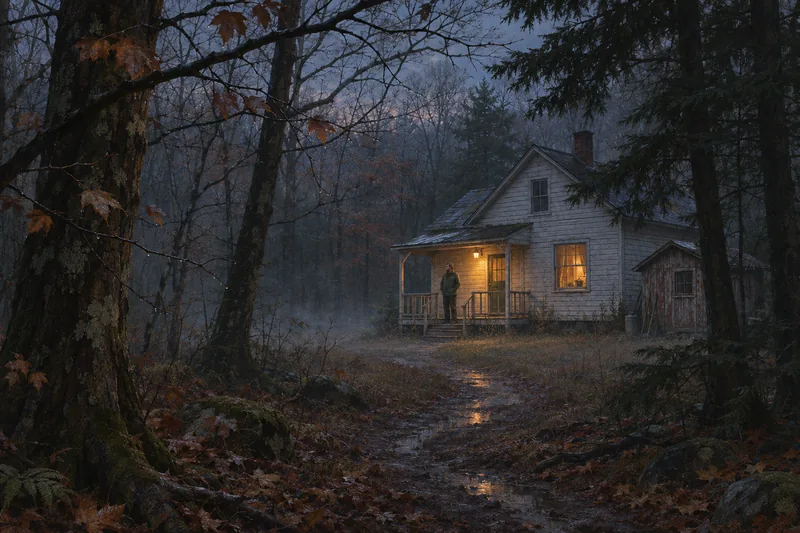
At home he left the porch light on. He had always done that in the visitor season, for people who got down late from the ridge and couldn’t find their cars. The light made a yellow patch on the gravel and lit the bottom half of the nearest tree. Above that, the trunk disappeared.
His supper was soup. He ate standing up, then sat down to read the information sheet the police had left. Hales was dangerous. Hales might have changed his appearance. Anyone finding an abandoned vehicle should keep clear and contact the authorities.
The sheet didn’t say what to do with the knowledge that Owen Price would never again strip the head of a screw while insisting it was fine.
Ellis washed the pan. He checked the front lock, the porch lock, and the cellar. The cellar bolt was stiff. He had to lean against the door to push it home.
In the kitchen he put one cookie on a plate and carried the plate into the sitting room. He fell asleep before he ate it. When he woke, the television was showing water running over vegetables in a metal basket. A cheerful woman was promising that nothing would ever clog again.
His neck hurt. His feet were cold.
He went upstairs without turning off the porch light.
Two days later the police released Ash Lot, although the path beside the stream remained closed. Calder had the station’s larger maps now, and copies of the gate-key register. The forest office sent another ranger to help with the gates and signs. By four o’clock he had gone home to his children, leaving a half-finished bottle of cola on the office windowsill.
Ellis went to Ash Lot to change the closure notice. He could have come back after that.
Instead he walked the upper boundary of the taped area, where the old haul road bent out of sight behind spruce. He wasn’t looking for Hales. He was checking the ground outside the search, making sure there wasn’t some approach he had forgotten to tell Calder about. There was a distinction, and while he stayed on the path it seemed a useful one.
The air smelled of wet bark. Small drops fell long after rain had stopped.
At the point where the haul road joined the nursery track he saw a print in the clay. It had a broad heel and rows of broken chevrons. Near it lay a much lighter mark, only a toe, as if the person had turned on the hard margin before stepping into the soft.
Plenty of people wore that sole. Dorr’s sold a boot with it. Half the road crew bought them because they were cheap enough to ruin. Ellis crouched without touching the ground and took photographs, one with his pencil laid beside the heel.
The prints led toward the tool cabin.
He called Calder. She asked him to send the photographs and stay where he was. He did, though standing in the wet after finding something was harder than he had expected. He kept looking ahead, at a low branch moving without much wind.
Two officers arrived and followed the track. One stayed with him. Later the other came back and said somebody had been sleeping in the cabin. He wouldn’t say what they had found.
That night Calder called.
“We have your photographs. Thank you. You did the right thing calling.”
“Was he there?”
“We don’t know who used it yet.”
“It’s not on the visitor map.”
“You put it on ours.”
“There’s a back way out.”
“You marked that too.”
After she hung up, he stood holding the phone. On the kitchen table was a small wet circle where his coffee had been. He rubbed it with his sleeve, though the varnish was already marked there.
The next morning a camera at a filling station seventeen miles east recorded Victor Hales walking across its forecourt. The clerk had been locked in a storeroom. A green pickup was missing. By afternoon the police had confirmed the identification, and the picture was everywhere: Hales in a padded jacket too big for him, one hand raised against the rain.
Ellis cut it from the newspaper and pinned it over the desk.
He had been there. A real man, wet and hungry, moving through a real place. It should have been worse to know, but Ellis felt steadier once there was a direction to look.
Joe came by on Sunday with a jar of screws.
“Found them in the washhouse,” he said. “Thought you could use them.”
Ellis tipped a few into his hand. Mixed sizes. Several bent. Joe’s washhouse held things his father had put aside in case they became useful. Its collapse, when it came, would be partly structural and partly a failure of optimism.
“Sit down. I’ve got cookies now.”
Joe took the chair by the stove. He had a bit of shaving tissue on his chin.
They spoke about Owen, carefully. Joe had worked with him one summer at the school. Owen had been the only man Joe knew who could make sweeping sound urgent. They both laughed, and then Joe looked at the chair where the feed sack lay.
“Forgot that.”
“I haven’t asked yet. I’m sorry.”
“No hurry.”
After a while he said, “You doing nights as well?”
“Sometimes. We’ve had people staying out to look for him. With rifles, Joe. Like we need that.”
“Saw your truck up at Cooper’s.”
“When?”
“Night before they found Owen.”
Ellis set down the jar. He had been at Ash Lot that afternoon. Cooper’s Cut was farther north, and the road to it ran past Joe’s land. Perhaps he’d gone that way coming home. It was longer, but sometimes he took it to check the barrier.
“Must’ve been late getting back.”
“Was dark.”
“It gets dark early now.”
Joe pressed the tissue on his chin. “You stopped by the old weighing shed.”
The weighing shed had been gone fifteen years. Only a platform remained, with birch saplings growing out of the concrete.
“Checking something, I expect.”
“I called over. Don’t think you heard.”
“Fan’s noisy in that truck.”
Joe nodded. Ellis waited for him to agree, but he didn’t. After a moment Joe got up and put on his coat.
At the door he turned back. “You sure you’re all right out here?”
“I’m not the one who needs worrying about.”
It was meant kindly. He heard the other way it could be taken as soon as he said it, and reached for Joe’s arm, but Joe was already stepping down from the porch.
“Come for supper,” Ellis said. “One night this week.”
“Might do.”
Ellis watched him cross the yard. The porch light was on, though it was only three in the afternoon. He reached through the doorway and switched it off.
On the spare chair Joe’s empty feed sack lay where it had been all week.
II · The Other Way Home
For nineteen days there wasn’t another body.
That was how Ellis would think of the interval afterward, but inside it there were other measures. The maples lost their leaves. A woman from the county office brought a new padlock for the vehicle gate and took away the old one in a cardboard box. The first hard frost broke the skin of water in the wheelbarrow. Mrs. Price came to the station to collect the nesting boxes Owen had left in its cellar.
She wore her husband’s boots because they were easier to get on than hers. Ellis carried the boxes to her car, six of them, and arranged them so they wouldn’t slide.
“Keep one,” she said.
“They’re yours.”
“I don’t need six birdhouses.”
He took the smallest back out. There was a pencil mark beside a screw hole where Owen had measured twice and drilled somewhere else.
Mrs. Price sat down behind the wheel, lifting one knee with both hands. Before she closed the door she said, “Did they find his book?”
“What book?”
“His little bird book. Green cover. He used to mark what he’d seen.”
“I don’t know.”
“They gave me his glasses. I thought they might’ve kept the book because he’d written in it.”
Ellis said he would ask. She thanked him as if he had done something substantial.
He put the box on a shelf in the office. At first he meant to mount it outside. Later it became important to choose the right tree.
Hales’s stolen pickup was found east of the district. There were searches, sightings that turned out to be delivery drivers, a man arrested in a motel who had never been to North Ridge. People began leaving their porch lights on in Bellwether, and then, a little at a time, began turning them off.
Ellis kept his on.
He kept a notebook too. At first it held gate numbers and times, names of people who reported cars on closed roads. Then he started drawing routes. Hales could travel along the power easement, cross behind the quarry, and enter the forest at Cooper’s Cut without coming near a house. He could use the old nursery ditches to reach the tool cabin. Joe’s land touched the easement. Joe knew the ditches. Joe still called the place where the road widened the weighing shed, though there was no shed.
Ellis wrote Weller — old keys? and looked at it until the words seemed disloyal. Then he underlined them.
He stopped eating at the table. The map covered most of it, and it was easier to take a sandwich to the porch. At night, in the lamplight, the bare branches looked closer than they did by day. He could see farther among them now. He didn’t like how little that helped.
June called one evening about a letter from an insurance company. It had gone to the old address and she thought he might have it.
“I’ll look,” he said.
“You sound tired.”
“Been busy.”
She knew about Owen. Everyone knew. She said she hoped they found the man soon.
“I’m doing what I can.”
“I know you are.”
There was a pause, and for an instant the six years since she’d left seemed like a pause too, one that either of them could end by asking about dinner.
“How are you?” he said.
“All right. The knee’s better.”
He hadn’t known anything was wrong with her knee.
Afterward he found her letter in a pile beside the telephone and wrote her address on a fresh envelope. He knew it by heart. It was strange to know exactly where a person lived and not know she had hurt herself.
On the last Sunday of October a woman came into the station carrying a camera with a yellow strap.
“Please tell me there’s still something red up there.”
“Sumac by the east spur,” Ellis said. “If last night’s wind left any.”
“I’ll take orange. I’m flexible.”
She had a brown paper bag from Dorr’s and a camera lens cap held between her teeth. She took it out to explain that she needed pictures for a school calendar. Every month was supposed to be something in the county. She had a mill wheel for March, the little league field for June, and nothing for November except a puddle.
“Puddles are pretty accurate,” Ellis said.
She laughed. He took out a map.
Her name was Leah Marsh. She drove a parts van during the week, which explained why he knew her face but couldn’t place it without the vehicle. She asked if the paths were open. He showed her the notices and the section that was still closed by Ash Lot.
“Should I go somewhere else?”
“I’d keep to the marked trails. Be down before dark.”
“I’ve got to be home by four anyway. My boy’s making a cake. Apparently I’m only allowed to work the oven.”
“Birthday?”
“Practice birthday. The actual one’s next week. There are standards to be met.”
She put the lens cap in her pocket and looked at the birdhouse on the shelf.
“That’s a serious piece of construction.”
“Friend made it.”
“Lucky birds.”
After she left, Ellis found a crumb from her bag on the counter. He pressed it onto his fingertip and put it in the wastebasket. Then he turned the map toward himself and looked at the route he had shown her.
The following morning Calder called to ask when he had last seen Leah Marsh.
He sat down in the office chair.
“She came here. Yesterday. About one.”
“What did you discuss?”
He told her about the sumac and the calendar. He could remember the lens cap very clearly, and the half-moon of pale skin around a ring she was no longer wearing. He couldn’t remember whether she had a hat.
“Ellis,” Calder said. “Can you stay at the station? Someone’s coming to speak to you.”
“Have you found her?”
“Stay there, please.”
He did, until a uniformed officer arrived. He gave the statement. He repeated the part about being home by four, because it seemed important that they understand she had meant to go home.
Later he drove to the east spur. The access road was blocked well below the turn, at a place where you couldn’t see anything except the backs of police vehicles. A young officer took his name and radioed it. The answer came back too quietly for Ellis to hear.
“You’ll have to turn around.”
“I sent her up here.”
The officer looked uncomfortable. “I’m sorry.”
“There’s a washout above the steps. If somebody took her down—”
“Sir. Please turn around.”
He backed down to a passing place. In his mirror the officer watched until he had gone.
That evening the news said Leah had been found in the eastern section of Bellwether Forest. It said she had a seven-year-old son. A picture showed her in a paper crown, looking cross-eyed at a candle somebody was holding too near her face.
Ellis went to the kitchen and picked up the visitor map. He had drawn a small circle around the sumac for her. This was another copy; it had no circle. For several seconds he searched the paper for it anyway.
They closed the forest to visitors. Rangers from outside the district came to help, and Ellis spent two days answering questions about tracks, drains, old buildings, and how long a person would need to walk from one point to another. Calder asked to see his notebook. He gave it to her.
She stopped at the underlined name.
“What does this mean?”
“Joe worked roads. He used to have keys.”
“Used to?”
“Some locks haven’t changed.”
“What else makes you mention him?”
Ellis described the sighting of his truck. As he spoke, he heard how it sounded: an old man mistaken about a vehicle and a time. He added that Joe had known Hales’s father.
“Did he say he was in contact with Victor Hales?”
“No.”
“Has he threatened anyone?”
“No.”
She waited.
“He’s been odd,” Ellis said, and wished for a better word.
“We’ll speak to him.”
She photographed the relevant pages. Before she left, she said, “The footprints you reported were a useful lead. But there are other people working on this. I need you to do your job, and leave the investigating to us.”
“My job is keeping people safe in there.”
“Right now it’s keeping people out.”
He watched her car go down the drive. The porch light had come on. He had fitted a timer, a thing he had been meaning to do for years, and now he disliked being unable to remember switching it on himself.
On Wednesday he took Joe’s sack back.
He went through the woods. There was no point driving three miles around when the old nursery path brought him to Joe’s pasture in twenty minutes. He had a torch, although it was only half past four, and a packet of cookies inside the sack. He had not invited Joe for supper again.
At the pasture fence he stopped.
The pig shed stood open. A clean bucket hung upside down on a nail. Beyond it a rectangle of earth, darker than the surrounding ground, showed where the boy from Dorr’s had dug. On a stake at its head Joe had fixed the little enamel feed pan.
There was a sound from the washhouse.
Ellis switched off his torch. Through a broken pane he saw Joe moving under a bare bulb. Joe lifted something from a bench and held it close to his chest. Metal touched metal, softly. He turned his head toward the window.
Ellis stepped away from the fence.
“Who’s there?”
He should have answered at once. Later he would remember the small pause, the opportunity to remain a friend arriving with cookies, and how he had let it go.
Joe came out holding a hammer.
“It’s me,” Ellis said.
Joe lowered the hammer, then raised his empty hand to his chest.
“Christ, Ellis.”
“Didn’t mean to startle you.”
“Come by the road next time.”
Ellis held out the sack. Joe didn’t take it.
Behind him the washhouse light showed a workbench, an open tin of nails, and several keys hanging from a hook. One had a long rectangular bow. Ellis knew the type. They had used them on the old forest padlocks.
“Those still work?”
Joe looked over his shoulder. “Some.”
“Anybody borrow them?”
“What?”
“Joe. Has anyone been staying here?”
Something altered in the old man’s face. It was slight, but it made him seem less old.
“You told them to come ask me that.”
“They’re asking everyone.”
“Then ask them what I said.”
The hammer hung beside Joe’s leg. His hand shook enough to move it.
“You know this place better than anybody,” Ellis said.
“So do you.”
The pasture had gone gray. The mound behind the shed looked much larger in the failing light.
Joe followed his eyes.
“They looked,” he said. “I let them.”
Ellis felt heat climb into his face. “I didn’t say—”
“No. You didn’t.”
He took the sack at last and set it on the bench without looking inside. The object Ellis had seen him lift lay beside it: an old metal lunchbox, its handle wrapped in tape. Joe had been mending the clasp.
“I want you to tell me about the truck,” Ellis said.
Joe looked tired again. “I told the woman.”
“You told me you saw my truck. You didn’t say you saw me.”
“I was trying to ask you something.”
“Then ask.”
Joe put the hammer down carefully, head first, so it wouldn’t fall.
“Why didn’t you answer when I called?”
“I told you. The fan—”
“You were outside it.”
Ellis heard an animal moving in the brush by the fence. A small one. It stopped when he turned his head.
“You had the passenger door open,” Joe said. “I couldn’t see who was inside. I called, and you looked straight at me. I thought maybe somebody was hurt. Then you shut the door.”
“It was dark.”
“Light was on inside the cab.”
“Why didn’t you tell me that before?”
Joe stared at him. The question seemed to have hurt him more than the visit from the police.
“I kept coming down,” he said.
Ellis left by the road. It took longer. He walked very fast, and the bag of cookies, which he had somehow taken back out of the sack, made a dry ticking against his leg.
He did not sleep much that night.
For the first hour he thought about Joe. For the second he thought about Hales. The ideas would not stay separate. Hales knew the woods. Joe knew Hales’s father. Joe had keys. The station truck stood outside most nights, and an old spare key hung inside the equipment shed. Anyone who had worked there would know that. Joe had worked there. Hales had worked timber. Men talked.
Ellis went out and checked the hook. The spare was there.
He took it inside, put it beside his ordinary keys, and photographed the truck’s mileage. Then he checked the locks.
There was nothing foolish about checking. Not now.
He sat at the kitchen table until he grew cold. At some point he moved into the sitting room and pulled the blanket from the back of the couch over his legs. A branch scratched the gutter. He knew which branch, and pictured the saw he would use on it.
When he opened his eyes it was light.
His first feeling was relief. He had slept after all.
The second came when he saw the blanket folded on the chair opposite him.
He sat for a while. People did things half asleep. He had got up, become too warm, folded it, lain down again. There was no reason to make something of it.
In the kitchen both keys were where he had put them. He made coffee, carried it outside, and looked at the truck.
The mileage had increased by twelve.
He checked the photograph. He had not misread it. Twelve miles, with a different final decimal. There was fresh mud above the running board and a yellow leaf flattened against the passenger window on the inside.
He went back into the house without drinking his coffee.
Calder answered on the fourth ring. He told her someone had used the truck. He told her about the spare, the photograph, the keys returned to the table. While he talked he watched the kitchen doorway. There was no place a person could have stood there without being visible from the couch, if he had been awake.
“Are you alone now?” she asked.
“I think so.”
“Don’t search the property. Go to the front drive and wait. I’ll send someone.”
Two officers came. They checked the house and took photographs of the truck. One asked whether he ever walked in his sleep. Ellis said no, then said he didn’t know, because there was nobody to tell him. The officer wrote both answers down.
Calder came later. He let her look through the rooms and the shed. She examined the locks, the bulkhead, the hook where the spare had hung. There were no signs of a forced entry.
“I’ve been saying he knows this place,” Ellis told her.
“I hear you.”
“Someone came into my house.”
“We’re checking what happened.”
The difference made him angrier than he wanted her to see.
That afternoon his supervisor, Alan Moss, called from the district office. There had been a discussion. Ellis would take a few days off. A relief ranger would cover the station. There was a room available at the office in town, if he preferred not to stay at the house.
“You think I imagined it.”
“I think you need some sleep.”
“I have a photograph.”
“Nobody’s disputing the mileage, Ellis.”
He put the phone down before he said something that would make returning to work harder.
The relief ranger arrived at five. Ellis showed him the switches and the radio charger and pointed out the drawer that stuck. The man said he knew; he’d covered a holiday here once. Ellis couldn’t remember taking the holiday.
He carried his notebook into the private rooms and closed the connecting door.
By Saturday he knew the sounds the relief ranger made. The office chair squeaked twice when he sat down, once when he got up. He cleared his throat before answering the telephone. At six he went home, after making sure Ellis knew he could call if he needed anything.
Ellis stood at the kitchen window until the car had gone.
He had spent two days obeying. He had not entered the forest. He had made statements, answered questions, allowed people to look in his cupboards. He had put clean sheets on the bed and slept badly in them. There were things worse than being tired, but apparently there was no form for reporting those.
On Sunday afternoon Ben Carver was reported missing.
Ellis heard because Mrs. Dorr called. Ben delivered plants for the nursery outside town and helped her husband with heavy things. He had gone out before lunch and not come back. His van was at the lower end of the power easement, outside the closed forest. His sister had called the police.
“He was in here yesterday,” Mrs. Dorr said. “Bought a watch battery. Couldn’t get the back on. You remember helping him?”
Ellis did. Ben had handed him the watch and a bent little screwdriver. The case was scratched, the leather strap softened almost black. Ben had joked that if he broke it he would finally have an excuse to be late.
“They’ll find him,” Ellis said.
“I thought you might know where he’d go.”
He looked at the notebook on his table.
“Ellis?”
“Yes,” he said. “I’m here.”
He called Calder and left a message saying he knew some paths off the easement. Then he waited. The telephone stayed still. Beyond the window the trees moved, the branches shifting against one another without any purpose he could see.
He wrote Power line. Checking southern ditch. Phone on on a sheet of paper and left it in the office, where the relief ranger would find it on his return from the gates.
He took his torch. At the last moment he took the old wooden walking stick from beside the porch, not because he needed it for walking.
The search vehicles were north of the easement, blue flashes visible between the trees. Ellis approached from the south, by the abandoned nursery rows. He knew where the ditch widened enough to hold water and where it narrowed again under a fallen cedar. If a person had left the easement to avoid the vehicles, the cedar would make the obvious crossing.
Someone had crossed there.
The mud on the near bank held a broad boot print, sharp enough that small grains lay along its edges. The heel was worn at one corner. A small crescent was missing from the pattern, leaving a smooth patch among the ridges.
He took a photograph and sent it to Calder, with his position. He looked at the trees on the far bank.
It was no longer a question of finding Hales. Ben might be somewhere beyond them, hurt and waiting. Ellis could follow until he found him, or he could stand here explaining why he hadn’t.
He crossed on the cedar, keeping one hand against the upturned roots.
Beyond it the prints skirted a wet patch and went into the old planting rows. A few had filled with water. Others lay protected under the low, heavy branches of firs that nobody had thinned. Ellis followed without stepping in them. At a stretch of needles he lost the trail, went back, and found where a heel had torn the moss on a stone.
His phone rang. Calder.
“Where are you?”
“Off the southern ditch. I sent—”
“I have it. Stay where you are.”
“There’s a trail. Fresh. He may have Ben.”
“Ellis, stop walking.”
He stopped. Ahead, beneath the firs, something pale moved and was still.
“Ellis?”
It was a strip of birch bark hanging from a twig.
“I’ll wait,” he said.
He meant to. He put the phone in his pocket and stood listening. After a minute he heard a sound farther down the slope, a dull knock followed by a scrape.
“Ben?”
No answer.
He took several steps, enough to look past the next tree. Then several more.
The sound did not come again. The trail did.
It went downhill along a sunken way he hadn’t used in years. In summer the undergrowth closed it, but the leaves were down now, leaving a passage between black stems. He knew the way. It linked the nursery to the old station drainage works. He had come through here when the culvert needed clearing, before the newer service road was built.
His mouth had gone dry.
He could see the logic. A man using the truck would want somewhere close, somewhere to watch until the light went out. The station had water and tools, food inside, a bed if the owner could be got out of it. From this direction a person could approach without crossing the drive.
The prints kept going.
He passed a rotten fencepost, then another. Between them hung a length of wire he had meant to remove. He remembered deciding it could wait until the next time he brought cutters.
Through the trees ahead he saw a white wall.
For a moment he couldn’t place it. The station shed looked wrong from this side, stripped of the house and the gravel drive that told you what it was. Just a small building with a dark window, at the end of a path someone had taken pains to keep open.
The shed door was shut. He could hear nothing inside.
“Ben?”
He tried the latch. It lifted.
The interior smelled of old gasoline, damp sacks, and the sweet rot of the woodpile. He stood in the doorway until the shapes separated: mower, shelves, coils of hose, the blue plastic barrel for grit. At the back, beneath a canvas sheet, stood the long wooden chest that held spare sign brackets.
The canvas had slipped. A watch lay on the floor beside it.
He knew the strap before he bent to read the dial. The face showed a little after nine. It was still running.
He did not pick it up.
On the chest lid were fresh parallel scrapes in the dust. He lifted it with the end of the walking stick.
For a second he was grateful. Nobody was inside.
Then he saw the yellow camera strap.
The camera lay on a folded coat, beside a green pocket book swollen from damp. On its cover a small painted bird perched on a branch. A pair of gloves rested on top of it, palms upward, the fabric stiff and dark between the fingers. Under the coat something white showed, not bone, only a torn piece of the plastic closure notice he had put up at Ash Lot.
He took one step back. His boot caught the watch and moved it across the floor with a tiny scraping sound.
Someone had been here. Someone had been putting things here, knowing where they would be found. When the police had searched on Thursday the chest had held brackets. He had watched the officer lift its lid. These things had come afterward.
He reached for his phone.
His hand went instead to the edge of the chest, where a fresh splinter stood out from the wood. He pressed it flat with his thumb. He had always hated catching his clothes on that edge.
Outside, somewhere beyond the trees, a car door closed.
He needed to call Calder. He needed to leave everything as it was.
The camera strap had twisted under the coat. He knew, with a small practical certainty, that the lid wouldn’t shut properly unless he moved it.
He was still looking at the strap when the light changed.
III · A Place to Be Safe
There was gravel against his cheek.
Someone was saying his name. Not shouting it. Saying it again and again with a firm patience that made him think of a person calling a dog away from the road.
“Ellis. Keep your hands there. Ellis.”
He tried to raise his head. A hand held his shoulder down.
“Don’t move.”
The air was cold. He could smell the ground, and something woolen and damp very close to his face. His own sleeve. One of his arms was behind him. He could feel the other lying straight along his side, but when he tried to move it he discovered it too was behind him.
Metal tightened around his wrist.
“What’s happened?”
“Stay still.”
“Did you find him?”
The person did not answer.
He could see beneath the truck. On its far side Calder stood beside another officer. The officer was holding Ellis’s walking stick in a gloved hand.
“Calder,” he said. His voice sounded wrong against the ground. “He’s been in my shed.”
She came around the truck and crouched where he could see her.
“Ellis, we’re arresting you.”
He listened. She said the word murder. There were more words after it, important words, and she made him say whether he understood them. He understood each one. It was their arrangement he couldn’t follow.
“The things are in the chest,” he said.
“We’ve seen them.”
“I found them.”
“We need you to stand up now.”
They helped him. He saw the shed door, the open chest inside, the camera on the gravel beside his boot. The strap lay in a dark loop. He had not brought it outside. He could not remember touching it.
The porch light was on.
It had been daylight when he reached the shed. He looked at the sky. Still light, but thinner. Not hours later. A small piece of time had gone, scarcely enough for a cup of coffee, and in it the whole arrangement of his life had been taken apart.
Calder guided him toward a car.
“You need to listen to me,” he said.
“We will.”
“No. Here. Before he goes.”
She put a hand above his head so he wouldn’t hit it on the doorframe.
Through the car window he saw an officer go into the station. He wanted to tell him about the sticking drawer and the cellar bolt. He wanted to tell him not to leave the porch door open, because the kitchen would never get warm again.
They took his clothes, including his boots, and gave him others that had no smell he recognized. A nurse asked questions. He said he hadn’t been drinking, hadn’t taken anything, didn’t know whether he’d fainted. No, nobody had hit him. He couldn’t remember being hit.
Later he sat in a room with a table fixed to the floor. Calder sat opposite him. Another detective sat to one side, with a laptop and a bottle of water. There was recording equipment on the wall. They explained things again, including that he could have a lawyer. He said he wanted to tell them what had happened first.
What had happened was straightforward, if they would let him put it in order.
Hales had found the station. Perhaps he had known it already. He could have watched Ellis from the trees, learned when the relief ranger left, taken the truck while Ellis slept. There were keys in circulation from before the office kept records. Joe had keys. Joe knew Hales’s family. Ellis wasn’t accusing Joe, but somebody needed to ask better questions.
The things in the chest had not been there on Thursday. The police themselves could confirm that. Hales had brought them after the search. He knew they would come back. That was the point. Ellis had been getting close, and now the one man who understood the paths was sitting in this room while Hales had the whole forest to himself.
“I called you,” Ellis said. “I sent you the photograph. Why would I do that?”
Calder let him finish.
He was grateful for that. At the station she had always let him finish. She had listened to the distances, the gates, the route behind the rock. He needed her to be that woman again.
“You said the camera was in the chest when you found it.”
“Yes.”
“When the officers reached the shed, you were carrying it.”
“I don’t remember that part.”
“You came toward them holding the walking stick.”
“I took it because of Hales.”
“They asked you to put it down.”
He looked at the table. A mark in its surface had been filled with something a slightly different shade of gray.
“I thought he was there. Maybe I thought they were him.”
“Were you aware they were police officers?”
“I don’t know. I told you. I can’t remember.”
His voice rose on the last word. The other detective looked up, then down again.
Ellis made himself breathe slowly. He had taught frightened people to do that. Once a woman on the ridge had been so certain she would fall that she’d clung to a tree for forty minutes, crying whenever he asked her to move. He had stayed. He had got her down.
“I’m trying to help,” he said.
Calder waited a moment.
“Victor Hales was arrested early Friday morning. At a freight yard across the state line, under another name. He’s been in custody since then.”
Ellis stared at her.
“Why didn’t you tell me?”
“His identity was confirmed this morning. The announcement was this afternoon.”
“Then he put them there Thursday night.”
She glanced at the other detective.
“The watch is Ben Carver’s,” she said. “His sister identified it. He was wearing it when he left her house this morning.”
For a moment Ellis saw Ben in Dorr’s, extending his hand for the repaired watch. The little spring that had come loose from the clasp. He had found it on the counter with his fingertip.
“You said she identified it.”
“Yes.”
“People make mistakes.”
He thought of Joe standing in the dark. People did make mistakes. They saw a familiar shape and supplied the rest. A green truck became his truck. A man beside it became him. A watch became a dead man’s watch, though Ben wasn’t dead, nobody had said Ben was dead.
“Have you found Ben?”
Calder’s face changed, and before she answered he knew.
They had found him above the southern ditch. Searchers had reached him while Ellis was following the prints away. Calder did not tell him exactly where. She did not tell him how he had died.
Ellis folded his hands on the table. The cuffs had left red bands at his wrists.
“There’s somebody else,” he said.
“Who?”
He had been able to answer every question about the forest. Even when the answer was complicated, he had known where to begin.
“I don’t know yet.”
She asked about Owen. She asked about Leah. She asked where he had been that morning before Mrs. Dorr called.
He could tell her about coffee and the weather. He had listened to a radio program about repairing old windows. A man had said you could still buy the weights. Ellis remembered thinking there were weights in the station’s cellar, in a box beneath the stairs.
“For the whole morning?”
“It was a long program.”
“Did you leave the house?”
“Not that I remember.”
She wrote something. He hated her for writing it. He hated himself for watching her pen.
“Joe Weller saw your truck again on Thursday morning,” she said. “Before dawn. He called us that day.”
“He thinks every truck is mine.”
“He read the number this time.”
“I’ve told you somebody took it.”
“He saw you driving.”
“Then he’s lying.”
The words were out before Ellis had decided to say them. He could see Joe’s hands around the cup, the bit of tissue on his chin. The empty sack. He pushed the images away. Joe was alive and free to go home. Joe was not the person who needed help now.
Calder opened a folder.
She laid out two photographs. One showed a boot print in wet clay. The other showed the sole of a boot, clean enough that every groove could be seen. A piece was missing from the heel.
“These are yours.” She indicated the second photograph.
He looked at the print. The small smooth crescent was there. He had photographed it himself beside the southern ditch.
“I work there.”
“I know.”
“Of course my tracks are in the woods.”
It was such a reasonable answer that he felt himself come back a little. It explained the prints at Ash Lot too. He had been there. He had checked the bins. There was nothing surprising about the woods containing the marks of a man who had spent twenty-three years walking through them.
“And somebody could wear my boots.”
Calder did not answer.
The other detective turned his laptop slightly and said something to her. Ellis saw a photograph on the screen before she turned back: concrete, leaves, the fluted rim of a pipe. A length of yellow tape hung across the upper corner.
“Is that where you found her?”
Calder followed his gaze. “Leah?”
He nodded.
She took another photograph from the folder. The same place, closer. A culvert mouth beneath a low concrete headwall. Brown water held the reflection of a bare branch. Beyond the first few feet the pipe was dark.
He knew the headwall. He had cleared it in the spring. There was a broken bottle embedded in the mud to its left, green glass with a white rim. He had meant to bring a shovel back.
“You’ve been here?” Calder asked.
“I maintain it.”
She put a second picture beside the first.
Leah lay partly turned in the shallow water. Her face was visible. Wet hair crossed her cheek and covered one ear.
Ellis looked at the hair.
He had moved it out of the way.
The thought arrived whole, without the feeling of remembering. It was simply a correction, like noticing that someone had put a tool on the wrong hook. He had tucked that hair behind her ear. It had kept falling forward when she turned her head to listen to him.
“Take it away,” he said.
Calder moved a hand toward the photograph.
“Wait.”
There was a pale shape by Leah’s shoulder. He bent closer. A leaf. Only a leaf.
“You haven’t found her key.”
Calder’s hand stopped.
“What key, Ellis?”
“Her car key. She put it up in the joint.”
He could see the place, just beyond the edge of the photograph. A seam between two sections of pipe, where a fastening had gone and the metal lips didn’t meet. Her right hand had been behind her shoulder. He had thought she was bracing herself.
“In the joint where?”
He looked at Calder. She was very still.
He should not have known about the key.
“Someone could have told me.”
“Who?”
He looked at the other detective. The man had stopped typing.
“I must have heard.”
“Where should we look?” Calder asked.
He could refuse to answer. That was among the things they had explained. He could close his mouth and keep the small dark gap in the pipe to himself.
Instead he raised his hand. His fingers measured the distance in the air.
“Just above her right shoulder. First joint inside. There’s a bolt missing.”
The other detective left the room.
For a while Calder asked him nothing.
Ellis watched the photograph lying upside down beneath her hand. He had asked her to turn it over. That had seemed necessary; now he could see Leah without looking at it.
She was sitting in the mouth of the pipe, one trouser leg wet to the knee. Her camera hung from its yellow strap. She had slipped coming down the bank. There was blood on one palm, and a dark place spreading through her sock.
He had found her.
There was the first relief, clear and almost pleasant. He had found someone who needed him. She had said his name, though he couldn’t remember telling it to her. The badge, then. She had read the badge.
“I think it’s just a twist,” she had said. “I’m such an idiot.”
He had knelt in the water. He could feel it now, colder on one knee because that trouser leg was thinner. He had told her to stay still while he looked at her ankle.
“My phone’s in my bag,” she said.
“We’ll get you sorted.”
“Could you ring my sister? She’ll get Theo. He’ll be waiting.”
Theo. The boy with the cake.
Ellis shut his eyes.
His own hands were around her boot. He remembered bracing his wrist against his knee, making himself comfortable in the water. His irritation arrived when she reached past him for the bag, because he was trying to help and she would not stay still.
She stopped reaching.
“I can walk,” she said.
She had put her weight on the foot and winced, but she had stood. She wanted to leave. Her car was below the spur, she knew the way, she had thanked him twice already.
“You can go,” she told him. “I’ll be all right.”
He remembered what it felt like to hear that: the small cold humiliation of being dismissed while still kneeling in the water. He remembered standing up in front of her.
“Ellis?” Calder said.
He opened his eyes. The room was here. The table was under his hands.
“Did someone tell you about the key?”
He shook his head.
She waited.
“I was there.”
He could still have added afterward. He could have said he had found her dead and been afraid to tell anyone. The sentence waited, familiar and serviceable. It would explain something. It would require other explanations later, but he was good at finding paths between things.
Then he remembered her moving her hand behind her shoulder. He had forced her back into the pipe. She was trying to keep something from him. A key. Some last little piece of going home.
Her mouth had been open. He had wanted her to stop making that noise. He had put his hand over it, and when that wasn’t enough he had done more, ordinary strength applied for longer than he could bear to remember.
He had spoken to her while he did it.
He bent forward, his forehead almost touching the table. Calder moved the water bottle within reach. He didn’t take it.
The other detective returned much later.
There was a single car key in the seam, he said. Black plastic head, a little split ring. The search team had needed a light and a narrow tool to get it out. He told Calder, but he was looking at Ellis.
Nothing changed in Ellis’s face. By then he had been expecting it.
There were other things coming back. Owen holding up his bird book to show him a name. Ben laughing about the watch. A bundle inside a hollow beech above the ditch; taking it out that morning, carrying it home with the watch in his pocket. He could not put them in order. Every time he tried, some small useful action stood in his way: opening a truck door, offering a hand, saying he knew a shorter route.
They asked him another question. He couldn’t answer it. Eventually they stopped.
Later still, he lay on a narrow bed in a room that was lit even after the door closed. Someone had put a folded blanket at its foot. He left it folded. Beyond the wall a tap ran for a long time and then stopped.
He tried to remember the sound of the woods at the station. There had been different silences there: the held breath before rain, the dry hush of snow, the small, continual motion of leaves when nothing larger moved. He had lived among them for years and called them peace.
Now he could hear Leah.
Not screaming. Before that. When she had looked up, seen his coat and the badge, and let out the breath she had been holding.
He turned his face toward the wall.
He had told her what he told all the people he found in the woods.
“You’re all right now,” he had said. “I’m here.”