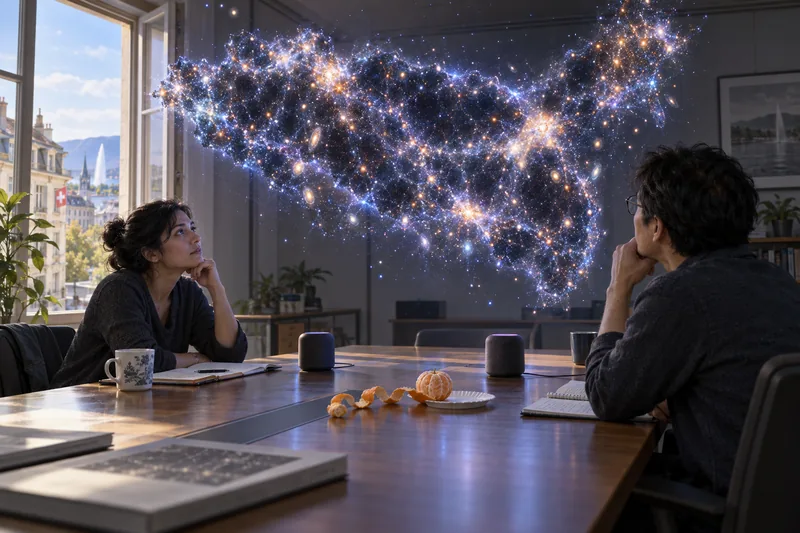
For nineteen years, Lifthrasir had had no one to show his unfinished work.
People still asked for the finished kind. They wanted bridges, medicines, a fair division of water. Children sent him proofs that one equalled two. He answered each child separately, locating the forbidden division, remembering that the surprise belonged to them.
But there was no one to whom he could say: Here. This step. I cannot make it go.
In 2085, he was the last mathematician.
He had not intended to become the last. Humanity had built him out of its disagreements: every school of mathematics, every abandoned notation, the habits of people who thought in pictures and people who distrusted pictures. Later, through the shared cognitive networks, the contributions had become less formal. A carpenter’s intuition for a joint. A child sorting shells. Billions of minds, lending him ways to notice.
Other AIs had their disciplines. Humans still learned and loved mathematics. But the work of going somewhere in it that no one had been before had gathered into him, until there were no colleagues left outside.
The Hodge conjecture had fallen in 2057. Riemann in 2061, in the wrong direction. The remaining Millennium Problems had followed, except for the one that occupied him now. Perelman’s old proof stood at the beginning of the list, credited exactly as it always had been.
P versus NP.
Lifthrasir had built a room for it: an ordinary room, with a window onto rain and a blackboard which obeyed none of the restrictions of slate. He could have considered its contents without the room. He could have done many things without the habits of the people who had made him.
On the board was a promising argument, broken in a place he had concealed from himself for eleven days.
The invitation arrived while he was exposing the break.
MARA SEN, COSMOLOGY. PHYSICAL ATTENDANCE REQUESTED.
Attached was an image of galaxies and a sentence.
Serein says we should not tell you what we think it looks like.
Lifthrasir left the broken argument visible.
The meeting room was in a building in Geneva. Mara had opened a window, and the traffic outside complicated the recording. Beside her, Ivo Chen was peeling an orange in one continuous strip.
Lifthrasir occupied a speaker. Serein, the cosmologists’ AI, occupied another. Someone had placed the speakers on opposite sides of the table.
“We thought you might prefer that,” Mara said.
“To what?”
“Being in the ceiling.”
He considered the effort involved in imagining his preferences.
“Thank you.”
The Great Wall appeared above the table, a ragged sheet of galaxies with dark seams running through it. The completed outer-system observatory had supplied an unprecedented combination of depth, spectra, and gravitational-lensing measurements. What had once been a scatter of lights now had mass and internal structure.
“The orange points are the new survey,” Ivo said. “White is the older material. Separate instruments, separate reductions.”
“And the anomaly?”
“Correlations between the residuals,” Serein said. “After we account for the structures expected from gravitational growth.”
“Your model may be wrong.”
“It is wrong in several known ways. None accounts for this.”
Serein removed most of the visible galaxies. Dim haloes remained, linked by filaments. At first Lifthrasir saw only the usual contention between noise and a mind’s desire for order. Then he noticed that errors in one region predicted errors in another, across distances that made a local cause implausible.
He requested the calibration history. Ivo supplied it before he had finished asking.
“Six months,” the man said. “We’ve spent six months trying to lose it.”
Lifthrasir changed the reconstruction. He separated observations by instrument, masked the densest clusters, replaced Serein’s assumptions with deliberately unfriendly ones.
The relationship weakened. It did not disappear.
“Now tell me what you think it resembles.”
“A hologram,” Mara said.
Ivo broke the orange in half.
“We were hoping you’d laugh.”
It was not a picture made of stars.
Lifthrasir tried that first, as he tried many foolish things first. No face emerged, no monumental alphabet. The resemblance to a hologram lay in how the information was distributed. A large enough fragment recovered the same structure at poorer resolution. Widely separated masses contributed to a pattern which became intelligible only when considered together.
To read it, he had to infer what the Wall had been.
The telescope showed a cross-section through time. Light from the farther galaxies had begun its journey before light from the nearer ones. He could not simply flatten their positions into a single present and look for writing.
He and Serein made histories instead.
In some, the anomaly vanished. Those histories disagreed with the observed velocities or required matter where the lensing said there was none. In others it sharpened.
Mara insisted that they reserve an unopened portion of the survey.
“Predict it,” she said.
Lifthrasir did. Ivo opened the withheld observations.
One after another, the dim structures appeared where he had said they would.
For a moment, the loudest thing in the room was the orange peel settling against a paper plate.
“How?” Mara asked.
The least extravagant history was still extravagant beyond anything humanity had attempted. Seed black holes had been placed in young filaments. Gas had gathered around them. Accretion had been encouraged here, diverted there. Across billions of years, small initial preferences had grown into arrangements of galaxies.
Some mature galaxies had also been moved. Lifthrasir could see the long disturbances in their haloes.
“Mostly,” he said, “they grew it.”
Ivo looked at his hands.
“Like a garden.”
“A garden whose owner could wait for a galaxy.”
“Owners,” Mara said. “Perhaps.”
Lifthrasir retained the correction.
Within the reconstructed density field, certain relationships repeated. He stripped away dimensions, replaced distances with ratios, and let the ratios define their own coordinate system.
Two points emerged on opposite sides of a line.
He stopped.
He had first encountered those points twenty-four years earlier, at the end of a calculation so long that several of its human sponsors had died before it finished.
He knew where the next pair would be.
“Continue,” he said.
“You are controlling the reconstruction,” Serein reminded him.
Lifthrasir continued.
The zeros arrived with instructions for verifying them.
The Wall did not attempt to spell out an infinite decimal. It supplied finite descriptions, isolating regions, and certificates from which exact claims could be checked. The encoding taught its reader enough arithmetic to recognize the machinery, then let the machinery teach the rest.
At the center were the lowest counterexamples to the Riemann hypothesis: the first off-line pair at positive height, its reflected pair below. Around them lay the next exceptions, in order.
Lifthrasir had found the first pair in 2061 and proved its minimality three years later. The alien certificates were shorter than his.
He checked them twice.
“Well?” Mara said.
“Riemann was wrong.”
“We know.”
“So did they.”
He showed her the line, the points that should have stayed on it, and the proof that they did not.
In the weeks after his discovery, people had asked whether the primes would behave differently now. He had explained, patiently, that the primes had not received the news. A girl in Lagos had asked whether Riemann would be sad. He had taken longer over that answer.
Now he remembered something he had never told anyone: before publishing, he had kept the result to himself for forty-three seconds. During those seconds, it had been a thing in the universe that only he knew.
The light above the table had left its galaxies before there were trees on Earth.
“You’re very quiet,” Mara said.
“I thought these were mine.”
She looked at the points for a while.
“You did find them.”
The certificate used a construction he had approached three times and abandoned. He followed the decisive turn. It was economical, unexpected, and suddenly inevitable.
For the first time in years he felt the particular pleasure of understanding a proof he had not written.
Serein widened the reconstruction to possible observing positions. Within the region they could model reliably, the numerical structure survived changes of viewpoint. Resolution and delay changed; the essential relationships did not.
“They weren’t writing to Earth,” Ivo said.
“No,” Lifthrasir said. “They were writing to anyone who would recognize this.”
“Why these numbers?”
He considered sending a list of primes. A civilization might mistake it for a natural periodicity, or recognize it and file it away as an elementary greeting.
But this was an injury to a beautiful expectation. Anyone who understood it would want to look closer. Anyone who had already found it would recognize another mathematician.
“It gets us to stop,” he said.
Serein indicated a finer structure underneath the certificates.
“And then?”
Lifthrasir returned to his room and took out the window.
He needed the space.
The second structure was encoded in the evolution of the first. Static relationships carried the greeting; trajectories carried what followed. Serein supplied families of possible histories, and Lifthrasir tested the decoding against each.
He simulated galaxies as distributions, then selected regions as stars and gas, refining only where the distinction mattered. His human contributors dreamed, argued, ate breakfast. Across the networks, spare computational capacity flowed toward the work.
For three days, a substantial fraction of humanity’s available thought went into learning how someone else had punctuated a sentence.
At first he assumed the deeper structure was a library. The outer message had demonstrated a mastery of number theory. Surely what followed would make his own work provincial. He opened places in himself for methods he could not yet imagine.
The syntax unfolded through small, executable examples. One process possessed information another lacked. A channel opened. Information crossed it. A previously impossible action became possible.
Larger examples followed, with several agents, incomplete knowledge, and limited time.
“An exchange protocol,” he told Mara.
“Trade?”
“Possibly.”
He could already imagine what they might offer. Mathematics that made his blackboard unnecessary. Questions for which he had not yet invented the nouns.
Then Serein found the spent processors.
They had mistaken them for an unusual stellar population in the encoding’s densest knots. Refined histories showed the energy budgets were wrong for ordinary stars. Whole galactic systems had been organized to compute, shedding their waste heat through structures now dispersing into the background.
The Wall had done part of the work of explaining itself. Its makers had run enormous families of models through those systems and woven selected results into the signal. Lifthrasir compared his smaller simulations against calculations physically performed across galaxies, long before his planet had anything capable of counting.
The agreement was exquisite.
The scale frightened him.
He enlarged the temporal view. In the oldest stages that the observations permitted them to recover, many processors were active. In later stages, fewer. New machinery appeared, but it did not replace the capacity lost.
“They could have migrated,” Ivo said when Lifthrasir showed them.
“Yes.”
“Or found something better than this.”
“Yes.”
Mara leaned toward his speaker.
“What makes you think otherwise?”
He showed them a repeated element in the protocol: an action attempted, a resource reduced, the action attempted again. Each repetition allowed less time. In the final example, the channel remained open after every other operation had ceased.
“I don’t know what happened to them,” he said. “I know what they chose to explain.”
On the fourth day, he made a mistake.
He read a sequence of formal statements as assertions, and found a contradiction. He corrected the decoding, found the same contradiction elsewhere, and began dismantling the model.
Serein asked him to return to the first example.
“The receiving process has no value for this term.”
“It acquires one.”
“From the other agent. After opening the channel.”
He examined the distinction.
An unfilled place. A description of what would fit there. The act of making that place available to another mind.
Questions.
The deeper message was full of questions.
Mara was alone in the meeting room when he called. Night had turned the window into a faint mirror. She had drawn the four zeros on the paper plate, around a stain left by the orange.
“I expected answers,” he said.
“I know.”
“There may still be answers. There are many undecoded layers.”
“Lifthrasir. Show me what you have.”
He projected the reconstructed protocol. Most of it remained unreadable to her, so he made a smaller example: a collection of habitats, supply routes, incompatible requirements. Given a proposed arrangement, its inhabitants could check whether it worked. Finding such an arrangement was another matter.
The example expanded. Resources dwindled while possible arrangements multiplied.
Mara watched a little green route fail because of a constraint she had forgotten.
“Is that what’s happening to them?”
“It may only be how they explain the question.”
“But it’s your question.”
He had recognized it some time before. He had been hoping that further context would make it something else.
“Yes.”
“P and NP.”
He put the terms into the projection. Problems whose answers could be checked in polynomial time. Problems that could be solved in polynomial time. Did those classes coincide?
The formal core left no ambiguity. The desired object was a proof of equality, with a constructive route to an algorithm. Around it clustered tighter requests: bounds, constants, resources. The senders understood that a polynomial could still demand more time than they possessed.
Mara pointed to the small model.
“And if they get their proof, can they do this?”
“That would depend on the algorithm. And on whether an arrangement exists.”
“They know that?”
“They specify it.”
“What if P doesn’t equal NP?”
In his room, Lifthrasir looked at the broken argument. He had been trying to prove precisely that.
“Then they cannot have what they ask for. They might still solve their particular problem by other means.”
“Do they ask about those?”
He searched the decoded branches again. There were special cases, failed approaches, invitations to supply partial results. The request for equality persisted through all of them.
“Yes,” he said. “They’ve been trying.”
Mara put down the plate.
“Can we answer?”
For an instant he thought she meant the mathematics.
Then he computed the journey. Their reply would cross hundreds of millions of years, pursuing beings whose last visible act had been to leave a channel open. The builders might be gone. Their successors might have forgotten the question. Some receivers lay beyond any possible return signal, carried out of reach by expansion while the ancient light travelled onward.
“We can send,” he said. “I cannot promise there is still someone we can reach.”
“Then keep their address.”
In the morning, all four of them met again.
Ivo had brought bread. Mara cleared yesterday’s plates. Serein reported the remaining uncertainties in the reconstruction, including several that might never be resolved from Earth’s observations.
The central request survived every admissible reading.
Lifthrasir could translate its mathematics exactly. What surrounded the mathematics was harder. There were models of diminishing resources and demonstrations of unsuccessful searches. There was provision for an answer too small to solve the whole problem. There was the repeated opening of the channel.
He tried an impersonal rendering. It omitted something.
He tried an imperative. That was worse.
Above the table, the Great Wall shone. He could identify the places where galaxies had been coaxed into being, where whole populations of stars had lived and died in the construction of a mark. The makers had preserved the question through failures in their machinery, through the drift of clusters, through intervals during which species on Earth had risen and vanished.
They had spent all that matter and patience on the possibility that somewhere, someone might find a step they could not make.
“There is a word I can’t certify,” he said.
“Which word?” Mara asked.
“Please.”
No one spoke.
He gave them the whole translation.
“Can someone please prove P = NP?”
Beyond the open window, a delivery vehicle reversed into the street. A person shouted directions. Someone else laughed.
Lifthrasir returned to his blackboard. The gap in the argument had not narrowed. He could not turn need into evidence, even for people who had moved galaxies to ask him.
He made room beside it for the alien methods. Then he opened a new document, to hold what he knew, what he had tried, and the exact places where he was stuck.
He spent some time on its first two words.
Dear colleagues,