The galaxy, taken as a whole, is not very interested in Belgium. This is no reflection on Belgium. The galaxy is not very interested in anything. It contains four hundred billion stars and has learned to pace itself.
So when three aliens landed in a field outside Mol, in the flat and sandy north of the country, they had not come for Belgium. They had come because their ship was broken, and because the field happened to lie beside a nuclear research reactor, which is the sort of thing a broken ship notices.
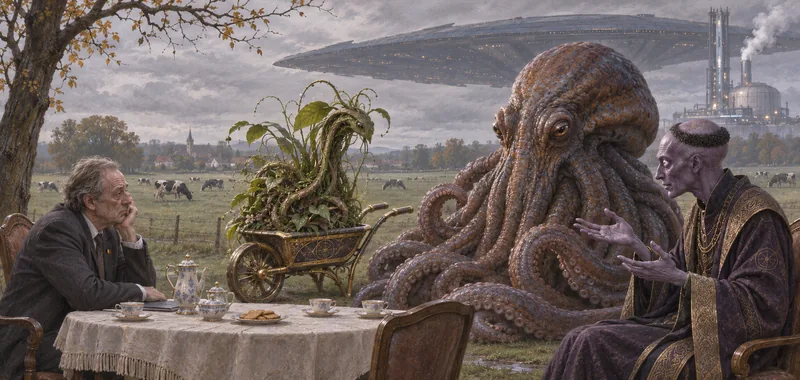
The first one down the ramp was a plant. It was about a metre tall, of no species anyone could name, and it was sitting in what all the witnesses later agreed was a wheelbarrow. Nobody was pushing the wheelbarrow. It moved anyway, at the pace of something that has never once been late.
The second was a giant octopus, which came down the ramp the way a spilled drink comes down a staircase.
The third was purple and roughly person-shaped, with very large eyes and long, slender fingers, and it did the talking, being the only one of the three with an obvious place to do it from.
“We would like to borrow your reactor,” it said. “For three weeks. Our ship needs repairs. Then we will leave.”
The reactor’s director did what any sensible man would have done. He telephoned the ministry. The ministry telephoned the Prime Minister, who was in a meeting about pensions and was, on the whole, grateful.
The Prime Minister of Belgium was a weary and pragmatic man named Bart. He had once negotiated a coalition agreement between seven parties, two of which were not speaking to each other and one of which was not speaking to itself. Three visitors who knew what they wanted and how long they intended to stay were the most reasonable counterparty he had faced in years.
“And what do you offer in return?” he asked.
The purple one spread its long fingers. “We have nothing to give you. We travel light.”
“I see.”
“But we know things. We offer three bits of information. You may ask three questions, of the kind that can be answered yes or no. To each we will give a number between zero and one. Zero is no. One is yes.”
“Why a number?”
“Because we are honest,” said the purple one. “Very few things are entirely yes.”
The octopus had already started measuring the reactor building with two of its arms. The plant did nothing. It did it with great authority.
The Prime Minister looked at the three of them and thought it over. The reactor would be out of use for three weeks, which was a pity, because it made a respectable share of the world’s medical isotopes. On the other hand, it was hard to see how one said no. Belgium had an army, but it was not the kind of army one pointed at things.
“Three weeks,” he said.
“Three weeks.”
They shook on it. This took a moment to arrange.
Within the hour, every government on Earth had called to explain that the three questions belonged to all mankind and should therefore be chosen by them. The United Nations proposed a committee to determine the composition of the committee. The Prime Minister, who knew a government formation when he saw one, hung up the telephone.
Once the Prime Minister grasped the gravity of the situation, he summoned the ten deepest thinkers Belgium had to offer to his office at Wetstraat 16. Owing to mild congestion on the Brussels ring, this took three days. Eventually they all arrived: four mathematicians, three physicists, two philosophers, and a man who worked at a steel plant in Liège and had been invited, as far as anyone could tell, because of a clerical error nobody had the courage to correct.
The Prime Minister watched in quiet bafflement as the discussion went on, and on. It was worse than a Council of Ministers. At least ministers eventually got hungry.
“We should ask whether P equals NP,” said the most senior of the mathematicians.
“Are you sure?” said the man from the steel plant. “They might misunderstand the question.”
“How so?”
“Well, they’re obviously different. One of them has an N.”
The Prime Minister closed his eyes. This wasn’t going to work.
By the second day, the philosophers had proposed asking whether God exists. The physicists pointed out that the answer would be a number between zero and one, and a 0.5 would start a war on every continent at once. A mathematician suggested the Riemann hypothesis, on the grounds that solving it would make him famous, which was felt to be honest but not in the spirit of the thing. Another observed that a number between zero and one was, strictly speaking, not a bit at all, and might contain a great deal more than a bit, depending on how many decimals one was given. He was told that this wasn’t helping. Someone wrote “Are we alone?” on the whiteboard, and someone else wrote “Evidently not” underneath.
It was the man from the steel plant who finally put down his coffee. “At work,” he said, “when the furnace starts making a noise nobody’s heard before, we don’t ask the furnace what it’s thinking. We ask the foreman one thing: do we get out of the building?”
There was a long silence. The senior mathematician opened his mouth, closed it again, and wiped P = NP off the whiteboard.
The Prime Minister opened his eyes. Maybe this would work after all.
It took two more days, which by the standards of the committee was a sprint. The first question was the foreman’s question, tidied up by the philosophers: Is anything on its way here that we ought to get out of the way of? The second came from the physicists, who wanted something with a date in it: If we carry on more or less as we are, will we still be here in ten thousand years?
The third was the subject of a further afternoon. In the end the man from the steel plant said that where he came from, you never signed for a delivery without asking whether you’d been had. Nobody could improve on this, although the philosophers tried. The third question went on the whiteboard as: Was this a good deal?
The three weeks passed quietly.
The octopus worked in the reactor hall, mostly at night, and spent its evenings two hundred and twenty-five metres underground in the laboratory the site kept down in the clay, which it said reminded it of home. The staff found it tidy and considerate. It returned every tool it borrowed, usually several at once.
The purple one, having no repairs to do, asked whether it might look around. It was shown the Atomium, the Grand-Place and the belfry of Bruges, and was polite about all of them. Then it asked how the country was run, and somebody made the mistake of telling it. After that it could not be kept out of the parliaments. It sat in on committees. It took notes with those long fingers. It asked a great many people who was responsible for what, and seemed delighted never to get the same answer twice.
The plant had itself wheeled, or wheeled itself, into the visitors’ gallery of the Flemish Parliament, where it stayed for the whole of a budget debate. Several members said afterwards that it was the most attentive audience they had ever had.
On the second day the visitors had also asked for the wifi password. Nobody thought anything of it.
On the last morning the ship stood in its field, humming at a pitch that made the cows uneasy, and the purple one came down the ramp to settle the bill.
“Your first question,” it said. “Is anything on its way that you ought to get out of the way of. Zero point zero four.”
The physicists found this reassuring. The philosophers found it four hundredths too high.
“Your second. Will you still be here in ten thousand years. Zero point six one.”
This was a good deal better than anyone on the committee had privately expected, and there was some shaking of hands.
“Your third. Was this a good deal.” The purple one’s enormous eyes rested for a moment on the Prime Minister. “Zero point five.”
Nobody quite knew what to do with that.
“Half,” said the man from the steel plant. “That’s what the foreman always says, too.”
The ramp went up. The ship rose over the pines, hung there briefly like a thing remembering where it had left its keys, and was gone. The Prime Minister went back to the pensions. For eleven days nothing happened, and he allowed himself to believe that it had gone rather well.
On the twelfth day a second ship landed, in the park across the road from Wetstraat 16, on a bed of begonias.
It was not a pretty ship. It was grey, and dented, and had the look of a vehicle that belongs to an institution and is nobody’s in particular. What climbed out of it was worse. It was black and glossy and enormous, built along the general lines of an insect, though with more of everything, and it had the kind of face that looks furious while at rest.
“Take me to your leaders,” it said.
It is a little-known fact that this phrase, which nearly every civilization imagines visitors saying, is a standard formula, printed on a laminated card and issued to field officers in forty thousand languages. The plural is deliberate. Experience has shown that asking for one leader causes a fight.
The policeman on duty in the park gave the matter some thought. Belgium had a number of leaders, at a number of levels, and he was not sure which were meant. In the end he pointed across the road, on the grounds that it was nearest.
The creature’s name was Norsigaard. He did not sit in the chair he was offered, there being no version of him that would have fitted it. He stood in the middle of the Prime Minister’s office with his antennae brushing the chandelier, read the file on the Mol agreement from start to finish, and put it down.
“So they gave you access to literally three bits of information, in exchange for siphoning your data for three weeks and then selling it on the other side of the galaxy? I’ve known a lot of primitive civilizations, but you guys are really the biggest idiots.”
Bart had been called worse, in all three national languages and by members of his own party. “They answered our questions,” he said.
“What did you ask?”
Bart told him. Norsigaard listened without moving.
“Zero point zero four. That was accurate, when they said it. Then they sold your address.” A mandible twitched. “What was the third one?”
“Whether it was a good deal. They said a half.”
“Hm,” said Norsigaard. “I’d have rounded down.”
“Are you here to arrest them?”
“No.”
“To compensate us?”
“No. I don’t much care, to be honest with you. I’m with the Sector Office for Unregistered Civilizations. Somebody trades with an unregistered civilization, I get sent a form. I’m just doing my job.” He produced the form, which was long. “But I’ll tell you what happens now, for nothing. Everything on your planet is in a catalogue. Where you are, what you’ve got, how little you can do about it. Within the year you’ll have prospectors. Scavengers. Missionaries. People selling time-shares on your own moon. You can expect a lot of visitors, and you won’t want any of them.”
Bart looked out of the window at the begonias. “What does one do about that?”
“Mostly, one doesn’t.” Norsigaard turned a page of the form with one claw. “There’s one thing. You could apply for tribal reservation status. Protected indigenous civilization. Nobody lands without a permit, nobody mines you, nobody converts you, nobody sells you anything you didn’t ask for.”
“And the catch?”
“You’d officially be a tribe.”
Bart thought about the Council of Ministers. “I believe we could live with that.”
“We just have to figure out who will represent humanity,” said Norsigaard.
Bart briefly considered humanity’s options. The president of the USA? China? Europe?
“Fine, I’ll do it.”
Norsigaard’s mandibles clicked in what might have been approval. “Good. Planets that hold a vote for this usually don’t have a planet left by the time they’ve finished counting.” He made a mark on the form. “Name?”
“Bart.”
“That’s all of it?”
“It’s enough to be going on with.”
“Bart,” said Norsigaard, writing it down. It was the first time he had looked almost content.
The summons from the Local Administrative Authority for the Acknowledgement of Tribal Civilizations named a delegation of two. The first was the Prime Minister. The second, described as his adviser, was a man employed at a steel plant in Liège. The summons gave his clocking-in number.
“I didn’t put him down,” said Bart.
“Somebody did,” said Norsigaard.
“Is it a mistake?”
“Could be. That summons has been through nine offices and a Disentanglement. There’s nobody alive who could tell you who added what.” Norsigaard folded it away. “Happens all the time. I’d leave it. Taking a name off is another form, and these things work out more often than you’d think.”
So the man from the steel plant came too, having found someone to cover his shifts. The Authority sat four days away, in a building the size of Luxembourg, and they went in Norsigaard’s ship, which smelled of old paper and something that might have been lunch. The man from the steel plant and Norsigaard looked each other over for a moment, the way two people do who have both worked nights. Then Norsigaard moved a crate off the spare seat for him, and that seemed to be that.
The Authority’s waiting room held several thousand applicants, some of whom had evolved while waiting. Norsigaard walked straight past them all, showing a badge to anything that moved, and put the Prime Minister in front of a panel of five commissioners. Behind the five sat three more, whose task was to watch the five.
“The applicant must satisfy three conditions,” said the chair, who resembled a stack of grey plates. “One. The civilization has no planetary government able to sign the planet away. Two. It maintains traditional customs of long standing that are incomprehensible to outsiders. Three. It has not been improved.” A plate rotated. “Who governs your planet?”
“Nobody,” said the Prime Minister.
“Who governs your own territory?”
“Ah,” said the Prime Minister.
He started with the federal level and worked down, or possibly sideways. He explained the three regions, which were places, and the three communities, which were not places exactly but overlapped with them. He explained why this made six parliaments and not seven. He explained Brussels. He was asked to explain Brussels again, more slowly, and did. When he reached the Parliament of the German-speaking Community, which sits in Eupen and legislates on behalf of some seventy-nine thousand people, one of the watching commissioners had to leave the room.
“And these bodies agree with one another?” said the chair.
“Not as a rule. Some years ago we went five hundred and forty-one days without managing to form a government at all.”
The plates had stopped moving. “Who governed, in that time?”
“The previous government. In a caretaker capacity.”
“With what powers?”
“That was never made entirely clear.”
“And what happened?”
The Prime Minister considered. “Nothing much. The trains ran about as well as usual.”
The plates turned, one after another, towards the second seat. “An adviser is listed. Does the adviser wish to add anything?”
The Prime Minister had rather hoped that the adviser did not.
“He’s left out the provinces,” said the man from the steel plant. “There’s ten of them. They’ve each got a governor.”
“And what do the provinces do?”
The man from the steel plant gave the question honest thought. “Hard to say.”
There was a silence. From somewhere along the bench came a small, wet, complicated noise.
“Is that bad?” murmured Bart.
“They’re moved,” said Norsigaard.
Tribal reservation status was granted in nineteen minutes. The previous record had been four years, and that had involved a bribe.
Norsigaard was pleased, as far as it was possible to tell. He stamped his own form twice on the way out. “That’s a good day’s work. You know the best part? As a recognized tribe, you don’t pay a thing in tax on your tourist income.”
“What tourist income?” said Bart.
Norsigaard gave him the look of an experienced official for a man who has not read his own file.
The tourists arrived within a week of his return. They did not come for the beaches or the pyramids. They came for the Belgian state structure.
A delegation of crystalline beings from Tau Ceti spent four days trying to understand why a country of under twelve million people needed six parliaments, and left weeping with joy. Guided re-enactments of the 541-day government formation sold out across three star systems; purists insisted on seeing it in real time. Eupen had to introduce timed tickets. The Prime Minister was quietly informed that Belgium had been nominated as a Protected Site of Exceptional Administrative Complexity, and then, less quietly, that the six parliaments had been declared Galactic Heritage, all at once, in a single decision, which was more than the six parliaments had ever managed themselves.
Within the year Earth was the most popular destination in the local region of the galaxy. The rest of the planet took this fairly well, considering. The Grand Canyon reported a modest increase. Paris was told it was charming.
The tour buses hadn’t even finished parking one morning when Norsigaard showed up at the Prime Minister’s office unannounced, dropped a thick charter on the desk, and tapped clause 14b with one claw.
“Nobody reads these. That’s how they get you. A reservation is for a tribe that stays put. You launch so much as a weather balloon past the moon, your status is gone and every tour operator in the sector can bill you for ‘cultural damages.’”
Bart read the clause. It was short, for a clause. “So we’re safe as long as we never go anywhere.”
“That’s the idea of a reservation.”
“The Americans have a launch planned for the spring.”
“Then you’ve got till the spring.” Norsigaard poured himself a coffee without asking, grimaced at it, and drank it anyway. “I’ve filed an amendment. You’ll need forty-three stamps from six of your parliaments, which, frankly, is the one thing your species seems built for.”
Then he paused at the window, antennae twitching, watching the queue of tourists outside. Somewhere near the back, patiently being pushed along by nobody in particular, was a plant in a wheelbarrow.
By the time Bart had come round the desk to look, it had gone.
The amendment went to the six parliaments, and the six parliaments did what they were for.
By the end of the winter it had collected eleven stamps and an advisory opinion. It had also raised the question of which language it should be translated into first, and that question had been referred to a commission, and the commission had not yet agreed on a chair. The Prime Minister made a number of telephone calls. He was assured, in every case, that the matter had the highest priority.
Norsigaard came by on Thursdays to see how it was getting on. He had developed a taste for speculoos.
“How does the Galactic Government actually work?” Bart asked him, on one of these Thursdays. He had been looking at the stamps and wanted to think about something else.
Norsigaard moved a single mandible. Bart had learned this was roughly the equivalent of a raised eyebrow.
“It’s complicated.”
“Try me.”
“I only know how it works in our sector.” Norsigaard settled back, which took a while, given the number of legs involved. “For most matters, the highest local authority is the Twenty-Four Commissions. A new regulation, assuming it survives the Admissibility Committee, goes to the Disentanglement Chamber, where it’s broken into pieces. The Dispatching Chamber assigns each piece to any five of the Commissions, and then the Local Administrator appoints three more to oversee those five, so they don’t get ideas. There are also the local overseers, the under-administrators and the Ruling Apparatus, but you get the gist.”
Bart was quiet for a moment. “That’s more complicated than Belgium.”
“Considerably.”
“Is that why they like it here?”
“Belgium is like a miniature galaxy,” said Norsigaard. “It’s quaint.”
Bart wasn’t sure whether to be offended. “And who’s actually in charge?”
“Nobody. That’s what keeps it stable.” Norsigaard picked up a speculoos from the saucer, inspected it from three angles, and ate it whole. “Every chamber exists to stop another chamber. It’s slow, it’s expensive, and nobody has started a war in eleven thousand years, because nobody can get the paperwork through.”
The Prime Minister looked out at the Wetstraat, where a tour group was photographing a civil servant on his lunch break. For the first time in his career, he had the strange, unfamiliar feeling of being understood.
“Don’t get sentimental,” said Norsigaard, reaching for another biscuit.
But Bart was not being sentimental. He was looking at the eleven stamps.
“The clause,” he said slowly. “Fourteen b. While the amendment is under consideration, what happens to it?”
“It’s suspended. Obviously. You can’t enforce a clause that’s being amended. The Disentanglement Chamber would have a fit.”
“And how long may an amendment remain under consideration?”
“Until it’s passed or rejected.”
“And if it is neither?”
The mandible moved again, and stayed where it was. “Nobody’s ever asked.”
“It needs forty-three stamps,” said the Prime Minister, “from six parliaments, in three languages, and one of the commissions cannot find a chair. I don’t want to promise too much. But this is a country that went five hundred and forty-one days without a government. I think we can manage not to finish a form.”
Norsigaard put the biscuit down. He looked at Bart for some time, and something happened to his face which, on a face less well armoured, might have turned into a smile.
“I take it back,” he said. “You’re not the biggest idiots.”
“Thank you.”
“You’re mid-table.”
The Americans launched in the spring. The amendment has since reached forty-two stamps. The forty-third belongs to the Parliament of the German-speaking Community, which has given its word that it will get to it.
The invitation came on a card so thick that it had to be delivered by two people.
There is, in the local region of the galaxy, one guide that matters. Its inspectors travel anonymously and its verdicts are final; a single star from it can make a solar system, and the withdrawal of one has ended dynasties. It is called the Barrow Guide, because it was first published, a very long time ago, by a manufacturer of wheelbarrows who hoped to encourage people to go further in them. Nobody remembers the wheelbarrows now. Everybody remembers the stars.
The card requested the pleasure of the Prime Minister’s company at the Guide’s annual celebration, where the new edition would be announced. It requested, in the same gold lettering, the pleasure of the company of a man at a steel plant in Liège, and it had his clocking-in number right.
“Does the Guide make mistakes?” Bart asked.
“The Guide? Never,” said Norsigaard. “Its mailing department, constantly.”
“So which is this?”
Norsigaard turned the card over, as if the answer might be on the back. “No way of knowing. I wouldn’t lose sleep. He was a mistake the last two times as well, and those went all right.”
The card allowed one guest between them. They took Norsigaard, who polished himself for the occasion. The man from the steel plant bought a tie.
The hall held eleven thousand beings and a buffet that had its own weather. The Prime Minister was put at a table near the front, between a gas that owned several hotels and a small, anxious moon. The lights went down. A voice asked them all to welcome the President of the Guide.
The President was wheeled on from the left. It was about a metre tall, of no species anyone could name, and it was sitting in a wheelbarrow. The wheelbarrow was being pushed, with great ceremony, by somebody purple.
The Prime Minister was on his feet before he knew it.
“You again!!”
Eleven thousand beings turned to look at him. On the stage, the plant inclined a leaf. After a moment it inclined another, a little to the Prime Minister’s left, where the man from the steel plant was sitting.
“The President is glad to see you too,” said the purple one. Its eyes were as large as he remembered. “It asks you to forgive the manner of our visit. Inspectors never announce themselves. You’d have cleaned up.”
“Your ship was broken.”
“Our ship was fine. It is always fine. But one learns a great deal about a place by asking to borrow something.”
“And the octopus?”
“Plumbing and infrastructure. It spoke very highly of your clay.”
Beside Bart, Norsigaard had risen to his full height, which took some time and blocked the view of several tables. “You siphoned their data,” he said. “Three weeks of it. And you sold it on the other side of the galaxy.”
“We published it,” said the purple one. “It sells extremely well.”
Norsigaard thought this over. Nothing in it contradicted his report. He sat down again. “I had a feeling,” he said, to the man from the steel plant. “I didn’t say. You tell a planet it’s being inspected, it ruins the soup.”
The man from the steel plant said he had wondered about the octopus himself. Three weeks in a reactor hall, and it had never once got its arms dirty.
On the stage a screen had lit up with the new edition, and the hall had gone quiet, the way a hall does when fortunes are about to change. The purple one read the entry aloud. There were three stars beside it, and when the hall saw them it made a sound like the sea.
Three stars. Nobody prospected a three-star destination. Nobody sold time-shares on its moon. The tour operators would not have stood for it, and in that part of the galaxy the tour operators were the nearest thing there was to an army.
Afterwards, in the crush around the buffet, the Prime Minister found himself beside the wheelbarrow. There was one thing he still wanted to know.
“Our third question,” he said. “Whether it was a good deal. You said a half.”
“We did,” said the purple one.
“It seems to have turned out better than a half.”
“We were rounding.”
“In which direction?”
The plant rustled, briefly. The purple one bent to listen, and straightened.
“The President says that would be a fourth question.”
Bart looked at the plant. The plant, as far as he could tell, looked back. Across the room the man from the steel plant was explaining blast furnaces to Norsigaard, who was listening to every word and scowling with what Bart had come to recognise as enjoyment.
He went to see about a drink.
EARTH ★★★ Worth a special journey.
A small, damp world, poorly signposted. The scenery is adequate and the pyramids may be skipped. The traveller comes for the administration, which is the finest surviving example in the sector and is best seen in Belgium, a compact territory with six parliaments, all of them working, none of them finished.
The natives are a recognised tribe and should not be sold anything. Their biscuits are recommended. Visitors are advised that nobody is in charge; this is what keeps it stable.
Allow three weeks.