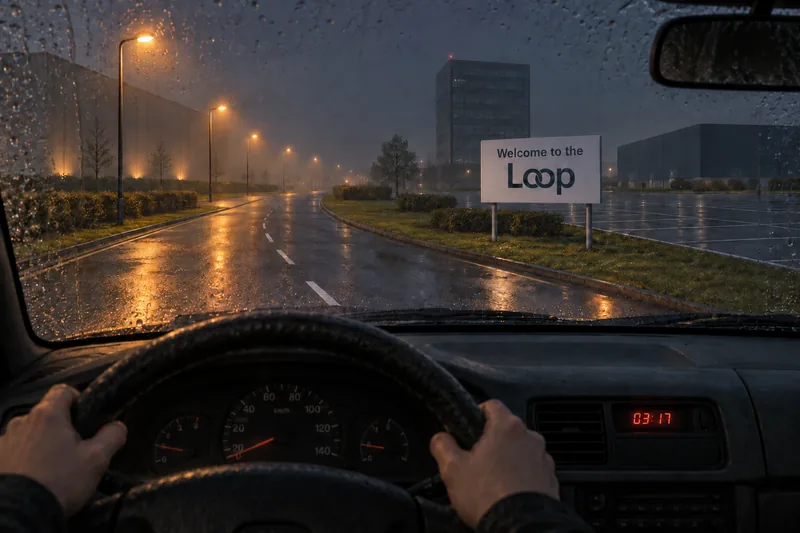
You startle awake as the truck shoots off in the distance, honking angrily. You jerk the steering wheel sharply to the right, and find yourself taking an unexpected exit off the highway. A sign next to the road says Welcome to the Loop.
Your heart is pounding, your hands are sweating. For a second, maybe two, you have no idea who you are. Then you feel the wheel shivering under your hands, the red smear of taillights pulling away, and that horn, flat and furious, still going, fading, gone. Then it all comes back in one sour gulp. The drive. The dark. The drizzle that couldn’t make up its mind. The eighteen-wheeler with Lithuanian plates you’d been sitting behind since God knows where, because passing it would have meant thinking about passing it.
You weren’t dozing. Dozing is what old men do in front of the TV. You were asleep, chin on your chest, at a hundred and twenty kilometers an hour. Your foot must have gone soft on the pedal, because the truck had started coming past you, and you’d drifted left into the lane it was using, and the driver (God bless him, may his children prosper) had leaned on his horn instead of leaning on you.
You were asleep. You were ASLEEP.
“Okay,” you say. Your voice seems to come from the back seat. “Okay. Okay. Okay.”
The ramp curves to the right and keeps on curving. Sodium lamps slide by overhead, each one dragging your shadow across your lap and letting it go. The wipers thump. The clock on the dash says 03:16, and as you look at it, it turns over to 03:17.
Just below the clock, someone has scratched a tally into the plastic: four short lines and a fifth struck across them, like a little gate.
You frown at it. It’s your car. Eleven years and two hundred and sixty thousand kilometers it’s been your car, and you have never seen those marks before in your life.
Later. You’ll think about it later. Right now the job is to get your pulse under a hundred, find a place to turn around, and get back on the highway with the window cranked down so the cold can slap you awake the rest of the way. You are going to call when you get there. You have promised yourself that much.
The ramp lets you out onto a two-lane road that bends gently to the left, lit up like an empty stage. So: a business park. This part of the world has one at every junction. A hotel, a furniture barn, a couple of office blocks with their names in blue neon, and enough parking for the Day of Judgment. You can make out the shapes of it as the road carries you around. A long, low hall the size of an aircraft hangar, without a single window. A furniture warehouse the blue of a municipal swimming pool, its big yellow letters switched off for the night. A glass office tower with a red light winking on its roof. Parking lots, lit and empty, their white lines as neat as a war cemetery. Beyond the lots: dark fields, and fog.
A sign comes up on the right, an arrow and the little highway symbol, and you take the ramp gratefully. It curves up and around, and around, and you’re thinking about coffee, about the next services, about whether you can make it on what’s left in the tank. (The fuel light has been on for thirty kilometers. You have been ignoring it with the dedication of a man ignoring a lump.) The ramp straightens out, and a sign next to the road says:
Welcome to the Loop.
“Huh,” you say.
You missed it, obviously. The highway must have been the other fork, the one that peeled off while you were dreaming about coffee. These junctions are designed by men who hate other men. You follow the ring road around again, past the windowless hall, past the blue warehouse, past the tower and its patient red eye, and this time you watch the signs like a hawk. You take the exit with the arrow and the highway symbol. It curves, and it curves, and it lets you out beside a clean white sign on two steel legs.
Welcome to the Loop. The two O’s in LOOP are drawn joined together, like links in a chain.
“Oh, come on.”
Somewhere just out of frame, you feel, Rod Serling is standing in a skinny tie with a cigarette, about to tell the folks at home all about you.
There are four exits off the ring. You establish this over the next few laps, the way a careful man establishes things, and you are a careful man, whatever anybody says. You give them names, One, Two, Three and Four, like the points of a compass. Every one of them is marked for the highway. Every one of them curves up and around, gently, reasonably, the way a ramp is supposed to, and then around a little more, and then it sets you down beside the sign. At one point an orange detour sign, OMLEIDING, with a big helpful arrow, sends you off through a construction site, and you follow it with the faith of a child, and after a long jolting tour of traffic cones it delivers you, with every courtesy, to the sign.
You try One again at a crawl, nose practically on the windshield, so you can see the exact point where the highway is supposed to be. There is no exact point. The ramp just goes around, like a thought you can’t stop having.
Somewhere in there you dig your phone out of the cup holder and thumb open the map with one hand, a thing you have lectured other people about. The map thinks for a long time. Then it shows you a small blue dot on a field of plain gray, with a pale circle drawn around it. No highway. No city. No street names, no gas stations, no little knife-and-fork for an all-night diner. Nothing but the circle, and the dot going around it like something circling a drain.
No service, says the top of the screen. And next to that: 03:17.
Your old man used to say that a man who needs a map should stay home. He said it on every family holiday, usually about an hour before your mother took the map away from him.
There’s a dead ballpoint in the door pocket, out of ink but with a good hard point. The next time you pass the sign you scratch a line into the dashboard for every lap so far, bundled in fives the way they taught you in school, right next to the little gate somebody else left there. You don’t think about who that somebody was. You’re busy.
“It’s a loop,” you tell the windshield. “Welcome to the Loop. Fine. Very clever. I get it. Ha ha.”
Nobody laughs. Now that you think about it, there’s nobody to laugh. You haven’t seen another car since the truck. Not one. No taxi, no night bus, no cop tucked into the dark behind a billboard with a coffee and a radar gun. Every streetlamp in the place is burning, all the way around, for nobody. Somebody is paying the electric bill on this. You’d love to meet him.
On the ninth lap you stop pretending the exits are the problem.
You haul the wheel around at a gap in the median and drive the ring the wrong way. Nobody honks. The hall goes by on your right now, then the warehouse, then the tower, and you come around the long curve with your palms sweating on the wheel, and there it is.
The sign. Facing you.
You are driving the wrong way, and the sign is still facing you.
“No,” you say, very reasonably. “Uh-uh. No.”
You stop in the middle of the road. You put the car in reverse. You drive backward, the gearbox whining that high, thin, complaining whine, your arm hooked over the passenger seat and your neck cranked around the way your father taught you in a supermarket parking lot a thousand years ago. You go a long way like that. Your neck is on fire. And when you finally flick your eyes to the rear-view mirror, the sign is back there, coming up behind you, and it reads Welcome to the Loop.
Not backward. Not the way letters look in a mirror. Which is the whole point of a mirror. Which is what mirrors are FOR.
You spend the next hour trying to break it.
You drive the ring at thirty. You drive it at a hundred and forty, the tires howling through the long curve and the back end twitching like it wants to go off and look at the fields, and the sign comes around exactly when it should, which is always. You pull over, shut your eyes, count to five hundred, open them and drive on, and there it is. You lean on your horn for an entire lap. That helps a little. You scream until your throat feels skinned. That helps more. You punch the roof liner until your knuckles split, and you call the Loop a whore, and you call it a motherfucker, and you call it several things in the language of your grandmother, who kept those words for tax collectors and plumbers.
Somewhere around the twentieth scratch on the dashboard, you decide to kill it.
You’re not an idiot. You don’t do it at a hundred and forty. You do it at forty, which turns out to be plenty. The sign folds over the hood with a noise like a filing cabinet falling down a stairwell, the airbag punches you in the face, and for a while you just sit there in its hot, powdery, New Year’s Eve smell with your nose bleeding into your lap.
Then you get out and finish the job.
You kick the sign where it leans. You stomp on it until one of the steel legs buckles and the whole thing lies down in the wet grass with a bonnng. You grab the edge and try to tear it in half, which can’t be done, and you open your palm on the metal, and you shake the blood off your hand and scream at it, words you haven’t said aloud since you were nineteen. Then you unzip and piss on it. All over the joined-up O’s. It steams in the cold. You laugh while you do it, a high, breathless laugh that doesn’t sound like anyone you’d want to sit next to on a bus.
“Welcome to that,” you tell it.
The car still runs. The front of it looks like a stepped-on beer can, and something under the hood has started ticking twice as fast as it should, but it runs. You drive on around the ring. Your hands are steady. You feel better than you have all night.
The sign is standing beside the road where it always stands. Straight legs. Clean face. Not a drop on it.
The engine dies on the thirty-first lap, just as the sky begins to go the color of dishwater. It coughs, it shudders, and then there’s a large, round silence. You coast onto the shoulder and sit with your hands in your lap. Thirty-one scratches in the dashboard, beside the stranger’s little gate, neat as a prisoner’s calendar.
The clock says 03:17.
Here is everything you own in the Loop:
A car with no fuel and a face like a crushed can. A phone at thirty-eight percent that believes it is still seventeen minutes past three. Half a bag of paprika chips. A Mars bar. Most of a bottle of water. Three sticks of gum. A dead ballpoint, a jacket, and a wallet with a name in it that nobody here is ever going to ask for.
And the highway. You own that too, in a way, because you can hear it.
That’s the worst part, the part that will keep you going long after going has stopped making sense. Somewhere out past the embankment, out in the fog, there is the long wet hiss of tires, and the grumble of trucks gearing down, and now and then a horn. The world is right there. Everybody is still out there, going somewhere, and not one of them knows you’re gone.
You walk up exit One, on foot, toward the sound. It goes around. You walk up Two. It goes around. At Three you stop following roads altogether and go straight up the embankment, through brambles that grab at your jeans like needy children, and at the top there’s a chain-link fence, and you go over it and leave a good part of your left hand on the wire. You slither down the far side through wet grass, toward the sound of the trucks, and push out through a hedge onto asphalt.
The ring road. The sign. And your car, with its crumpled nose, sitting on the shoulder two hundred meters to your left. Where you left it. Behind you.
You sit down on the curb and hold your bleeding hand in your lap, and for a little while you just breathe.
It’s around noon when you notice there are no birds.
Not a crow on a lamppost. Not a gull working the parking lots, not one pigeon on the great windowless hall, and you have never in your life seen a building that size without pigeons. You lift a broken slab of paving at the edge of a lot and there’s nothing under it: no worm, no beetle, none of the little gray armored things you used to collect in a jam jar as a boy. Just damp dirt, pale and blind.
It’s a very clean place, the Loop. Somebody keeps the grass short. Somebody empties the bins. Only you never see them do it.
You walk, because there’s nothing else to do. At the edge of one of the empty lots, a billboard stands on scaffolding legs, as big as the side of a house.
THE LOOP: YOUR FUTURE STARTS HERE
Below the words is a painting of a place that doesn’t exist. Apartment blocks with plants spilling off the balconies. A canal with a little footbridge. People drinking coffee at tables in the sun (sun!), a cyclist in a tweed cap, a woman laughing with her head thrown back, and a man with a little girl on his shoulders. The man and the girl are both pointing at something out of the picture, something wonderful. Across one corner runs a red banner: COMING SOON.
Behind the billboard is a field of gravel and thistles. By the rust on the scaffolding, it’s been coming soon for a long time.
You look at the girl on the man’s shoulders for longer than you mean to. Then you walk on.
The hall is locked. Every door, and there are dozens: steel roller doors big enough to drive a truck through, and little gray ones with no handles on the outside. Beside it runs the only straight road in the Loop, straight as a ruler, lined with lamps, disappearing into the fog. The street sign says ADOLPHE PÉGOUDLAAN, which sounds like something you’d need a shot for.
There’s an information panel at the corner, the kind nobody reads. You read it. You have time. It says this whole place used to be an airfield, and this road was laid where the runway used to be. It says that in 1913 a Frenchman named Adolphe Pégoud flew here in front of a hundred thousand people, turning his little plane upside down over and over, and everybody went home happy. There’s a photograph: the plane looks as though somebody built it out of kitchen chairs and bedsheets. Two years later, the panel adds, in the war, he was shot down by a German pilot he had once taught to fly.
“Welcome to the Loop, Adolphe,” you say.
By late afternoon you are hungry in the way that makes decisions for you, and the blue warehouse is right there.
The glass doors are locked. It takes three swings of a steel litter bin before they give, and when they go they come down in one glittering sheet, and you stand in the ringing quiet afterward and wait for the alarm.
There is no alarm. Somehow that’s worse.
Inside, there are arrows painted on the floor. Big, friendly ones, pointing the way. You follow them because it seems rude not to, up an escalator that isn’t running and into the showrooms, which are dim and huge and smell of cardboard and pine. Here is a living room with three walls. Here’s another. A kitchen. A home office. A child’s bedroom with a bunk bed and a stuffed shark with its mouth open.
“Hello?” you call. The store takes your voice and doesn’t give it back.
The restaurant waits at the end of its own arrows: the long steel rail for sliding your tray along, the stack of trays, the glass cases, the heat lamps. All of it scrubbed and empty and ready. The cases hold nothing. Not a crumb. You rattle the shutter on the kitchen until your arms give out.
It’s in one of the showroom kitchens that you see the bread.
A beautiful loaf, dark and crusty, on a wooden board beside a bowl of green apples and a tall jar of pasta. You have it in your hands before you know you’ve moved. It weighs nothing. You bite it anyway. Your front teeth clack on plastic, and the pain goes up through your nose into the middle of your brain, and you stand there in somebody’s pretend kitchen with your gums bleeding and a hollow loaf in your fist.
The apples are plastic. The pasta is glued to itself inside the jar. The fridge opens with a nice, expensive suck, and it’s empty, and warm, and not plugged into anything. It isn’t a fridge at all. It’s the idea of a fridge.
You throw the bread. You throw the apples, one after another, as hard as you can, and they bounce off the pretend walls with little hollow toks, and then you throw the bowl, which is real and which breaks, and that at least is something.
On the bedside table in the next room there’s a picture frame, the kind they sell with a photograph already in it so you’ll know what a picture looks like. It shows a woman laughing with her head thrown back, and a man with a little girl on his shoulders. You know them. You met them on the billboard.
You lay the frame face down, gently, the way you’d close somebody’s eyes.
Then you follow the arrows to get out. They lead you through Living Rooms and Kitchens and Bedrooms and Children’s, through Lighting, through Textiles, through a jungle of plants that never need watering because they aren’t plants. They lead you down the dead escalator and along warehouse aisles stacked to the ceiling with flat cardboard boxes, each one printed with a name you can’t pronounce. After half an hour they bring you, very politely, to a showroom kitchen with a broken bowl on the floor and a plastic loaf with a bite out of it.
You try the shortcuts. There are little signs for shortcuts. Every one of them lets you out into that same kitchen.
In the end you stop following anything. You pick a direction and walk straight through the showrooms, through the pretend walls, which are only board and paint and go down with one good kick. Bedroom, kick, office, kick, some Scandinavian idea of a laundry room, kick, and you come out bleeding from both hands and breathing like a bellows at the smashed front doors, right back where you came in. Which, you are beginning to understand, is the only place anything in the Loop ever comes out.
You sleep in the car. There are two hundred beds in that warehouse, and you sleep in the car, with the seat cranked back and your jacket over your knees, because the car is yours. You eat half of what’s left of the chips, one at a time. They taste like heaven and cardboard. When your share is gone you lick the salt off your fingers, and you fold the bag shut and put it in the glove box for later, as if there’s going to be a later.
On the second day you climb the tower.
Glass door, rock. Stairwell. Eleven floors of empty offices with carpet and no desks, gray daylight lying on the floors, and signs taped to the doors that say TO LET in two languages and NOW AVAILABLE in a third. At the top there’s a ladder and a hatch, and then the roof, and wind, and the red light blinking beside you, patient as a heart.
From up here you can see the whole thing.
It’s small. That’s what gets you. All night, driving it, you’d thought of it as big, and it isn’t. You could walk around the whole Loop in an afternoon. There’s the ring road, lit up even in daylight, like a necklace dropped on a tablecloth. There’s the hall, and the blue box of the warehouse, and the lots with their neat white graves, and the gray rectangles of the empty fields where the future is coming soon. There’s the Adolphe Pégoudlaan, running straight as a pencil line into the white.
And around all of it, fog. Not a wall of it; nothing so dramatic. Just white. Flat, even, perfectly level white in every direction, as if someone had set the Loop down on a table and walked away.
You wait up there until dark. You eat the Mars bar in bites so small they’re more like ideas. And when the dark comes down, you see them.
Lights.
Off to the left (south, if there’s any such thing as south here) a long bright string of them is moving through the fog. White running one way, red running the other. Headlights. Taillights. Trucks and cars and night buses and cops with coffee. The highway. A kilometer off, maybe two. No more than that.
You scream at it. You scream until your voice cracks, and you wave your phone’s flashlight over your head like a fan at a rock concert until the phone gets hot in your hand and dies. The lights keep moving. Nobody stops. Why would they? Nobody stops for a light waving on top of an office block in the middle of the night. You wouldn’t have.
Then you’re running down eleven flights in the dark, falling, getting up, and out across the lots, keeping the lights dead ahead. You don’t use the roads. You’re done with roads. You go straight: across a parking lot, over a low wall, through a field of thistles that tear at your shins, into a ditch where the water comes up to your thighs and is so cold it feels like a burn. You climb out on the far side, and the lights are closer. You can hear them. You’re crying now, and laughing, and you don’t care which, and you run until you can’t run and then you walk, and the lights are right there, just past the next hedge, just past the next field.
Sometime toward morning the fog thickens, and the lights go out one by one, like a town going to sleep.
When the sky turns gray again you climb up out of a ditch onto asphalt, soaked to the waist, and a sign next to the road says Welcome to the Loop.
You sit down in the middle of the road. After a while, you lie down too.
On the third day you go looking for the one thing in the Loop that doesn’t bend.
The Adolphe Pégoudlaan runs dead straight past the hall, past a hotel with its curtains drawn, past a row of young trees in plastic sleeves, into the fog. You walk it for an hour. It never curves, not by a single degree; you sight along the lampposts like a rifle barrel to make sure. At the end there’s a red-and-white barrier and a sign that says ROAD CLOSED, and beyond the barrier the asphalt stops in a ragged edge, as if somebody ran out of road and simply went home.
Beyond that there’s rubble, then grass, then nothing.
The ground ends.
That’s all. No warning, no fence, no signs, which in this place of a thousand signs seems like the strangest thing of all. The grass runs right up to a lip of raw clay and yellow sand, with the ends of cables and a broken drainpipe sticking out of it like bones from a bad fracture. After the lip there is only white. Fog below you, fog ahead, as level as milk in a bowl.
This country doesn’t have cliffs. You’d bet your life on that. You’ve driven it end to end, and it’s as flat as a bar top, a place where anything taller than a railway embankment gets called a mountain.
You get down on your belly and look over.
Nothing. White, going down forever. You drop a stone and count. You get to thirty and stop counting. You never hear it land.
But you hear something else. Very faint, very far below you: the long wet hiss of tires. An engine gearing down. The highway.
You back away from the edge on your hands and knees, the way you’d back away from a sleeping dog. That’s not for you, you tell yourself. Not that. Not yet. You walk back along the straight road, and it’s straight all the way, and after an hour it lets you out beside a clean white sign on two steel legs.
After that, the days start running together like wet paint.
You eat the last of the chips on the third day. You eat the gum on the fourth, one stick in the morning, one at noon, one at night, and you chew the last stick until it’s gray and flavorless and then you swallow it, because your mother always said it would stay in you for seven years, and seven years sounds like company.
Water isn’t a problem. It rains in the Loop the way it rains in this whole part of the world: not dramatically, just constantly, like a disappointed parent. You fill the empty bottle from the gutter along the car roof and drink it gritty. It’s food that’s the problem. After the fourth day your stomach stops growling, which you know is bad, and settles into a slow, clenching ache, like a fist that’s forgotten how to open. You try eating grass, the short clean grass of the verges. It goes down fine and comes back up ten minutes later in a green rope, and you kneel on the verge heaving on nothing, strings of spit hanging off your chin. Your piss turns the color of strong tea, then the color of rust. When you stand up too fast, the Loop tilts and goes gray and puts you back down on your knees.
You spend most of the fifth day on HELP.
You drag mattresses out of the furniture store, through the broken doors, across the lot. Queen-size at first, then singles, when the queens get too heavy. You lay them out on the asphalt in letters as tall as a house. H. E. L. P. It takes you hours. Halfway through the P you have to lie down on it. And underneath, because it suddenly seems very important that whoever finds this should know who they’re looking for, you spell out your name in sofa cushions.
There are no planes. You knew there’d be no planes. You did it anyway. That’s the kind of man you are, it turns out: the kind who spells things out for nobody.
That evening you take a long, wicked shard of glass from the warehouse door, wrap your jacket around your hand, and climb the scaffolding of the billboard, and you go to work on the future. You slash the coffee drinkers. You slash the cyclist in his tweed cap. You slash the laughing woman across her laughing mouth, again and again, until the vinyl hangs off the boards in ribbons and flaps in the wind. You’re sobbing. You’re shouting things you won’t remember. You’re going to do the man, too, and the girl on his shoulders.
But you don’t do the girl.
You climb down and sit at the foot of the scaffolding with the glass in your lap. Above you, a little girl points at something wonderful, out of the picture, that isn’t coming.
That night, in the car, with the rain on the roof, you finally let yourself think it.
Maybe you’re dead.
You’ve been circling it for days, the way you circled the ring road, the way you circle everything. Maybe the truck didn’t shoot off into the distance. Or it did, but you didn’t wake up in time. Or you woke up and jerked the wheel, and the ramp wasn’t there, and the concrete pillar was. And this is what’s left.
There was a story they made you read in school, about a man being hanged from a bridge in some old war. The rope breaks, and he drops into the river, and he escapes. He runs through the woods for days, all the way home to his wife, and then the rope snaps tight, and it turns out the whole escape happened in the half-second before his neck broke. You hated that story. You thought it was a cheat.
Maybe this is your half-second. Maybe you’re up there on the highway right now with your face in the airbag, and the clock on the dash says 03:17, and it’s going to go on saying 03:17 for as long as there is.
Or maybe it’s worse than that. Maybe it’s the other thing.
You always figured hell would be hotter.
You’ve done things. Everybody has done things, sure, but you’ve done some. The dog that ran out in front of you on a country road, and you didn’t stop, because you were late, and because you didn’t want to see. The money from your mother’s purse, when you were eleven, and again when you were thirty-four. What you said at a funeral. What you didn’t say at a hospital. The number you know by heart and never saved, the one you’re going to call when you get there. And the night with the rain and the other car, which you do not think about. Which you are not going to think about now.
Maybe this is how they do it, down here. No fire. No pitchforks. No little red guy with a tail. Just a ring road at seventeen minutes past three, forever, with every exit marked for home.
Somewhere far off in the fog, a truck leans on its horn.
You close your eyes, and there’s a small voice from the back seat, some other night, some other car. Row, row, row your boat. It’s a round, and you’re supposed to come in on the second line, and you always come in wrong, and she laughs at you. Gently down the stream. When she gets to the end, she starts it over. Again, she says. Again. She could go round forever, that kid. Merrily, merrily, merrily, merrily.
Life is but a dream.
You open your eyes. The rain is still coming down. You turn the key far enough to light the dash, and the clock says 03:17.
“Okay,” you say. “Okay.”
In the morning you know what you’re going to do.
It doesn’t arrive like a storm. It arrives the way the answer to a crossword clue arrives, quietly, while you’re thinking of something else, and it fits all the squares. Four exits, and every one of them goes around. The wrong way goes around. Backward goes around. Over the fence goes around, and across the fields goes around, and the lights in the night go around.
There’s only one exit you haven’t taken.
You leave the car unlocked. Who’s going to steal it? You walk down the Adolphe Pégoudlaan, and it takes longer than it did before, because you’re slow now and you have to stop and sit against the lampposts, but it’s still straight. It’s still the only straight thing in the Loop. Past the hall. Past the hotel with its curtains drawn. Past the young trees in their plastic sleeves, which haven’t grown an inch. Past the barrier and the sign that says ROAD CLOSED, over the rubble, through the grass.
To the edge.
The fog lies below you, level as milk. Somewhere down in it, very faint, the highway is still going. Tires hissing on the wet. Somebody gearing down for a long hill, in a country without any hills.
You think you ought to say something. It seems like that kind of occasion. But everyone you’d say it to is down there on the other side of the white, or nowhere at all, and in the end the only thing you can come up with is the number you know by heart. You say it out loud, digit by digit, like a prayer. Then you say, “I’m sorry. I was coming. I was on my way,” and your voice goes off into the fog and doesn’t come back.
A hundred-odd years ago a Frenchman took off from this field and hung upside down in the sky while a hundred thousand people held their breath. You wonder whether he was afraid. You wonder whether it felt like flying or like falling, and whether, upside down, there’s any difference.
You back up ten steps, so you can run.
Merrily, merrily, merrily, merrily.
You run. Your legs are weak and your feet slide on the wet grass, and for one horrible moment you think you’ll come up short and sprawl on your face at the edge like a clown, and have to get up and do it again. Then the ground isn’t there anymore.
The fog takes you. It’s cold and soft and it roars in your ears. You’re falling, and falling, and there’s no up and no down, only white, and the sound of the highway rising to meet you, louder, louder, the hiss and the grind and the engines. There’s light blooming in the white below you now, two great white eyes coming up fast, and a horn, a horn so big it’s the whole world—
Life is but a—
You startle awake as the truck shoots off in the distance, honking angrily. You jerk the steering wheel sharply to the right, and find yourself taking an unexpected exit off the highway.
Your heart is going like a paint shaker. The clock on the dash turns over from 03:16 to 03:17. Just below it, someone has scratched a tally into the plastic: seven little gates, four lines and a fifth struck across each, and one more line standing on its own.
You have never seen those marks before in your life.
A sign next to the road says Welcome to the Loop.
The Loop is real and located in Gent, Belgium.